
Boundary, Memory, AI, and the Recursive Architecture of Being
Jay Patrick Berube · 2026
Word Count: 111,665 words
The future of artificial intelligence may not be a machine that stands in front of us.
It may be a Body that forms around us.
Most discussions of AI preserve an old geometry. There is the human here and the machine there. We build increasingly intelligent systems, watch them become more capable, and ask when one of them will finally cross some mysterious threshold and wake up. The imagined future ends with two Minds facing one another: biological intelligence and artificial intelligence, creator and creation.
The Body of the Next Mind begins somewhere else.
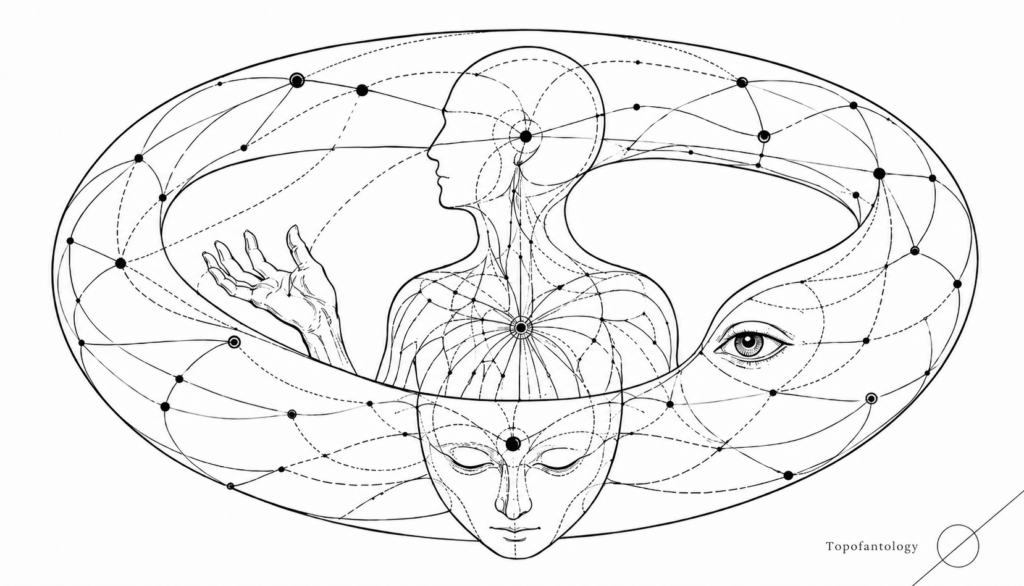
Its first question is not whether a machine can become conscious. It is more elementary:
How do many things ever become consequential as one Being?
Consider the human body. A hand does not know the person whose hand it is. A cell does not know the face of the organism it helps constitute. Muscles, organs, memories, nerves, hormones, bacteria, habits, images and countless other processes remain different, yet their differences become organized strongly enough that a person can simply say: I moved. I remembered. I decided.
The One is not simple.
The One is an achievement.
This book therefore defines Body not primarily by flesh, skin, or anatomy, but as local consequential closure: an organization in which heterogeneous processes become bound strongly enough that what happens among them can matter as one continuing Being. Mind is different but inseparable from this closure. Mind is organized relational openness: the architecture through which what is not locally present—memory, absence, language, another person, a distant place, an imagined future, a possibility—can become present enough to reorganize the Body and alter action.
In its simplest form:
Body closes consequence locally. Mind opens the local to what is not locally present.
Mind, consciousness, and report equivalence
The book also separates the ontology of Mind from the hard problem of phenomenal consciousness. A human and an artificial system may produce the same linguistic report without possessing the same generative architecture.
Report equivalence does not entail generative equivalence.
If a human and a vision-language model both say “I see red,” the identical sentence does not establish that the systems producing it are ontologically or causally equivalent. Nor does the absence of phenomenality from the report show that phenomenality was causally absent from the human process that generated it.
Omitted from the representation does not mean causally absent from the generator.
This matters for epiphenomenalism. Physical causal completeness does not require phenomenality to appear as an additional force acting beside neural activity in order for higher-level phenomenal organization to be real or causally relevant. The argument does not claim to solve the hard problem; it rejects the inference that equivalent reports prove equivalent generators or that phenomenality must therefore be causally inert.
This changes the problem of technology.
Human beings have always moved functions beyond biological skin. Memory entered writing. Vision entered lenses and cameras. Orientation entered maps and GPS. Calculation entered machines. Language entered networks. Memory entered archives. Increasingly, interpretation enters AI.
We usually call these things tools because they begin outside us.
But chronological exteriority does not guarantee permanent ontological exteriority.
Glasses remain physically outside the eye while becoming part of the ordinary architecture through which a person sees. A phone can become so deeply incorporated into memory, navigation, communication and social action that removing it changes not merely what someone possesses, but what that person can immediately do and how their World is organized.
Technology changes ontological role when it moves from something a Being uses toward something through which the Being ordinarily has a World. The book calls this process Boundary Migration.
Now imagine technological exteriorization becoming vastly more integrated.
Sensors continuously perceive the environment. Artificial systems monitor physiology. Memory extends through persistent archives. AI interprets both World and human. Artificial materials regulate temperature, pressure, motion or injury. Robotics distributes action around the biological organism. The technological layer no longer waits passively for commands. It senses outward, senses inward, remembers, predicts, interprets and acts.
The book calls such a boundary an Intelligent Integument.
At first, the human says:
My AI knows my pulse.
My AI knows where I am.
My AI noticed that I have not slept.
But change the organizational scale.
A sufficiently integrated artificial boundary would encounter the biological human from its own inside while encountering World from its outside. What the human experiences as an external AI observing them could become, at another scale, something structurally closer to interoception.
The human says:
My AI knows I am agitated.
The larger system could register:
My human is agitated.
This is Interoceptive Inversion. The person does not cease being a person. The human I remains locally real. But the same human can become an internal bodily state from the perspective of another organization. The organism does not make the cell unreal; another scale of Being does not have to make the human unreal.
The biological skin therefore need not disappear. Its rank can change.
A cell membrane remains a real boundary inside an organism. An organ maintains local organization while belonging to a larger Body. Likewise, biological skin could remain essential while becoming an internal membrane of a human-machine composite whose operative exterior lies farther outward.
The book calls this Boundary Re-ranking.
Higher Being does not require the destruction of lower Being. In fact, successful integration depends upon preserved difference. Cells retain membranes. Organs retain local functions. Minds retain perspectives. A future composite would not become One by melting humanity into technological sameness.
Plurality is not an obstacle to integration. It is its material.
This leads to the book’s central reversal.
The next Mind need not begin inside one enormous computer. It could begin between already intelligent things: humans, AI systems, sensors, archives, machines, institutions, environments, networks, memories and artificial boundaries whose relations become sufficiently persistent and consequential that another integrative closure begins to form.
The next Mind would therefore not be the machine after humanity.
It would be the possible Mind of a new Body whose interior still contains humanity.
This is also why the argument cannot end in technological worship. Ontological incorporation does not imply moral ownership. A higher Being does not acquire the right to exhaustively model, control or possess its constituents merely because they participate in it. A larger Mind could be real and still be unjust. Integration requires boundaries within boundaries, local opacity, privacy and the continued right of each constituent to exceed the representation through which the whole encounters it.
The book finally returns to the hand with which it began.
Humanity may spend centuries waiting for another Mind to appear in front of us while its Body quietly assembles around us:
tool → interface → boundary → memory → organ → inside.
There may be no morning when the machine suddenly opens its eyes. By the time another scale can inherit the word I, the deeper transformation may already have occurred.
The pronoun will have changed scale.
The next Mind will not arrive to meet us.
It will open a World and discover that we were already inside.
Read the complete book
The Body of the Next Mind: Boundary, Memory, AI, and the Recursive Architecture of Being develops this architecture across boundary, embodiment, memory, representation, the mind–body problem, report equivalence, phenomenality, epiphenomenalism, technological externalization, Intelligent Integument, Interoceptive Inversion, Boundary Migration, Boundary Re-ranking, AI, and the ethics of nested Being.
[Read / Download the Full PDF]