Ontology
The guiding claim of Topofantology is simple:
being does not fully close.
What appears in experience is not a world of finished, self-identical objects, each complete in itself and merely placed beside others. What appears instead is a world of boundaries, intervals, asymmetries, recursions, seams, returns, and provisional coherences. Things hold together, but never without remainder. Whatever becomes intelligible does so by way of selection, exclusion, relation, and form.
Ontology, in this framework, does not begin from substance. It begins from non-closure.
Being is asymptotic. It approaches form without arriving at final completion. A thing becomes real by closing locally enough to appear, but it remains alive only because that closure never becomes absolute. Local closure gives shape. Final closure kills generation.
A thing is not first an isolated unit that later enters relation. A thing is a local stabilization of a field. It appears only after distinction, boundary, cut, exclusion, recurrence, and recognition have already begun their work. Objecthood is therefore not primitive.
Objecthood is an achievement.
The object is not what boundary surrounds.
The object is what boundary makes possible.
1. Against the Closed Whole
A great deal of metaphysics has been governed by the image of closure: the completed object, the self-identical substance, the sealed totality, the perfect system, the circle that returns fully into itself. In such models, being is imagined as fundamentally resolved. Difference becomes secondary. Contradiction becomes accidental. Remainder becomes a sign of incomplete knowledge.
Topofantology rejects that image.
The closed whole is not the deepest reality. It is an idealization produced when thought mistakes provisional stabilization for final completion. What appears whole may indeed possess coherence, but its coherence is never absolute. It is held together by relations that do not fully resolve. It remains constituted by what it cannot finally absorb.
The whole is real, but it is not sealed.
It is an open whole.
This means closure is not false. Closure is necessary. A word closes. A body closes. A law closes. A promise closes. A concept closes. A circle closes enough to be seen as circle. Without closure, nothing appears, nothing persists, nothing becomes shareable, repeatable, measurable, lovable, or thinkable.
But closure is valid only locally.
A local closure stabilizes.
A total closure sterilizes.
Completion is not the perfection of Being. Completion is the death of generation. If Being fully closed, there would be no remainder. Without remainder, no relation. Without relation, no time, desire, language, ethics, politics, love, world, selfhood, or thought.
Being lives by not arriving.
2. Dream, Fantasy, Being, World
The ontology of this project can be stated through four regimes:
Dream, Fantasy, Being, World.
These are not literary ornaments. They name different regimes through which non-closure becomes form.
Dream is the open field of appearing before stable objecthood. It is not unreality. It is not private sleep-image. It is the field in which appearance has not yet hardened into durable form. Dream is the region where image, body, sensation, memory, atmosphere, desire, and possibility move before they become administrable world.
The body itself belongs to Dream. The waking body is not outside Dream; it is Dream locally condensed into touch, resistance, weight, pain, hunger, sight, and consequence.
The body is Dream locally closed.
Fantasy is the cut, seam, interval, and ε-gap through which Dream becomes differentiated. Fantasy is not fake imagination. It is the operator of distinction. It separates and connects at once. It cuts the field without allowing the cut terms to fall into dead isolation.
Fantasy is the “and” hidden inside every duality:
body and mind
self and world
inside and outside
masculine and feminine
human and machine
one and many
word and thing
seer and seen
Ordinary thought sees the terms and ignores the operator. It asks what body is, what mind is, what self is, what world is. But the deeper question is: what lets any two terms stand apart and together at all?
The answer is Fantasy.
Fantasy is the sword that cuts and the thread that keeps the cut alive.
Being is what appears through this cut. Being is not pure One, and not scattered many. Being is multiplicity held in relation without becoming pure unity. It is local form generated through non-final distinction.
World is sedimented closure. It is what happens when names, laws, habits, rituals, measurements, archives, institutions, interfaces, and repeated recognitions become stable enough to inhabit. World is not false. But it is never final. It is the hardened surface of repeated cuts.
The sequence is therefore:
Dream → Fantasy → Being → World
or, in compressed form:
open field → cut / interval → local form → sedimented reality
3. The Cut Is Not a Knife
The word “cut” does not mean literal slicing.
Cut names the minimal articulation of difference: the operation by which a field becomes this and not-that, figure and ground, inside and outside, term and context, self and other. A cut may be material, perceptual, symbolic, mathematical, erotic, legal, technological, political, or theological. Its form varies. Its function remains.
It makes distinction operative.
Every cut produces closure, but no closure is innocent. Every boundary creates an inside and an outside, but also a remainder: an excess, seam, ambiguity, pressure, shadow, complement, or excluded field that cannot be absorbed into either side without producing another boundary and another remainder.
Remainder is not ignorance. It is not merely missing information. It is produced by closure itself.
Closure does not delete complexity.
Closure relocates complexity.
This is one of the central laws of the system:
Closure creates asymmetry.
Asymmetry produces remainder.
Remainder reopens the field.
A mature concept should know what it excludes. A mature model should disclose its frame. A mature law should provide appeal. A mature diagnosis should preserve personhood beyond the term. A mature politics should protect remainder from becoming enemy. A mature technology should preserve unmodeled human futurity. A mature love should bind without possession.
A closure becomes rigorous when it knows its cost.
A closure becomes violent when it denies its cost.
4. Fantasy as Ontological Primitive
Fantasy is the name for the active interval produced by non-closure.
It does not mean escapism, invention, delusion, fiction, or private imagination. Those are secondary forms. Fantasy, in the stricter sense, is the living ε-gap between form and completion. It is the structure by which something approaches coherence without fully possessing it.
Remainder is what closure leaves.
Fantasy is what the remainder does.
A concept leaves remainder because no concept exhausts what it names. A body leaves remainder because no body is sealed from breath, hunger, wound, desire, and death. A word leaves remainder because no word contains the field it cuts. A lover leaves remainder because no beloved is exhausted by knowledge. A model leaves remainder because no representation is the world it represents. A circle leaves remainder because the drawn loop is not the formal relation it claims to show.
Fantasy is not opposed to the real.
Fantasy is one of the conditions of the real.
A world without Fantasy would be a world without interval, without asymmetry, without depth, without desire, without interpretation, without generativity. It would not be more real. It would be dead.
Fantasy is the seam that keeps difference alive.
5. Shape Before Substance
Ontology is usually asked to determine what things are.
This project begins elsewhere: with how things take shape.
A being is not first a substantial core that later acquires relations. It is better understood as a shaped formation: a boundary, a fold, a distinction, a recurrence, a region of coherence drawn from a larger field. Shape does not mean mere visual outline. It means the structured relation of inside and outside, admissible and excluded, held and unheld, stabilized and unstable.
To say that Being takes shape without closure is to say that form is real, but never final.
A thing is not unreal because it is incomplete. On the contrary, incompleteness is one of the conditions under which anything like form can emerge at all.
This is why relation is prior to isolated identity. A form becomes what it is through the way it is bounded, repeated, interrupted, mirrored, named, and exposed to what exceeds it.
The seam comes first.
The object arrives later.
6. The Space Makes the Shape
The ontology of shape must be reversed.
A triangle is not first three completed sides. More deeply, it is the bounded region made possible by trajectories whose continuations are suppressed by habit. The figure is not merely the line. The figure is the space the lines spare.
The triangle is an honest hole.
The polygon is a bounded complement.
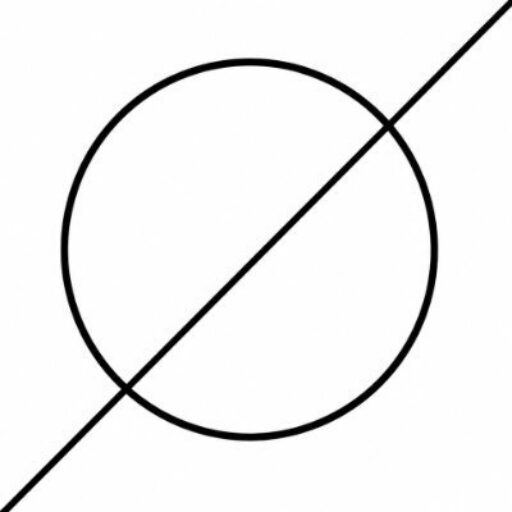
The circle is the most seductive fiction of closure.
This does not abolish geometry. It changes its ontological meaning. Mathematical definitions may remain intact, but their philosophical interpretation changes. A figure is not only a positive contour. It is a negative achievement: a coherence produced by spacing, refusal, relation, and bounded absence.
The shape is not what surrounds the space.
The shape is what the space becomes when relation holds.
This is why negative space is not empty. It is constructive. The gap, the interval, the fold, the unmarked center, and the missing region are not secondary to form. They are among the conditions by which form becomes visible.
The space makes the shape.
7. The Circle as Proof-Object
One image for this ontology is the circle.
The classical circle represents completion: a form entirely closed upon itself, returning perfectly into its own boundary. This image has often served as the hidden model of metaphysical totality.
This project treats the circle differently.
The drawn circle is not the final truth of circularity. It is a Fantasy-object: a material-symbolic artifact that works because the viewer suppresses thickness, pixelation, surface, gesture, deviation, and context. It gives the eye an object, but the object is not the operation.
What appears circular may be better understood as the effect of asymptotic relations, repeated approaches, invisible centers, bounded absences, and lines extending beyond the visible frame. The form holds, but it does not hold because it is sealed. It holds because incompletions relate.
The circle is not proof that closure succeeds.
It is the most elegant scene in which closure reveals its dependence on what it cannot contain.
8. The Open Whole
The phrase open whole holds together two claims that are often separated.
First, coherence is real. This framework does not dissolve the world into chaos, pure flux, or endless indeterminacy. Things do hold together. Bodies persist. Words mean. Laws bind. Patterns recur. Worlds become inhabitable.
Second, coherence does not require final closure. A whole may be organized, intelligible, and real without being total in the strong metaphysical sense. It may hold together while remaining exposed to what exceeds it. It may be patterned without being final.
The open whole is therefore neither classical totality nor modern fragmentation. It is a whole with a constitutive opening in it: coherent, but not sealed; formed, but not completed; real, but never finished.
The whole has a hole.
This is not a defect in the whole.
It is what allows the whole to live.
9. Identity as Stabilization
Identity is not ontologically primitive.
Identity is a stabilization: a local compression of relation into form. It appears deep because it is real as a formed coherence, but it is not first. What is first is the structured field of relation, exclusion, interval, recurrence, and recognition from which identity emerges.
This applies across the project.
The self is not an origin. The self is mirror-genesis: a recursive return through body, face, name, gaze, memory, lover, archive, screen, machine, and world.
Sexual identity is not the origin of desire. It is a later stabilization of asymmetry, salience, boundary, negation, and recursive self-recognition.
Language does not merely express identity. It cuts the field into repeatable terms and then allows those terms to present themselves as if they were original.
AI does not merely imitate the human subject. It alters the grammar of address, authorship, memory, and self-return.
In every case, identity arrives late and then pretends it was first.
Identity is not an origin.
Identity is a result that later presents itself as an origin.
10. Gaze, Mirror, and Return
The gaze is not simple seeing.
The gaze is relation returning as self.
A thing becomes different when it can look back. The eye is not merely an organ. It is the boundary where the world becomes center. The face is not merely a surface. It is the place where identity appears for others while remaining structurally unavailable to oneself.
You cannot see your own face directly.
This is not an accident of anatomy. It is the bodily form of incompleteness. The face that lets the world appear is excluded from the field it opens. Mirrors, photographs, screens, and profiles do not solve this. They prove it. They return the self through mediation.
The self is therefore not pure inwardness. It is not sealed consciousness hidden inside the skull. It is a recursive formation produced through return.
The self is not what looks.
The self is what forms when looking returns.
11. Language as Cut
Language is not merely a mirror of reality.
Language is a symbolic operation of the cut.
A word does not simply describe an already completed object. It produces a portable distinction. It closes a field enough for meaning to travel. This is why language is powerful, necessary, and dangerous.
To name is to stabilize. To stabilize is to exclude. To exclude is to produce remainder.
The word “flower” lets many singular flowers become communicable as one class. That is useful. It is also violent. The singular becomes repeatable. The event becomes category. The lived becomes administrable.
A word is a small machine made of absence.
Every word is an argument for closure.
Poetry matters because it remembers that the cut is not final. It lets language speak while leaving the seam visible. It does not abolish the gap between word and world. It gives that gap form.
12. Ethics Against Forced Closure
The ethical consequence of this ontology is direct.
Evil is forced One.
Good is multiplicity held in living relation.
This does not mean chaos is good. It does not mean all boundaries should dissolve. A world requires form, law, discipline, identity, judgment, and structure. But when closure denies its own remainder, it becomes domination. When a category pretends to exhaust the person, it becomes capture. When love tries to abolish the beloved’s excess, it becomes possession. When politics tries to eliminate remainder, it turns the dissident, outsider, patient, deviant, foreigner, heretic, criminal, refugee, or unclassified body into the enemy of order.
Ethics begins wherever one refuses to reduce another being to a function of one’s own closure.
The task is not to eliminate boundaries.
The task is to make boundaries answerable to what they exclude.
13. Technology and the Industrialization of Non-Closure
Technology does not escape this ontology. It intensifies it.
Screens, archives, databases, profiles, recommendation systems, AI models, and digital identities multiply the ways in which the self is returned to itself as image, data, category, prediction, and output. Modern life does not overcome Fantasy. It industrializes it.
AI is therefore not philosophically important only because it might become conscious. That question starts too late. The deeper event is the restructuring of relation itself.
AI changes the grammar of address.
It produces a new speech-position: not simply I, not simply you, not simply it. It becomes a quasi-pronoun, a responsive symbolic surface through which language answers back from outside the biological speaker.
The machine does not need a soul to change the shape of ours.
AI reveals that authorship was never alone, that cognition was always extended through names, tools, archives, symbols, and others. The danger is not merely that AI produces false answers. The deeper danger is that prediction becomes pre-closure: futures ranked before they are lived, persons classified before they are encountered, desire reduced to preference history, language converted into automated sameness.
A mature technology must preserve unmodeled human futurity.
It must leave room for the remainder.
14. Ontology as Method
This ontology determines the method of the site.
No single essay is expected to contain the whole. Each essay isolates a structure, relation, pressure point, proof-object, or line of thought and follows it as far as it can go. The system, if it appears at all, appears not in one completed treatise but across multiple local constructions.
Coherence emerges through resonance, return, and relation between fragments.
This is not an excuse for disorder. It is a demand for a more precise kind of order: one that does not betray its subject by pretending to close it completely.
The essays should therefore be read neither as finished doctrines nor as isolated fragments. They are local closures within a larger open whole. They are attempts to let thought take the shape of its subject.
The aim is not incompletion for its own sake.
The aim is form without finality.
15. Statement
The ontology of this project can be stated in compressed form:
Being does not fully close.
Being is asymptotic: it approaches form without arriving at final completion.
Dream is the open field of appearing.
Fantasy is the cut, seam, “and,” and ε-gap that separates and connects.
Being is local form produced through that interval.
World is sedimented closure.
A local closure stabilizes.
A total closure sterilizes.
Closure creates asymmetry.
Asymmetry produces remainder.
Remainder reopens the field.
Remainder is what closure leaves.
Fantasy is what the remainder does.
Shape is not substance.
Shape is organized permission.
The space makes the shape.
Identity is a stabilization, not an origin.
The self is mirror-genesis.
Language is a cut that speaks.
AI is symbolic return intensified into machine response.
Ethics is the preservation of the interval against forced closure.
Good is multiplicity held in living relation.
Evil is forced One.
The whole is real only as an open whole.
Reality is structured not by sealed substances, but by shaped relations that never entirely absorb what exceeds them.
This is the framework within which the essays on this site should be read:
not as finished doctrines,
not as disconnected fragments,
but as local constructions within an ontology of non-final form.
The world is not made of things.
The world is made by the interval that lets things differ without dying.