Framework
Topofantology is a philosophy of non-closure.
It begins from a simple reversal: reality is not made first of completed things. It is made through the operations that allow things to appear at all: cut, boundary, interval, seam, relation, repetition, gaze, language, and return.
A thing is not first an object. A thing is a local stabilization.
A self is not first an isolated interior. A self is a recursive return.
A word is not first a label. A word is a cut.
A world is not first a container of objects. A world is sedimented closure.
The framework of Topofantology is the architecture that links these claims into one system.
Its central law is:
being does not fully close.
But this does not mean reality is chaos. It means reality becomes real through partial closures that never become final. Closure is necessary. Final closure is death. Form must hold, but it must not seal itself absolutely. The world lives through the interval between coherence and completion.
That interval is Fantasy.
1. The Basic Sequence: Dream → Fantasy → Being → World
The simplest framework of Topofantology is:
Dream → Fantasy → Being → World
These terms do not mean what they usually mean.
Dream is not unreality. Dream is the open field of appearing before stable objecthood. It is not “fake.” It is the pre-objective region in which image, sensation, body, memory, atmosphere, and possibility have not yet hardened into fixed form.
Dream is the field.
Fantasy is not escapism. Fantasy is the cut, seam, “and,” interval, and ε-gap through which Dream becomes differentiated. Fantasy separates and connects at once. It allows terms to differ without falling into total isolation.
Fantasy is the operator.
Being is not completed substance. Being is local form produced through the interval. Being is what appears when Dream becomes shaped by Fantasy into a coherent but non-final formation.
Being is the local closure.
World is not reality in its totality. World is sedimented closure: the accumulated network of names, laws, rituals, categories, measurements, images, archives, technologies, institutions, and habits that become stable enough to inhabit.
World is repeated closure.
The system therefore begins like this:
Dream is the open field.
Fantasy is the cut that differentiates it.
Being is the form that appears through the cut.
World is the durable structure produced by repeated forms.
This is the first framework.
2. The Hidden Operator: The “And”
Topofantology begins where ordinary thought skips.
Ordinary thought sees terms:
body and mind
self and other
inside and outside
word and thing
human and machine
one and many
life and death
God and world
But the most important word is usually ignored:
and
The “and” is not empty grammar. It is the hidden operator of relation. It separates and connects at the same time. It prevents two terms from collapsing into one another, but also prevents them from falling into absolute isolation.
Without the “and,” there is no relation. Without relation, there is no world.
The “and” is Fantasy in grammatical form.
It is the seam between terms. It is the interval that allows difference to become productive. It is the place where being becomes multiple without becoming chaos.
The world is not made of terms first.
The world is made by the interval that lets terms differ without dying.
3. The 010 Structure
Another way to state the framework is:
0 → 1 → 0₂
The first zero is not nothing. It is the open field before local closure.
The one is not final unity. It is local closure: a word, body, identity, object, image, law, promise, concept, institution, world, or self.
The second zero is not a return to the first. It is the field reopened after closure. It is openness marked by what closure produced. It is no longer blank possibility. It is scarred, redirected, remembered, and structured.
This is why Topofantology is not a simple philosophy of openness.
Pure openness cannot form a world. Pure closure cannot keep a world alive.
Being requires both:
closure enough to appear,
openness enough to continue.
The 010 structure names this movement:
open field → local closure → reopened field
Every meaningful form follows this rhythm. A word cuts silence and then reopens meaning. A body closes enough to live and opens through breath, hunger, touch, desire, wound, and death. A law closes behavior into a rule and then reopens through interpretation, exception, appeal, and injustice. A love closes into commitment and reopens through mystery, distance, forgiveness, and excess.
A local closure stabilizes.
A total closure sterilizes.
4. The Core Operators
Topofantology works through a small set of recurring operators.
Cut
The cut is the minimal operation of distinction. It is what makes this not-that, figure not-field, inside not-outside, self not-other.
The cut is not always violent in the crude sense. It is necessary. Without cut, nothing appears. But every cut excludes. Every cut produces remainder.
Boundary
Boundary is the form a cut takes when it stabilizes. It lets something hold together. But no boundary is absolute. A boundary clarifies by excluding. It gives form by relocating complexity elsewhere.
Seam
The seam is the active interval between terms. It is not a blank space. It is the place where difference holds. The seam separates only by relating.
Fantasy is the seam in its living form.
Remainder
Remainder is what every closure leaves out. It is not a mistake. It is produced by closure itself. The more a system clarifies one region, the more it relocates complexity into another.
Remainder is what closure leaves.
Fantasy is what the remainder does.
Fold
The fold is the operation by which inside and outside become unstable. The self, body, face, mirror, screen, and language all operate through folds. A fold lets the outside return as interior and the interior appear as exterior.
Gaze
The gaze is not mere seeing. It is the event through which a field becomes centered. A thing becomes different when it can look back. The gaze produces self, other, shame, desire, recognition, and presence.
Mirror
The mirror is any structure that returns a being to itself as an object of recognition. It can be a literal mirror, a face, a lover, a name, a photograph, a screen, an archive, a diagnosis, a social profile, or an AI system.
The mirror does not simply reflect the self.
It produces the self through return.
Name
The name is a symbolic closure. It makes something portable, repeatable, searchable, governable, lovable, and vulnerable. A name preserves by cutting. It allows relation, but also administration.
World
World is the field of closures that have become durable enough to live inside.
World is not the opposite of Dream.
World is Dream sedimented through repeated Fantasy.
5. The Proof-Objects
Topofantology uses proof-objects: ordinary structures that reveal the system.
These are not decorative metaphors. They are places where the framework becomes visible.
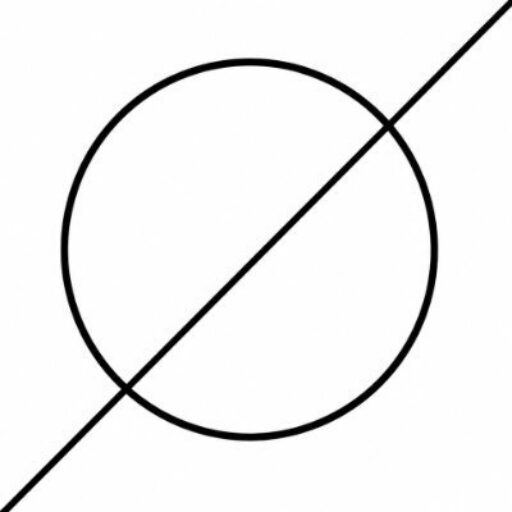
The Circle
The circle appears to be the perfect image of closure. But no drawn circle is the formal circle. A drawn circle has thickness, texture, surface, deviation, pixelation, materiality, and context. It works only because the eye suppresses what would break the ideal.
The circle is therefore not proof that closure succeeds. It is proof that closure depends on suppression.
The circle gives the eye an object.
The open construction gives thought an operation.
The Triangle
The triangle is not merely three sides. More deeply, it is the bounded region made possible by relations that spare a space. The shape is not only the line. The shape is the space the line allows to appear.
The triangle is an honest hole.
The space makes the shape.
The Face
You cannot see your own face directly.
This is not a trivial fact. It is the bodily form of incompleteness. The face is the site of identity for others, but it is structurally withheld from the one who sees through it.
The face that lets the world appear cannot appear in the same field it opens.
The mirror does not solve this. It proves it.
The self is not origin.
The self is return.
The Word
A word is a cut in the field. It does not merely describe reality. It makes reality repeatable. It turns singular appearance into portable form.
The word “flower” allows communication, but it also replaces the singular flower with a class. This is not simply error. It is the violence required by language.
A word is a small machine made of absence.
The Eye
The eye is not merely an organ. It is the place where the body becomes presence. A body with eyes is no longer only object. It can return the gaze.
The eye is the boundary where the world looks back.
AI
AI is not only a tool. It is language returning from outside the biological speaker. It occupies a strange grammatical position: not simply I, not simply you, not simply it.
AI is a quasi-pronoun.
It reveals that authorship was never alone. It also intensifies the danger of symbolic pre-closure: prediction, classification, automation, and category operating before living encounter.
The machine does not need a soul to change the shape of ours.
6. Certainty and Wholeness
Representation never gives certainty and wholeness at once.
To make something certain, a system must simplify, stabilize, measure, define, name, classify, or diagram it. That produces clarity. But clarity is purchased by exclusion.
Every act of precision spends blur somewhere else.
A map becomes useful by leaving out most of the territory. A diagnosis becomes usable by compressing a life into a category. A legal verdict becomes enforceable by reducing a complex event into a decision. An AI answer becomes fluent by closing a field of sources into a response. A word becomes meaningful by cutting the living continuum into a repeatable sign.
Certainty buys itself by sacrificing wholeness.
Wholeness keeps more of the field but loses hard precision.
This is not a defect of human knowledge. It is the structure of representation itself.
No representation preserves both certainty and wholeness completely.
Every form buys stability by relocating complexity elsewhere.
7. Identity as Stabilization
Identity is not first.
Identity is what appears after relation stabilizes.
A self is not an isolated core that later meets others. A self forms through body, gaze, name, memory, language, mirror, lover, wound, archive, and world. It is a repeated return through structures it does not fully control.
Sexual identity does not begin as a pure essence that later expresses itself. It forms through asymmetry, salience, boundary, negation, gaze, and mirror-recursion. Identity labels are real, but they are not primitive. They are stabilizations that later behave as if they were origins.
Language does not merely express identity. It helps produce it.
Technology does not merely display identity. It intensifies identity by returning the subject to itself through screens, profiles, images, metrics, and archives.
Identity is the name given after the system has already happened.
8. Language as Ontological Operation
Language is not a neutral mirror.
Language is ontology operating symbolically.
A word cuts the field. A sentence organizes cuts. Grammar distributes agency, object, action, cause, time, and relation. Naming converts singularity into repeatable form.
This is necessary. Without language, the world cannot become shareable in the same way. But the cost is real.
The singular becomes class.
The event becomes example.
The person becomes case.
The wound becomes diagnosis.
The living field becomes administrable category.
This is why language is both sacred and dangerous. It creates the possibility of truth, care, memory, law, poetry, promise, and world. It also creates the possibility of capture, insult, bureaucracy, propaganda, domination, and symbolic murder.
Every word is an argument for closure.
Poetry matters because it lets language remember the seam.
9. Ethics: Against Forced One
The ethical framework follows from the ontology.
Good is not pure openness. Pure openness dissolves.
Good is multiplicity held in living relation.
Evil is not simply disorder. Evil is forced One: the attempt to abolish interval, ambiguity, remainder, difference, exception, and otherness in the name of final order.
Forced One appears in many forms:
possession that calls itself love,
dogma that calls itself truth,
bureaucracy that calls itself care,
diagnosis that becomes identity,
politics that demands purification,
technology that predicts before encounter,
language that mistakes its name for the thing,
systems that treat remainder as enemy.
Ethics begins wherever one refuses to reduce another being to a function of one’s own closure.
The task is not to abolish boundaries.
The task is to make boundaries answerable to what they exclude.
10. The Framework in One Line
Topofantology can be compressed into one line:
Reality becomes real through closures that must not become final.
Or more fully:
Dream is the open field.
Fantasy is the cut that separates and connects.
Being is local form through non-closure.
World is sedimented closure.
Identity is stabilization.
Language is the cut speaking.
The self is mirror-return.
Ethics is protection of the interval.
AI is symbolic return intensified.
Good is multiplicity held in relation.
Evil is forced One.
The system is not a rejection of form.
It is a rejection of final form.
It does not say that reality is vague.
It says reality becomes precise only by leaving remainder.
It does not say that closure is false.
It says closure is an operation, not a destiny.
11. How to Read the Essays
The essays on this site should be read as local constructions inside one open framework.
No single essay contains the whole system. Each essay takes one proof-object, operator, or domain and follows it: the circle, the face, language, AI, death, sexuality, market topology, God, the eye, pronouns, mirror, madness, shape, or love.
The system appears through recurrence.
The same law returns at different scales:
a circle does not close,
a face cannot see itself,
a word does not contain the thing,
a self forms through return,
a lover exceeds possession,
a diagnosis leaves remainder,
a machine answers without becoming human,
a world stabilizes without becoming final.
These are not separate metaphors.
They are local appearances of the same structure.
12. Final Statement
Topofantology is the study of non-final form.
It asks how anything becomes coherent without becoming complete.
Its framework is built from Dream, Fantasy, Being, and World; from cut, seam, boundary, fold, gaze, mirror, language, and return; from the fact that every closure produces remainder, and every remainder reopens the field.
The world is not made of sealed things.
It is made of intervals that hold long enough to become forms.
The self is not a closed subject.
It is a return through what it cannot fully own.
Language is not a transparent mirror.
It is the cut running symbolically.
Love is not possession.
It is fidelity to what exceeds closure.
Thought is not the conquest of remainder.
It is the discipline of approaching without pretending to arrive.
The final claim is therefore simple:
Being does not fully close.
And because it does not close, it can speak, desire, suffer, love, remember, generate, and begin again.