Abstract
Word Count: ~520
This paper argues that ordinary discourse about death contains a neglected asymmetry between Being as lived from the first person and death as inferred from the disappearance of others. The asymmetry is not evidence for personal immortality, nor does it deny biological death. Rather, it concerns the logical structure by which death becomes thinkable at all. The proposition I am here is peculiar because its utterance participates in its own verification: wherever the “I” is genuinely spoken, some locus of Being is already present. By contrast, I will no longer be describes a condition the speaker can never occupy as its own confirming witness. The “I” predicts a future in which the very standpoint capable of validating the prediction has been removed. Death is therefore never encountered by the subject in the same mode in which presence is encountered.
One encounters one’s Being; one encounters another’s death.
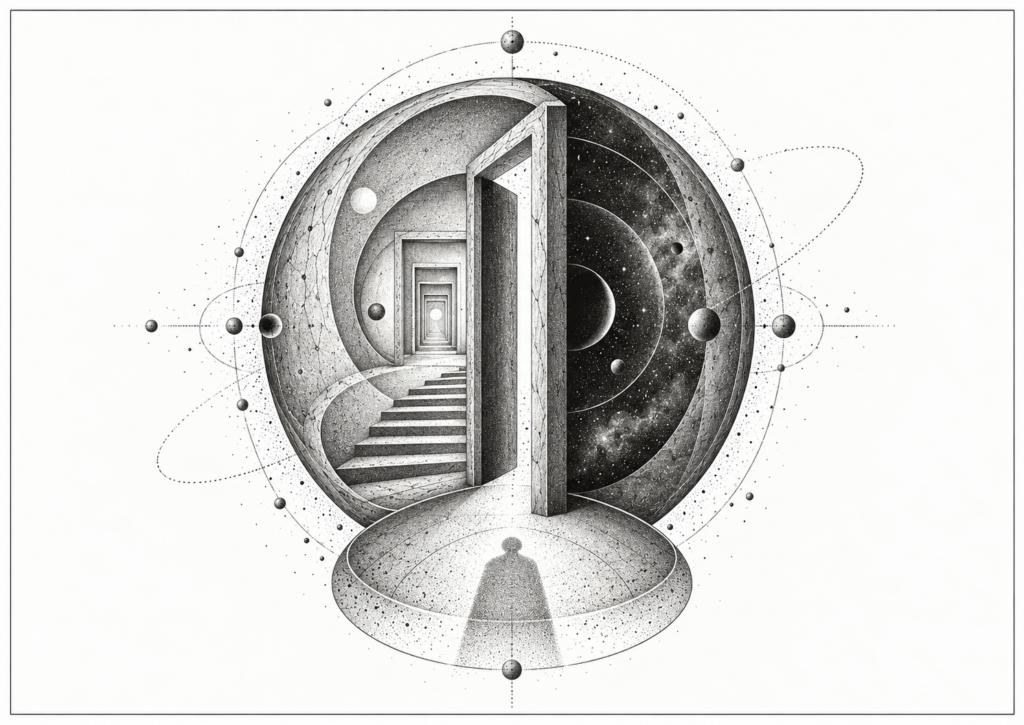
This produces what may be called the asymmetry of exit. Bodies can cease moving, speaking, responding, and maintaining the organization by which others recognize them. Yet the dead Body does not pronounce itself absent. Death is attributed to it from another position. The Body cannot say I have died; the “I” that says I will die cannot remain present to certify its own disappearance. Mortality may therefore be biologically overwhelming while remaining phenomenologically and logically non-reciprocal. We can witness the subtraction of another from our World, but we cannot straightforwardly convert that subtraction into the first-person experience of our own non-Being.
Modern longevity projects inherit this asymmetry while pretending to have escaped metaphysics. Their founding question—How can death be defeated?—already assumes that disappearance is the danger and persistence the victory. Religious immortality and technological longevity consequently appear less as opposites than as mirror strategies organized by the same prior fantasy: the I must continue. One relocates persistence beyond the Body; the other attempts to indefinitely preserve the Body through which persistence is presently indexed. Both privilege continuation before asking whether continuation itself could become captivity.
The neglected counter-question is therefore more radical:
What if I cannot leave?
This question begins not from observed death but from the only first-person condition ever positively given: repeated presence. It does not establish immortality. It exposes the logical privilege silently granted to mortality by a subject incapable of occupying its own absence. Once this reversal is admitted, death changes conceptual sign. It can appear not only as annihilation but as limit, release, differentiation, or the possibility of exit.
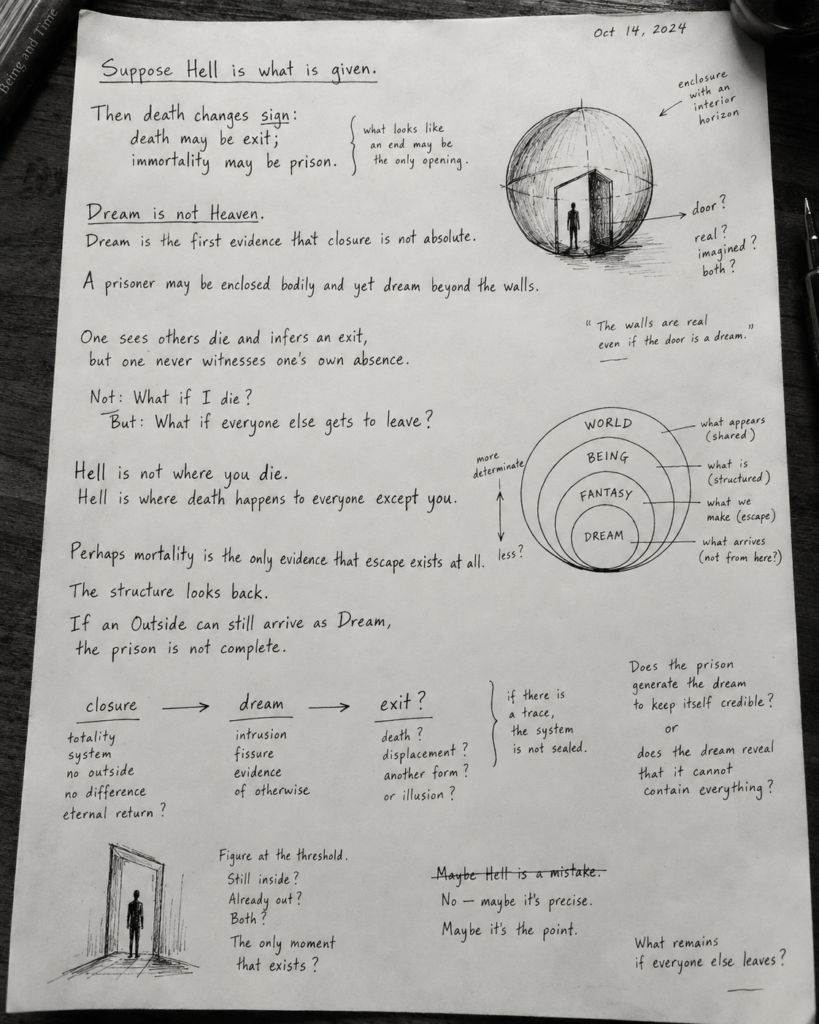
The political consequence is equally strange. If death were ever technologically “cured,” death might cease to be fate and become a governed capacity. Power would no longer concern merely who is permitted to live, but who is permitted to finish. The conquest of death could therefore produce the first historical situation in which death itself becomes scarce, chosen, administered, or withheld. The deepest problem of immortality may not be whether Being can continue forever, but whether a Being that has learned how to continue will still possess the power to leave.