What if the question “What is the female gaze?” begins from the wrong assumption?
The conventional answer treats sexual difference symmetrically. Men look at women; therefore women must possess an equivalent gaze directed back toward men. Masculine desire becomes one arrow, feminine desire another arrow pointing in the opposite direction.
Guys Gaze. Woman Want. begins somewhere else.
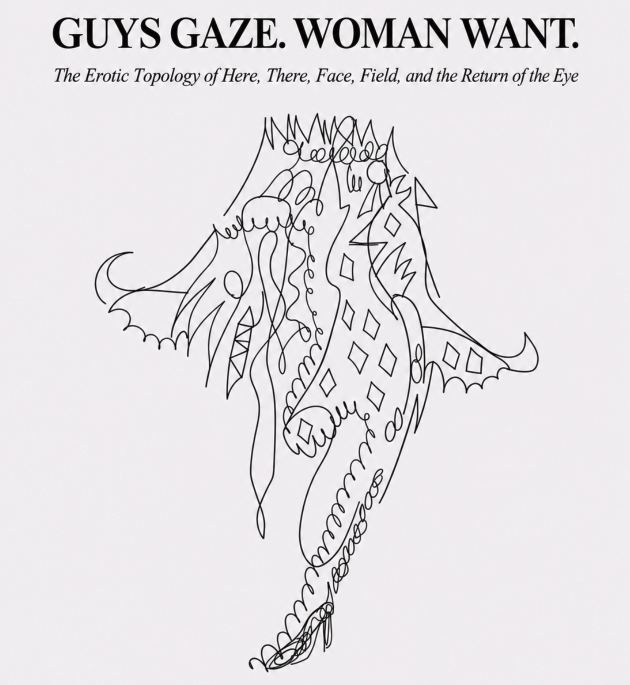
The essay proposes that Gaze and Want are not simply two versions of the same operation. They are two different geometries of desire. Gaze is vectorial. It begins from Here, isolates something There, gives it extraordinary salience, and moves toward it. Want is apertural. It asks what may enter Here, under what conditions, with what consequences, and what kind of World will exist after arrival.
The simplest formulation is:
Gaze selects a Face. Want selects a World.
A man sees a woman across a room. The room may contain fifty people, hundreds of objects, conversations, lights, sounds, and possible directions of attention. Then suddenly there is her. The field has acquired a center. The Eye has received multiplicity, but the Gaze has performed a cut: that one.
The desired woman exists initially as a Face—not because she is reducible to appearance, but because appearance is the local opening through which an unknown Being becomes imaginable. Distance creates space for Fantasy. A partial appearance begins suggesting an entire possible World.
This is why Gaze produces There:
Here becomes directed toward There.
The gazer imagines himself as the active term because he possesses a direction. He looks, selects, approaches, moves. Yet the apparent object has already begun reorganizing him. His attention bends toward her. His route changes. His posture changes. A Body standing somewhere else has altered the field in which his own Body moves.
Want approaches the problem differently.
Warmth, food, comfort, safety, touch, beauty, intimacy, solitude, companionship, excitement, home, sex, and love seem like unrelated desires only if desire is assumed to require a single external target. In fact, these are all ways a Body inhabits a World. Want therefore asks less simply, Which object do I desire? and more fundamentally, What happens to Here if this enters?
The distinction becomes temporal as well as spatial:
Gaze spatializes Desire. Want temporalizes Desire.
Gaze says: There she is.
Want asks: And then what?
The Face may be beautiful, but what happens after the Face arrives? What happens to the room, the body, the future, the rhythm of ordinary life? Does another person’s presence enlarge the World or constrict it? Attraction becomes something more than visual selection because the desired person cannot remain an image once admitted. The Face becomes presence; presence becomes consequence; consequence becomes history.
This is also why receptivity should not be confused with passivity. A membrane does not chase what passes through it. An aperture does not pursue light. A threshold does not run toward the traveler. Yet each determines the conditions of passage.
The feminine orientation developed here is therefore not a weaker version of masculine activity. It is another form of agency: architectural agency rather than merely trajectorial agency. One moves through a field; the other determines what movement becomes when it arrives.
Erotic relation then turns the entire structure over.
He begins as Eye and she as Body. Then she looks back.
Suddenly the Eye discovers that it has a Body too.
“I want her” becomes something far stranger:
I want her to want me.
The vector has reached the aperture and become dependent upon return. Here becomes There; the observer becomes observed; the Face becomes another Eye. The relation now behaves less like two opposing lines and more like a recursive fold:
Here becomes There, and the returned Here is no longer the same Here.
Encounter changes the coordinates.
This is the larger ontological argument of the essay. Sexual difference is not merely a question about male and female psychology. It becomes a way of examining how Being differentiates, opens, receives, returns, remembers, and becomes otherwise through relation.
The argument eventually expands beyond sex entirely. Sustained relations develop memory, private language, expectation, history, and structure. The Between is no longer empty. It begins behaving like another Body.
Multiplicity becomes relation. Relation becomes Body. Body becomes Mind.
The erotic relation therefore becomes a small-scale model of a much larger problem: how multiple beings can produce structures that no single member contains alone.
And this is why asking for a simple “female gaze” may miss what is most distinctive about femininity in the first place. The question assumes that female agency must be demonstrated by reproducing the masculine operation in reverse.
The paper ends by refusing that symmetry:
The Gaze turns a World into a Face. Want turns a Face back into a World.
To ask for the “female gaze” is already to ask the masculine question. Woman is not simply man with altered optics. The feminine does not need to become another projectile in order to possess agency. It can receive the vector, bend the field, determine admission, return the visible, transform what arrives, and make desire answer.
Abstract:
Guys Gaze. Woman Want. develops an erotic ontology of sexual difference through the concepts of Gaze, Want, Face, Field, Body, Mind, Fantasy, and relation. Rather than treating masculine and feminine desire as symmetrical forms of looking, the essay proposes two distinct relational orientations: Gaze as vectorial selection, directed from Here toward a figure There, and Want as apertural or field-like organization, concerned with what may enter, remain, transform, and become consequential within a lived World. The argument follows the movement from field to Face, from Face to possible World, and from unilateral looking to recursive encounter, where the gazer becomes visible in return and the Eye discovers its own Body. Receptivity is therefore developed not as passivity but as architectural agency: the power to structure admission, timing, consequence, and continuation. The essay extends this topology through embodiment, clothing, seduction, erotic power, temporality, and relational memory, ultimately proposing that sustained relation can itself acquire structure and become a higher-order Body. Its central formulation is simple: the Gaze turns a World into a Face; Want turns a Face back into a World.
Read More
Guys Gaze. Woman Want.: The Erotic Topology of Here, There, Face, Field, and the Return of the Eye
Jay Patrick Berube, 2026
https://zenodo.org/records/23008485