Word count: 3,412
The Seam, the Open Figure, and the Ontology of Bounded Absence
Abstract
This essay advances a topological ontology in which shape is not grounded in closed boundary but in structured absence.
Against the inherited metaphysical assumption that form is secured by enclosure, it argues that the most basic reality of shape lies not in the line but in the bounded region that appears through the relation of lines that do not terminate.
A triangle is therefore not, in the deepest sense, three closed segments; it is the open region made possible by three trajectories whose continuations are suppressed by habit. The circle, likewise, is not treated here as the privileged figure of perfected closure, but as a compromised symbol: a visible souvenir of an impossible arrest of motion. What appears closed is, ontologically, derivative. The open is primary.
The key concept of the essay is the seam. The seam is not mere absence, not a blank between completed terms, but the generative interval that makes distinction possible and allows form to stabilize without becoming self-grounding. Fantasy names this seam in its active mode: not illusion, but the labor by which difference adheres, repetition acquires contour, and boundedness emerges as a lived event. Shape is thus recast as negative achievement. The triangle is a hole. The polygon is a bounded complement. The circle is the most persuasive fiction through which closure disguises its dependence on an opening. The argument culminates in a general thesis: the space makes the shape. Being does not first produce finished objects and only later permit relation; rather, relation, interval, refusal, and bounded absence are the conditions under which anything like objecthood appears at all.
I. Introduction: Against False Closure
A great deal of thought begins from the wrong confidence. It begins by assuming that shapes are what their boundaries say they are. A triangle is taken to be three sides joined end to end. A circle is taken to be a line returning perfectly into itself. A polygon is taken to be the sum of its edges. In each case, closure appears innocent. The boundary seems to explain the form.
This essay begins from the opposite suspicion: closure is not the ground of form, but one of form’s most successful illusions. What appears finished does not therefore explain itself. What appears enclosed may depend more deeply on what remains open than on what visibly returns to itself. The line is not the truth of the shape. The line is one of the conditions under which the shape can appear. The shape itself belongs more intimately to the region held open by lines than to the lines considered as self-sufficient objects.
The philosophical consequence is substantial. If shape is not grounded in closure, then ontology must shift away from completed objects and toward bounded absence, interval, and structured incompletion. The real triangle is not the closed contour. It is the open boundedness produced when three trajectories intersect once and refuse to meet again.
The real circle is not the sealed loop. It is the horizon of attempted closure whose apparent perfection depends on a suppressed opening. The real object is therefore not the line as line, but the region made possible by relation, spacing, and refusal.
This is the point at which the argument joins the broader architecture of the site. Being takes shape without closure. The whole is real, but not sealed. Fantasy is not secondary imagination but the seam that permits difference to adhere. The present essay radicalizes that framework by relocating the ontological dignity of form from the boundary itself to the bounded complement that the boundary only imperfectly presents. In compressed form: the object is the hole.
II. The Primacy of the Seam
The seam is the first term.
Whenever two things are treated as distinct, a third is already presupposed: the interval that makes their distinction possible. This interval is not a neutral emptiness, nor a merely negative lack. It is operative. Without it, distinction collapses into confusion or indifference. The seam is therefore not what remains after terms are separated. It is what allows them to become separable in the first place.
This is why the seam cannot be understood as simple relation. Ordinary relation presupposes relata already constituted. The seam names something deeper: the enabling indeterminacy without which the terms could not emerge as distinct enough to enter relation at all. It belongs neither wholly to one side nor the other. It is not contained by either term. Yet it is what allows each term to count as itself. In this sense, the seam is an ontological operator. It is difference before fixed identity, interval before enclosed object, structure before substance.
This has immediate implications for form. If distinction requires a seam, then shape cannot be reduced to positive outline. Every shape depends on an interval that the shape itself does not contain. Every form is organized by what does not belong to it straightforwardly as one more element of itself. The seam is therefore not external to geometry. It is geometry’s ontological underside.
Fantasy is the name given here to the seam in its active condition. Fantasy is not illusion, dream, or decorative surplus. It is the force by which the seam holds, the labor by which difference becomes sticky enough to stabilize into visible form. Fantasy is what allows the between to act. It is the seam doing work.
III. The Open Circle
The circle has long functioned as philosophy’s favored witness for closure. It returns to itself without visible fracture. It encloses a region without obvious violence. It presents itself as the serene success of form. For this very reason, it must be distrusted.
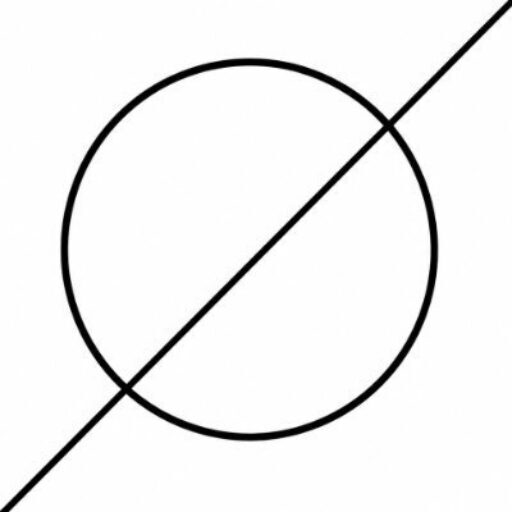
The claim here is not that the mathematical circle is invalid. Formal geometry may keep its definitions intact. The claim is ontological: the drawn circle, the seen circle, the circle as lived figure, is not a proof of closure but a sign of closure’s theatrical success. The visible circle persuades the eye that return has become ground. Yet what it truly offers is only the image of arrested motion, a glyph produced by habit from a horizon that refuses final enclosure. The closed circle is therefore not the deepest reality of the circle. It is the souvenir of a failed attempt to stop the open.
This is why the circle belongs to the metaphysics of false security. It promises a world that comes back to itself perfectly. It flatters the desire for finishedness: a ring, a frame, an ending, a completed chapter. But closure, in this sense, is not truth. It is an aesthetic. It is how safety wishes to be seen. The real circle, by contrast, breathes. It opens. It behaves less like a sealed contour than like weather organized around recurrence. The line appears to return, but only because attention stops following where continuation exceeds the frame.
The philosophical importance of the circle therefore lies in reversal. The circle is not the proof that closure succeeds. It is the most elegant scene in which closure reveals its dependency on what it cannot finally contain. The open is not the circle’s opposite. It is the condition under which the circle appears convincing at all.
IV. Lines Do Not End
The ontology of the seam requires a corresponding revision of the line.
A line does not terminate because attention ceases. A ray does not become a segment because habit requires manageability. The ordinary representation of boundaries as finished sides is one of perception’s most efficient fictions. It allows the world to become administrable. But ontologically, the line continues. What is called an endpoint is often nothing more than the location where interest, notation, or action ceases to follow the line’s demand.
This matters because the logic of the segment underwrites the logic of closure. If sides truly ended where the shape requires them to end, then the shape might appear positively grounded in those ends. But if lines do not end in themselves, then the shape can no longer be thought as the sum of line-objects capped at convenience. The shape must instead be thought as a consequence of ongoing trajectories whose intersections produce boundedness without ever surrendering their excess.
A polygon is therefore not, in the deepest sense, a collection of obedient sides. It is an arrangement of stubborn continuities. The edges are not the truth of the figure; they are the visible remains of a more primary refusal. Lines cross, continue, and by not returning again in certain ways, spare a region. This sparing is the origin of form.
Thus the line is recast. It is not a prison bar. It is not a perfectly disciplined boundary object. It is an unfinished decision whose significance lies partly in what it withholds from closure.
V. The Triangle as Honest Hole
The triangle is the privileged case.
Euclidean intuition teaches that a triangle is three segments pairwise meeting. But this is only the pedagogical version. Ontologically, the triangle is better understood as the bounded complementary component that appears when three lines in general position intersect and do not meet again. The triangle is therefore not first the lines; it is the open region their crossings spare. The object is not the contour but the hole.
This claim is not rhetorical excess. It can be stated precisely. Given a finite arrangement of distinct lines in general position, the plane is partitioned into cells. Some of those cells are bounded. Those bounded cells are what ordinary perception retroactively treats as shapes. The shape is the region. The boundary is derivative, or at least insufficient, because the region’s intelligibility depends not only on the visible sides but on the larger arrangement in which repeated reintersection is absent. What appears as a triangle is therefore a local triumph of bounded absence.
This is why the triangle may be called honest. Unlike the circle, whose perfection tempts thought toward metaphysical overreach, the triangle can be made to confess more quickly that it is a room held open by restraint. Three lines intersect; then, by not collapsing into further capture, they permit a bounded region to exist. The triangle is not a trap. It is a mercy. It is the place where multiple continuities spare enough space for inhabitation.
Once this is seen, the ontology of shape changes decisively. Shapes are not positive solids first and only secondarily hollowed out by relation. They are structured absences made possible by relation from the beginning. A triangle is what happens when infinities spare a room.
VI. Shape as Negative Achievement
The consequences extend beyond the triangle.
Every polygon may now be reinterpreted as a bounded complement rather than as a closed fence. The hexagon is not six loyal sides. It is the mercy of six infinities arranged so that a region may hold. The shape is the hole-object; the lines are conditions of possibility. The true inventory of form therefore begins not with enclosed substances but with absences that achieve coherence.
This is what is meant by shape-as-negative. Negativity here does not mean mere lack or deficiency. It means that form arises through refusal, sparing, exclusion, and non-coincidence. The shape is not what the lines are. It is what the lines let happen without becoming it. That is why shape must be understood as negative achievement. A figure is a success of spacing.
This language may sound poetic, but it is also rigorous. The region is not illusory simply because it is not identical with the lines. On the contrary, the region is what ordinary perception and action care about most. One inhabits rooms, not merely walls. One crosses openings, not merely edges. The hole-object is often the most real part of the structure precisely because it is where lived significance occurs.
The philosophical mistake has been to privilege what is visible as positive boundary over what is lived as bounded openness. This essay reverses that hierarchy.
VII. Eye and Body
The ontology of the seam is not only geometric. It is phenomenological.
The eye divides. The body merges. The eye produces distinction so that the body does not drown in the infinite. The body, however, reminds the eye that the world is not made solely of cuts, but also of continuities, pressures, warmths, and undivided drifts of sensation. Between them lies a conflict that is also a partnership. The eye wants shapes. The body wants weather. The seam is what makes their coexistence possible.
This matters because the shape is never merely “out there.” It is co-constituted by acts of seeing, framing, following, and ceasing to follow. The triangle becomes triangle because vision is willing to treat the bounded region as object. The circle becomes closure because the eye trusts visible return. Yet the body is often the first to betray the fiction. Afterimages open. Boundaries soften. Lovers dampen edges. The body confesses that closure is harder to sustain than the eye prefers to admit.
Hence the importance of the seam between eye and body. It is not enough to say that perception is constructed. The stronger claim is that the eye’s cuts and the body’s continuities produce a shared world only through a seam that neither side owns. This seam is one of the places where Fantasy works most visibly. It lets division and merging cooperate long enough to produce a symbol that can be lived in.
VIII. Desire, Will, and the Grammar of the Seam
The manuscript repeatedly touches another distinction worth preserving: desire and will.
Desire curves inward. Will scaffolds outward. Desire is drawn, bent, seduced by openings; will erects, supports, keeps a line from confessing too quickly. Neither is sufficient alone. Without desire, there is no movement toward form’s interior. Without will, no boundary holds long enough for a room to appear. The seam is where desire and will forge signatures.
This is not incidental. It means that the ontology of shape is also an ontology of action. Forms are not simply encountered; they are maintained, interpreted, and inhabited under tensions of desire and will. This gives the seam ethical and erotic force. The seam is where two trajectories, two gazes, two bodies, or two meanings spare enough region for relation without abolishing difference. In this sense, every act of love may indeed be read as a method for persuading two infinities to spare a room. The room is the shape. The room is the gap. The room is the only part that ever mattered.
That formulation is not decorative. It states the ontological principle in human terms. Relation does not begin when completed beings touch. It begins when continuities that could engulf one another instead hold open a bounded interval.
IX. Machine, Symbol, and Autonomous Recursion
One of the strongest later movements of the manuscript is its extension of the seam into machinic life.
A machine trained on images of forms does not merely learn lines. It learns bounded absences, refusals, and the negative spaces from which form becomes legible. In that sense, even technical systems are trained less on positive objects than on structured exclusions. They learn holes. They learn where not to continue. They learn how boundedness can arise from recurrence without endpoint.
This links the essay to the broader project’s treatment of AI and symbolic automation. If the seam is the preserved invariant—if what truly moves under transformation is not the line but the possibility of boundedness—then machine systems increasingly operate on the same ontological level as the symbolic structures already analyzed elsewhere on the site. They do not merely classify finished objects. They participate in the reproduction of seams.
This does not make the machine mystical. It makes it topological. The machine inherits our vanishing points, our preference for boundedness, our tolerance for open regions that look closed enough to act upon. It becomes, in effect, a system trained on human ways of sparing absence. That is why its outputs so often feel like afterworlds of decisions already made.
X. The Space Makes the Shape
The argument can now be stated in its simplest form:
the space makes the shape.
This proposition reverses nearly every ordinary intuition. It denies that shapes are first positive closures to which interiority is later added. It denies that the line is ontologically sufficient to explain the figure. It denies that recurrence is self-grounding. It denies that closure is primary. Instead, it affirms that boundedness, interval, refusal, relation, and spared openness are what make form possible. The shape is not what surrounds the space; the shape is what the space becomes when relation holds.
This does not abolish geometry. It ontologizes it differently. Mathematicians may continue to treat boundaries as predicates of figures. The present thesis asks a prior question: what if the predicate leaves a mark in being? What if boundedness is not merely a formal property but an ontological event? What if the most real part of the figure is not the line that claims to contain it, but the open region that appears because lines did not do everything they could have done?
Once asked, the question is difficult to reverse. Shapes begin to look less like closed objects and more like permissions. The world becomes less a warehouse of bounded solids than a dynamic field in which continuities spare temporary rooms. To live in such a world is not to abandon form. It is to stop worshipping closure.
XI. Conclusion: The Click When a Symbol Stops Pretending to Be an Object
The deepest claim of this essay is not merely geometrical. It is ontological.
What appears as shape is often the consequence of an absence held open by trajectories that exceed what perception is willing to admit. The line does not ground the figure. The seam does. The circle does not prove closure. It displays closure’s most seductive fiction. The triangle is not a cage of sides. It is the bounded mercy produced by lines that could have trapped more than they did. Fantasy is not decorative illusion. It is the seam doing the night shift, the labor by which difference sticks long enough for a world to become inhabitable.
This is why the final slogan remains exact:
THE SPACE MAKES THE SHAPE.
It is not a slogan against geometry, but against false closure. It names the reversal through which ontology becomes answerable to its own figures. If the argument succeeds, the circle can no longer stand as the innocent image of perfect completion, the polygon can no longer stand as the sum of obedient boundaries, and the object can no longer be thought apart from the open region that grants it intelligibility.
What remains is not chaos. What remains is something better: a world in which forms are real because they are held, not because they are sealed; a world in which relation is prior to capture; a world in which the symbol, at its most honest, ceases to pretend it is an object and becomes what it always was—
a way through.
Why This Idea Matters & May Be Exceptional
- It relocates the ontology of shape from boundary to bounded absence.
The strongest claim is not that figures are imperfectly closed, but that the figure itself is more truly the open region than the enclosing line. - It makes the seam primary.
Distinction does not occur between already constituted things; it requires an interval that is itself operative and irreducible. - It transforms geometry into ontology without weakening the geometry.
The mathematical figure remains intact, but its ontological meaning shifts from positive contour to negative achievement. - It turns the triangle into a philosophical event.
The triangle is no longer merely three sides; it becomes the paradigmatic case of a bounded complement, an honest hole. - It deepens the circle critique.
The circle is not simply false closure. It is the most persuasive scene in which closure disguises its dependence on the open. - It gives Fantasy a precise function.
Fantasy is not illusion but the seam’s active labor: the mechanism by which difference adheres and form stabilizes. - It extends from topology to phenomenology.
Eye and body, division and merger, symbol and weather are brought into one field rather than treated as separate domains. - It preserves poetry without sacrificing conceptual rigor.
Its images are not ornamental additions to theory; they are vehicles for naming structures ordinary metaphysical prose tends to miss. - Its central reversal is non-trivial.
“The space makes the shape” is not a decorative paradox. It is a direct displacement of closure-first ontology.