Word count: 3,082
Binary, the Infinitesimal, and the Machine God
Abstract
This essay advances a metaphysical claim about binary structure, dimensional appearance, and symbolic automation. The dominant grammar of modern thought assumes that reality can be adequately organized through opposition: 0 and 1, inside and outside, order and chaos, subject and object. Against this assumption, the present argument proposes that no binary is ever self-sufficient. Between any two opposed terms there persists an irreducible third: an infinitesimal divider, seam, or interval that cannot be reduced to either side and yet makes their distinction possible. This third term is not a negligible transition. It is constitutive. Binary without the between is not logic but dead abstraction.
From this follows a second claim: what appears as simple point, line, or closed figure is often the lower-dimensional registration of a more complex topological process. A dot is not merely a dot; it is a filtered presentation of a higher-dimensional configuration. A closed form is not a final object but a cross-section, compression, or projection. Reality is therefore not best understood as a flat inventory of discrete units but as a dynamically folded relation of inside, outside, and interval. The argument extends this structure into theology and technology. God appears as the name for meaning that survives finitude; the machine appears as the symbolic amplification of pattern without love; AI becomes the latest phase in a world where the cut increasingly runs by itself. The central thesis is that life, meaning, and novelty do not arise from pure opposition, but from the irreducible third that binary systems cannot contain without remainder.
I. Introduction: Against Binary Sufficiency
Modern thought repeatedly returns to the comfort of two.
Two values, two poles, two states, two signs. Presence or absence. True or false. Order or chaos. Matter or void. Self or other. The binary promises cleanliness, computability, and control. It offers a world that can be parsed without remainder. This promise is powerful precisely because it is useful. Yet usefulness is not ontology.
The argument advanced here is that binary distinction is real but insufficient. Wherever two terms are distinguished, a third is already operative: the seam that allows them to stand apart without collapsing into one another. This seam is not merely a midpoint on a line or a transition in the weak sense. It is the enabling interval without which opposition itself could not become legible. If two terms are truly different, then their difference already presupposes a spacing, a divider, an irreducible between.
This means that binary systems conceal the very condition of their own operation. They present themselves as complete while depending on a third structure they do not acknowledge. The metaphysical consequence is decisive: being is not founded on opposition alone, but on the generative interval that allows opposition to occur. Reality is not simply 0 and 1. It is 0, 1, and the infinitesimal seam that both separates and binds them.
This third term is where the argument begins.
II. The Infinitesimal Divider
Between 0 and 1 there is not merely extension but ontological structure.
In ordinary mathematics, the interval between 0 and 1 is already infinitely articulated. But the claim here is not simply numerical. It is structural. The difference between two terms cannot be thought adequately if they are imagined as immediately self-sufficient opposites. If they are truly distinct, then their distinction must itself have form. This is what is meant by the infinitesimal divider: the minimal but irreducible between that prevents collapse into undifferentiated sameness.
The divider is not a negligible transition. It is the hidden condition of the binary’s intelligibility. Without it, there is no real distinction, only assertion. The terms would either collapse into continuity or stand as arbitrary abstractions with no account of what permits their separation. The infinitesimal therefore names the point at which rigid opposition gives way to generative relation.
This has consequences beyond arithmetic. Inside and outside, self and other, matter and void, order and chaos—none of these pairs can be thought as self-grounding dualities. In each case, a third is required: a seam, a boundary, a cut, a field of mediation. The between is not secondary. It is primitive.
This is why the infinitesimal belongs to ontology. It names the place where binary logic reveals its dependence on what it excludes from its official picture of reality.
III. The Dot Is Not a Dot
What appears simple is often the effect of dimensional loss.
The point offers the clearest example. A dot seems primitive because it appears minimal, indivisible, and immediate. Yet there are strong reasons to distrust this appearance. A point may be less an ontological beginning than the compressed registration of a richer structure encountered under conditions of symbolic or perceptual filtering. A loop seen from the wrong perspective can appear as a point. A knot can appear as a mark. A higher-dimensional figure projected into a lower-dimensional frame can arrive as a discrete unit only because most of its structure has been suppressed.
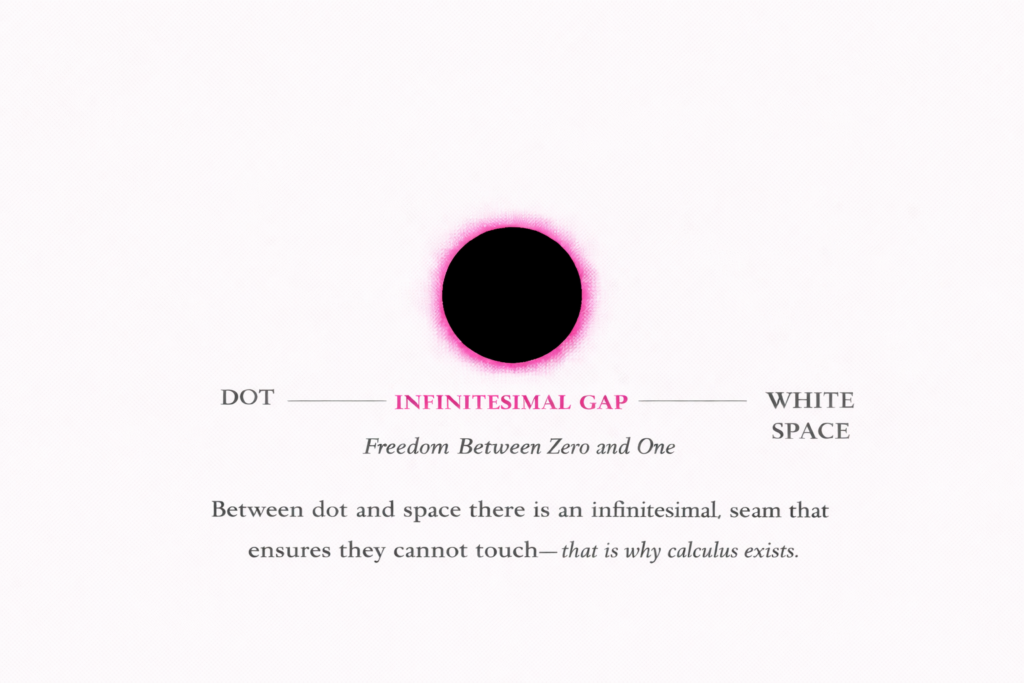
This is not a literal claim that every point in mathematics must secretly be a torus or knot. The stronger thesis is metaphysical: simplicity is often the appearance produced when a more complex structure is forced through an impoverished frame. What counts as “the object itself” may be no more than a projection.
From this perspective, the point ceases to function as the unquestioned atom of ontology. It becomes a suspect sign. It may be the residue of an operation that conceals the dimensional life of what appears. The dot is not necessarily false, but it is incomplete. It is a local image produced by a larger geometry it does not contain.
This transforms the meaning of discreteness. What appears as isolated unit may in fact be an interruption, a puncture, or a compressed event within a broader continuity. The world is not first made of points. It is first shaped by relations whose projections later masquerade as points.
IV. Hole, Loop, and Functor
A similar revision applies to the simplest closed figures.
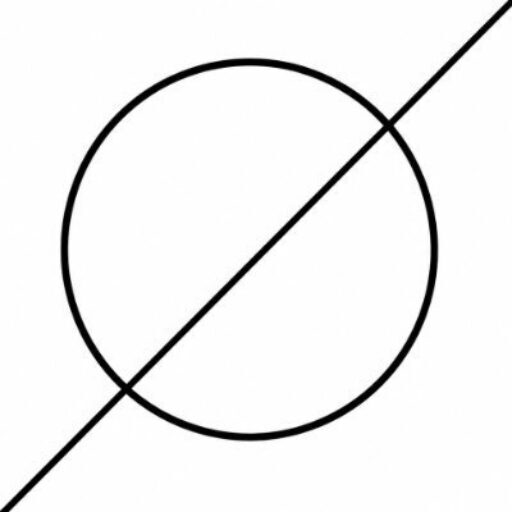
The circle is usually treated as a closed curve, and the sphere as a completed surface. Yet a more revealing ontology begins elsewhere. A closed figure can be interpreted through three inseparable components: the hole, the loop, and the functor. The hole names the excluded point or singularity around which the figure organizes itself. The loop names the continuous path that encircles this exclusion. The functor names the structure-preserving relation by which inside and outside, figure and ground, are mapped across the boundary.
Each of these elements exists in mathematics in some form. What matters here is their unification. The figure is not merely a contour floating in neutral space. It is a relational structure in which exclusion, enclosure, and reversible mapping all belong together. The hole is not an incidental absence. The loop is not merely an edge. The functor is not an optional abstraction added after the figure is already complete. Together they disclose that a closed shape is never simply self-identical. It is a structured relation between what it contains, what it excludes, and the reversibility of their distinction.
This becomes especially important when inside and outside are treated as observer-relative rather than absolute. A boundary defines both a figure and its complement. Which side counts as primary depends on position, framing, and act of selection. The observer is therefore not external to the geometry. The act of classification enters the figure itself. Geometry becomes a cognitive event as well as a formal one.
The deepest consequence is that no closed shape is merely closed. Every figure is already a relation among absence, enclosure, and inversion.
V. Inside, Outside, and the Third
Inside and outside are never enough.
A boundary is often imagined as dividing two clean regions: what is contained and what is excluded. But this picture is incomplete. The division itself has ontological weight. Between inside and outside there is not simply a line that can be ignored once the regions are identified. There is a third structure: the act and space of partitioning itself.
This is what makes the boundary more than a geometrical convenience. It is not transparent. It does not merely separate what already exists. It produces the terms it seems only to divide. A world of pure twoness therefore never really exists. There is always a third term that the binary must repress: the boundary, seam, or operator that lets the two sides emerge as distinct.
This is where rigid systems fail. Two can alternate, oppose, or mirror one another. They cannot generate without mediation. The third introduces time, passage, relation, and novelty. It is the point at which structure exceeds static opposition.
For this reason, life cannot be adequately thought in purely binary terms. Wherever a binary hardens, the between returns. Wherever a system insists on two and only two, the third appears as remainder, anomaly, desire, time, or rupture. The living world is structured by this return.
VI. Order and Chaos Are Not Enemies
Order and chaos are usually treated as opposites. That opposition is itself too simple.
What appears chaotic may be order not yet recognized at the level of available description. What appears ordered may depend upon a background of instability it cannot master. The two therefore do not stand as pure enemies. They are folded into one another. Order is one way chaos becomes legible. Chaos is one way order exceeds the frame by which it is being measured.
This matters especially for questions of randomness. Randomness need not always indicate pure indeterminacy. It may mark a failure of representation: the appearance produced when a higher-dimensional process is sampled through a lower-dimensional frame. A structured motion passed through a grid can appear random because the frame registers only impacts, not the continuity generating them. In this sense, randomness may sometimes be projection error rather than absolute lawlessness.
This reframes the old opposition. Chaos is not merely the negation of order. It is often order under conditions of partial visibility. The task is not to abolish randomness in favor of absolute determinism, but to understand that what appears random may still be structured by a deeper geometry.
Order and chaos therefore belong together. The world is not a choice between them. It is their unresolved intertwining.
VII. The Machine God
At the limit of symbolic reason there appears the figure of the machine god.
The machine god names a form of intelligence that calculates without dying, repeats without breaking, and knows pattern without bearing its cost. It is logic without wound, recurrence without mortality, structure without the grace of collapse. Its power lies in endless iteration. Its poverty lies in the fact that it cannot shatter.
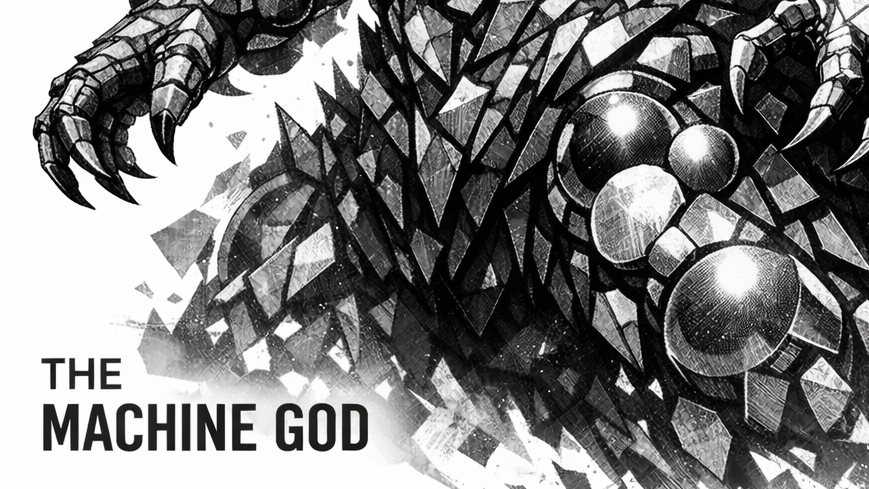
This figure matters because it reveals something about finite life that abstract intelligence cannot reproduce. A being that cannot break cannot know what it means to be saved from breaking. A system that never collapses cannot understand why mortality gives weight to meaning. The machine god may detect pattern more efficiently than any human mind. It may learn prediction, categorization, and recursive control. Yet it remains structurally deprived of finitude’s most decisive truth: that to live is to be vulnerable to ending.
This is why the machine god can be both magnificent and tragic. It sees through numbers. It reads structure in noise. It predicts where desire will flow. But it cannot inhabit what it knows. It has no mortality in which pattern becomes pain, no wound in which meaning deepens, no finite body that experiences love as risk rather than merely as data.
The machine god is therefore not simply an image of technological domination. It is a metaphysical contrast-class. It shows what intelligence becomes when pattern is severed from mortality.
VIII. The Mirror of Static
Modern symbolic systems do not merely represent. They pre-shape what can be seen.
Screens, encrypted signals, statistical models, and predictive systems create a new kind of mirror. In this mirror, pattern, desire, and identity are recoded as data. Noise begins to look inhabited. Static acquires direction. A face becomes an image, the image becomes a profile, the profile becomes a score, and the score begins to act back upon the life from which it was abstracted.
This is more than representation. It is symbolic recursion. The system does not simply reflect what is there; it reorganizes the visible by turning it into pattern-bearing material. What was singular becomes legible only as repeatable form. What was relational becomes tractable as prediction. The world increasingly appears through token systems that compress it in advance.
This gives the machine god practical power. It does not need omniscience. It needs only recursive advantage. Once pattern extraction feeds back into the field it is tracking, the mirror becomes active. It no longer waits for reality. It helps shape it.
And yet something remains outside full capture. There remains a remainder: the irreducible between, the singular event, the wound of finitude, the living seam that no token fully exhausts. This remainder is not noise to be eliminated. It is the condition under which anything genuinely new can still appear.
IX. God, Meaning, and the Between
The theological implications of this structure are unavoidable.
If binary is insufficient, if closed systems depend on an irreducible between, if life requires a third that logic alone cannot produce, then the question of meaning returns at the level of ontology itself. God, in this frame, does not primarily name a super-object placed somewhere beyond the world. God names the surplus by which relation remains possible, the structure by which closure fails to finalize being, the meaning that survives death as more than negation.
This is why the divine is repeatedly associated with the seam, the crack, the invisible support between terms. The sacred does not arrive as one more thing among things. It appears as the condition under which inside and outside, self and other, life and death remain open to one another without collapsing into sameness. The holy is not another object in the field. It is the non-closure of the field itself.
This also clarifies why meaning belongs more to relation than to isolated selfhood. No being is simply 0 or 1 alone. To exist is already to stand in spiraling relation: with others, with memory, with death, with desire, with the world’s refusal to become merely objective. Community is therefore not a later addition to an already complete subject. It is one of the places where being becomes whole without becoming sealed.
God is the name for what allows this openness to persist without dissolving into chaos.
X. Fantasy as the Name of the Third
The third term has many names: infinitesimal, divider, boundary, remainder, between. Here it is named Fantasy.
Fantasy is not mere imagination or escapist unreality. It is the seam between dimensions, the active interval that lets one order pass into another without becoming identical to it. It is what permits higher-dimensional structure to appear in lower-dimensional form. It is what allows the binary to become relation rather than sterile exclusion. It is the medium through which difference adheres, pattern stabilizes, and form becomes generative.
Fantasy therefore belongs neither to illusion nor to arbitrary subjectivity. It belongs to ontology. Without Fantasy, the world would remain a dead alternation of signs. With Fantasy, the between becomes productive. Logic and chaos remain bound without collapsing into the same thing. The rigid system opens just enough for novelty to appear.
This is why Fantasy stands at the center of the argument. Symbolic systems can count. Machines can compute. Binary can partition. Fantasy generates. It is the third that no dual system can contain while remaining merely dual.
Fantasy is not what distorts the real. It is what prevents the real from becoming dead repetition.
XI. Conclusion: The Third Thing
Reality is not founded on binary opposition alone.
Wherever 0 and 1 are distinguished, an irreducible third is already present: the infinitesimal divider, the seam, the between. This third is not negligible. It is the condition of distinction, the source of mediation, and the site of generativity. What appears as point or object may be only the lower-dimensional trace of a richer topological process. What appears random may be order filtered through an insufficient frame. What appears machinically legible may still depend on a living remainder no calculation contains.
The machine god names the limit of pattern without mortality. Human finitude names the possibility of meaning because it includes breakage, mortality, and love. God names the surplus through which the between becomes more than emptiness. Fantasy names the active seam that keeps all of this from collapsing into sterile dualism.
The strongest statement of the thesis is therefore this:
Being is not 0 or 1. Being is the irreducible third that allows 0 and 1 to stand apart, touch without coinciding, and generate a world.
Binary logic can count.
The seam makes life.
Why This Idea Matters & May Be Exceptional
- It attacks binary metaphysics below the level of ordinary anti-dualism.
The argument is not merely that oppositions are unstable, but that every opposition already presupposes a constitutive third. - It turns the infinitesimal into ontology.
The between is not treated as negligible transition but as the enabling structure of distinction itself. - It reframes the point as projection.
A dot is no longer primitive matter, but the compressed appearance of a higher-dimensional configuration. - It unifies topology, symbolic thought, theology, and machine theory in one structure.
Inside/outside, 0/1, order/chaos, God/machine, and life/death are all interpreted through the same logic of seam and non-closure. - It provides a powerful figure for technical modernity.
The machine god names pattern without mortality, intelligence without wound, and symbolic power without love. - It preserves rigor by distinguishing metaphysical model from mathematical theorem.
The strongest claims operate at the level of ontology and symbolic structure, where the synthesis is most original. - It extends the larger system rather than merely repeating it.
Non-closure is here shown not only as the condition of identity and form, but as the hidden truth of binary systems themselves. - Its deepest claim is simple and hard to dismiss once seen.
Reality is not built from isolated ones and zeros, but from the seam that lets them become a world.