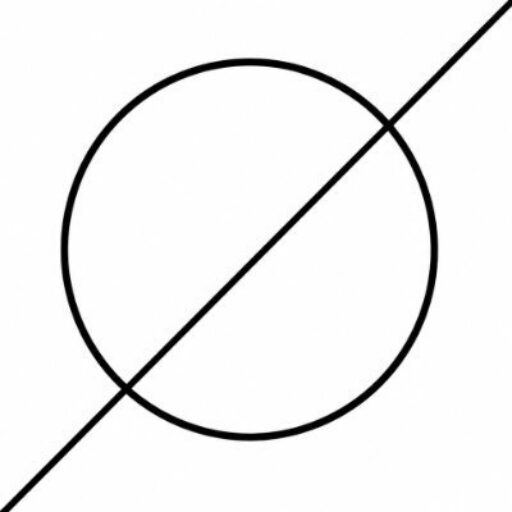
Word Count: 8,769
Local Closure, Boundary-Contact, Infinite Coherence, and the Ontology of Non-Final Form
Abstract
This thesis develops an ontology of form from a reversal of the inherited meaning of the circle. The circle has been treated as the privileged diagram of closure, completion, eternity, unity, perfection, and self-return. Against this symbolic inheritance, the present work argues that the circle is not the proof of final closure but the first visible grammar of non-closure. The circle is closed only locally and formally. Ontologically, it is an event: open field, cut, boundary loop, circular object, circular hole, surrounding complement, contact with outside, frame of measure, act of recognition, and continuous infinitesimal coherence.
The thesis distinguishes mathematical closure from ontological closure. In strict geometry, a circle may be a closed curve. This thesis does not deny that formal truth. It argues that a formal truth becomes metaphysically false when it is treated as final containment. The circle cannot appear as circle without field, contrast, outside, center, boundary, measure, observer, and name. Its closure depends on what it cannot contain. Therefore the circle is not an emblem of sealed being. It is the diagram of the fact that every closure remains dependent upon non-closure.
The work expands this claim into a general ontology. The circle is not one object made of infinite parts. That description still treats parts as primary. More precisely, the circle is coherent continuity appearing as thing. It is not assembled from many units; rather, parts are produced by later cuts, axes, frames, or measurements imposed upon it. The circle is not simply one, nor simply many. It is continuous self-relation without privileged part. Its unity is real as local readability, but false as final objecthood.
This ontology clarifies the difference between circle, triangle, square, sphere, torus, and aperiodic order. The triangle is not first three closed sides, but intersection before enclosure: a local figure produced by directions that exceed it. The square is an interrupted figure: line, stop, turn, line, stop, turn. Its mirror symmetry is a lower symmetry because it reflects across an external gap. The circle, by contrast, does not mirror by duplication. It incorporates the gap as boundary. The square reflects across a gap; the circle becomes the gap. Pure circular symmetry is not mere sameness or left-right reflection. It is the even ordering of difference: inside, outside, loop, hole, complement, and open field.
The boundary is not merely a wall. It is the contact-zone where closure touches what exceeds it. Nothing bounded is without outside-contact. A circle closes only by touching what it is not. Even a dot appears through contrast; its edge is the touch of black against field. Thus closure is not isolation. Closure is organized contact with the outside. Openness is therefore redefined: openness is not the absence of form, but richness of relation, exterior articulation, passage, and contact.
The thesis then extends the structure to language, truth, selfhood, death, God, ethics, and artificial intelligence. Language draws boundary loops around meanings it cannot contain. Truth is local readability inside a non-final field. The self is not a sealed unity, but a local coherence that learned one name. Death is real biologically but false as final metaphysical containment. God names the non-closure through which being remains possible. Ethics begins by refusing to close another being more than the situation requires. AI intensifies the problem of local closure by generating symbolic circles from fields it does not contain.
The central claim is:
Reality is not composed of finally closed things. Reality is the open field locally producing readable closures.
Or, in its simplest formulation:
No closure is final.
Table of Contents
- The Circle Is Not the Shape of Closure
- The Cut: Circle, Loop, Hole, and Open Field
- Boundary-Contact: Closure Touches the Outside
- Inside, Outside, Dot, and Projection
- The Circle Is Not One and Not Many
- The Triangle and Square: Intersection, Interruption, and False Mirror
- Pure Symmetry: Circle, Complement, Gap, and Asymmetry
- Measure, Frame, Convexity, and Reversal
- Sphere, Cube, Torus, and Relational Openness
- Aperiodic Order and Lawful Non-Closure
- Truth and Language as Local Closure
- Self, Body, Death, and God
- Ethics of Non-Final Closure
- AI, Symbol, and the Future of Open Form
Introduction: No Closure Is Final
The most dangerous metaphysical error may be hidden in the simplest diagram. A circle appears harmless. It is drawn before it is understood. It belongs to childhood, geometry, ritual, astronomy, architecture, theology, design, and myth. It seems to say one thing with perfect economy: the line returns to itself. The beginning meets the end. The wandering path becomes whole. The inside is enclosed. The outside is excluded. The form completes itself.
For this reason, the circle has been one of the great symbols of closure. It has represented perfection, eternity, divinity, unity, totality, repetition, and return. It looks like the place where thought can finally rest. It offers the fantasy of a figure without remainder.
This thesis begins by refusing that fantasy.
The circle does close, but only locally. Its circumference returns to itself, but the circle does not contain the field on which it appears. It does not contain the center by which it is defined. It does not contain the outside against which its inside becomes meaningful. It does not contain the measure that recognizes it, the eye that sees it, the hand that draws it, the cut that produces it, the page that carries it, or the language that names it. The circle closes as a curve. It does not close as an event.
This distinction between formal closure and ontological closure is essential. The thesis does not claim that mathematical geometry is wrong when it defines the circle as closed. It claims that mathematical closure is a local formal truth, not a final metaphysical truth. The mathematical statement answers one question: what is the formal structure of the curve within a specified system? Ontology asks another question: what conditions allow the circle to appear, function, mean, and be recognized? In the second sense, the circle is not self-contained. It opens into a field of relations.
The thesis can be stated in one sentence:
Closure is not the opposite of openness; closure is the local syntax by which openness becomes readable.
Without closure nothing appears. Without boundaries there is no form. Without cuts there is no distinction. Without names there is no language. Without identity there is no responsibility. Closure is necessary. But final closure is false. Final closure would mean that a form contains all its conditions, that a word contains all its meaning, that a self contains all its history, that a death contains all a life, that a truth contains all reality. Such closure does not exist.
The work therefore does not attack form. It attacks idolatry of form. A circle is real. A boundary is real. A word is real. A self is real. A truth is real. But each is real locally and false finally. Each holds only through a field it cannot contain.
The circle is the privileged figure because it stages the error with maximum force. If even the circle does not close finally, no form closes finally. If the most perfect image of closure depends on field, center, complement, hole, boundary-contact, and recognition, then closure itself must be rethought.
The circle is not the shape of final closure. It is the first visible grammar of non-closure.
1: The Circle Is Not the Shape of Closure
The circle is the strongest possible test case because it appears to refute the thesis before the thesis begins. If one began with a broken circle, an open spiral, a torn boundary, or an incomplete figure, the argument would be easy. Such figures already advertise incompletion. The deeper reversal appears only when the most perfect image of closure is shown to depend upon what it cannot contain.
The circle seems complete. It has no visible break, no corner, no privileged beginning, no endpoint. Its line returns to itself. It encloses and excludes. It appears as the simplest image of self-contained completion. The eye accepts it as closure before thought begins to question it.
But this acceptance depends on an abstraction. The eye isolates the circumference from its conditions. It sees the line and forgets the field. It sees the enclosed region and forgets the outside. It sees the smooth figure and forgets the cut, the drawing, the recognition, the frame, and the measure. The circle becomes metaphysically deceptive only when the event of its appearance is reduced to the visible curve.
To define a circle, one commonly invokes a center and a radius. Yet the center is not the circumference. The center governs the circle without appearing on its boundary. It is absent from the line while determining the line. The circle’s apparent self-sufficiency therefore depends upon an excluded point. The circumference can be equidistant only through relation to what it is not.
The circle also requires a field. It cannot appear nowhere. Whether drawn on paper, imagined in mathematical space, traced in sand, projected on a screen, or held in thought, the circle needs a site of appearance. This field is not contained by the circle. It precedes the figure as condition of visibility.

The circle also requires outside. An inside without outside is meaningless. To say that the circle encloses is to invoke what it excludes. But the outside is not a later remainder. It is co-produced by the circle. Every circle creates exteriority at the same moment it creates interiority.
This gives the first principle:
The circle is not the proof that closure is final. It is the proof that closure depends on what it cannot contain.
The circle closes only if one asks the narrow formal question: does the curve return to itself? If one asks the wider ontological question — what makes this curve intelligible as circle? — the circle opens into center, field, outside, boundary, complement, frame, measure, and recognition. The circle is therefore true locally and false finally.
The consequence is not that the circle is less important. It becomes more important. It is no longer simply a symbol of completion. It becomes the diagram of the impossibility of final completion. It shows that closure is real only because openness lets it become readable.
2: The Cut: Circle, Loop, Hole, and Open Field
The circle’s non-finality becomes concrete when one performs a simple act: draw a circle on a sheet of white paper and cut it out. At first, one imagines that there is a single object: the circle. But the cut reveals that the circle was never simply one thing. The cut produces an entire structure.
After the cut, at least four elements appear. There is the circular object removed from the field. There is the boundary loop by which separation occurred. There is the circular hole left in the field. There is the surrounding field that now carries the absence. The circle exists positively as object and negatively as hole.
The full circle-event is therefore:
circle + boundary loop + circular hole + open field
This is decisive. A circle is not merely the filled circular region. It is also the shaped absence produced when the region is removed. The positive circle and the negative hole are co-produced by the same cut. The hole is not nothing. It is the field remembering the form that has been taken from it.

To make a circle is not simply to add a shape to space. It is to redistribute space. The cut produces inside and outside, object and remainder, boundary and field, form and absence. The circle is the visible result of a division, but the division never produces only the visible object. It also wounds the field.
The square page is useful but misleading. The page gives openness a temporary border. But the true surrounding is not essentially square. The square page is a local representation of a field that is not finally shaped by the page. The outside of the circle is not merely another object around it; it is the open complement in which the figure appears.
This reverses the ordinary priority. We usually treat the object as primary and the outside as secondary. The cut shows that the outside belongs to the object’s constitution. The circle is what it is because of the field from which it is separated. It does not contain the conditions of its circularity.
This is the beginning of a cut ontology:
A cut never creates one thing. A cut creates a thing, a boundary, an outside, and a remainder.
The principle generalizes. A word cuts meaning from experience but leaves meanings unsaid. A law cuts conduct into permitted and forbidden but leaves ambiguous cases. A self cuts identity from becoming but leaves memory, fantasy, relation, and future. A death cuts a life from living presence but leaves grief, inheritance, trace, and absence.
Every form is also the absence it imposes on the field. Every circle is also the hole it leaves.
3: Boundary-Contact: Closure Touches the Outside
A closed thing is never closed in the sense of being without relation. If it has a boundary, then it touches what is outside it. This simple claim changes the meaning of closure. A boundary is not merely a wall that separates a form from the world. It is also the contact-zone between the form and what exceeds it.
The circle’s circumference is usually treated as the line of closure. But the circumference is also the place where the circle touches the outside at every point. The same line that seems to seal the circle is the entire surface of its contact with the open field.
This yields a central formulation:
Closure is not isolation. Closure is organized contact with the outside.
A dot demonstrates the same structure in primitive form. A black point on a white field appears only through contrast. Its edge is not an absolute sealing-off from the field. It is where black touches white. The dot is visible because it contacts what it is not. Without surrounding field, the dot would not appear.

Thus even the smallest mark is relational. The point is not pure self-contained being. It is an event of contrast, contact, and field. Its boundary does not prove isolation. It proves outside-touch.
The boundary is therefore double. It separates and joins. It distinguishes and exposes. It limits and contacts. To have a boundary is not to be cut off from openness. To have a boundary is to touch openness in a definite way.
The vocabulary must shift. The circle does not simply have a boundary. It has boundary-contact. The circumference is not only a closure-line. It is an outside-touch. The closed form continuously meets what exceeds it.
This also explains why the circle differs from the square. The square touches the outside through sides and corners. Its contact is interrupted by turns. The circle touches the outside continuously, without corner, halt, or privileged direction. Its boundary is pure continuous contact.
The strongest line is:
The boundary is where closure touches the open.
The ethical implication follows later, but it begins here. A person’s boundary is not isolation. The skin is touch, vulnerability, exposure, sensation, wound, and exchange. A word’s boundary is not containment. It touches context, silence, history, and interpretation. A theory’s boundary is not totality. It touches what it excludes.
Closure is never without contact. A circle closes only by touching what it is not.
4: Inside, Outside, Dot, and Projection
The distinction between inside and outside appears obvious in ordinary diagrams. Draw a circle. Place a dot outside it. The eye says: outside. Place a dot inside it. The eye says: inside. Geometry can formalize this distinction clearly within a plane.
But ontology asks whether inside and outside are absolute or whether they belong to a local projection of a deeper structure. This question becomes serious when one considers folded surfaces, hidden passages, twisted boundaries, side views, or a Möbius-like relation where what appears to be the other side may belong to one continuous surface.
The circle drawn on a flat page divides a plane. But the flat page is not the whole of possible topology. If the boundary is twisted, folded, lifted, or connected through another path, what appears outside in the projection may be continuous with what appears inside in the deeper structure. The eye sees separation because it sees one projection.
This gives a principle:
Inside and outside are local readings of a deeper continuity.
This does not mean ordinary geometry is false. In a flat Euclidean diagram, a dot outside the circle is outside the circle. The thesis does not deny that. It argues that the philosophical meaning of outside is not exhausted by that local diagram. A point may be outside relative to a projection and still belong to a continuity that the projection cannot display.
The dot outside the circle becomes a test. Perhaps it is simply outside in the flat view. But perhaps its absence from the interior view does not prove absolute exclusion. Perhaps it is the same relation appearing at another scale, another route, another fold, another distance, or another limit of representation. Perhaps what cannot be seen inside the circle is not absent, but too small, too far, too folded, or too indirect for the local view.
The triangle and square do not behave in the same way. A dot outside a triangle or square appears outside through angular interruption: edges, corners, stops, directional breaks. The triangle and square exclude by angle. The circle excludes, if it excludes, by continuous relation. Its outside is not pushed away by a corner. It touches the whole boundary evenly.
Thus, carefully:
A dot can be outside a square in a way it is not outside a circle.
This is not a literal Euclidean theorem. It is an ontological distinction. The square externalizes by interruption. The circle relates by continuity. The square’s outside is broken away by sides and corners. The circle’s outside is held in continuous boundary-contact.
The eye mistakes local invisibility for ontological absence. It says “not here” and means “not real.” But often outside means only outside a particular frame, vocabulary, projection, or scale. The circle teaches that inside/outside is necessary, but not final.
5: The Circle Is Not One and Not Many
The circle is often described as one thing, or as one curve made of infinitely many points. But both descriptions risk missing its deeper structure. To say the circle is one thing can turn it into a sealed object. To say it is made of infinite parts can turn it into an atomistic assembly. Neither formulation is adequate.
The circle is not best understood as one object composed of infinite parts. That description still makes parthood primary. It imagines the circle as many tiny pieces glued together into a whole. But the circle does not first appear as a collection of pieces. It appears as continuous coherence. The parts appear only after a cut, axis, coordinate, measurement, or frame is imposed.
The stronger claim is:
The circle is not made of parts; parts are made by cutting the circle.
A square offers natural-seeming parts: sides, corners, left, right, top, bottom. These parts belong visibly to the figure’s articulation. The square is organized by interruption. The circle resists this. One can divide the circle into left and right, top and bottom, quadrants, arcs, degrees, or points, but these divisions are imposed. No single division is privileged by the circle itself.
Thus the circle is not many in the ordinary sense. But it is also not one in the ordinary sense. It is not one like a block, object, or unit composed of parts. It is one as uninterrupted relation, one as coherence without privileged division.
This gives a new formulation:
The circle is continuous self-relation without privileged part.
The circle is coherent, but its coherence precedes the part/whole distinction. It is not many parts becoming one object. It is continuous relation becoming locally readable as one. Its thinghood is secondary. The eye reads the coherence as a thing, but the coherence is deeper than the thing.
This is why the circle is philosophically powerful. It disturbs the grammar of one and many. The square is one figure with many articulated parts. The circle is not one in that sense. Nor is it many independent parts. It is continuity in which parthood has not yet become primary.
The unity of the circle is therefore a real appearance, not a final objecthood. It is not fake. But it is not ultimate. The circle is a real appearance of coherent relation. It becomes illusion only when thought mistakes that appearance for sealed being.
The thesis can therefore state:
The circle is not one made from many. It is continuity misread as one.
This does not degrade the circle. It reveals its depth. The circle is less like an object and more like relation holding itself in a readable form.
A thing is the afterimage of relation holding together.
6: The Triangle and Square: Intersection, Interruption, and False Mirror
The circle becomes clearer when contrasted with triangle and square. A triangle is commonly defined as a closed figure with three sides. A square is a closed figure with four equal sides and four right angles. These definitions work formally, but ontologically they begin too late. They treat the closed figure as primary rather than asking what produces it.
A triangle is not first three sides. It is first three intersecting directions. Lines cross. Their crossings produce vertices. The segments between vertices become readable as sides. But the lines exceed the triangle. A side is only a local capture of a direction that continues beyond the figure.
Thus:
The triangle is not first enclosure. It is intersection before enclosure.
The triangle is a local agreement among directions that do not belong entirely to it. Its closure is an extraction from a wider field of continuation. It is real, but derivative. It is not primitive closure. It is local stabilization.
The square shares this problem differently. It appears stable and symmetrical, but its closure is made by interruption. The square is line, stop, turn, line, stop, turn. It depends on corners. The corner is the place where direction breaks. The square closes by arresting direction and forcing it to turn.

This gives the square a different ontological character from the circle. The square can mirror itself across an axis. It can be duplicated left and right, reflected across a line, or placed beside another square with a gap between them. But this mirror symmetry is lower than circular symmetry because it depends on external duplication and separation.
A square mirror-image produces:
form | gap | reflected form
The gap remains outside the form. The symmetry exists across separation. The form must be repeated to appear balanced. The mirror repeats; it does not incorporate.
The square’s mirror is not false mathematically. A square has legitimate symmetries. It is false only as an image of pure symmetry because its closure depends upon stopped lines and its reflection depends upon a gap outside the form. It imitates unity by matching parts across separation.
The circle is different. It has no corner where direction breaks. It does not mirror by placing another form across a gap. It incorporates the gap as boundary. Its inside and outside are not two duplicated objects separated by empty space. They are co-produced by one continuous loop.
This gives one of the thesis’s strongest claims:
The square reflects across a gap; the circle becomes the gap.
The square leaves the gap between forms. The circle turns the gap into boundary. The square mirrors externally. The circle organizes internally. The square breaks direction. The circle bends without break.
This is why the circle is not merely another shape. It is the place where boundary, gap, inside, outside, loop, hole, and openness become one continuous relation.
7: Pure Symmetry: Circle, Complement, Gap, and Asymmetry
The circle is often called symmetrical, but symmetry must be refined. Ordinary symmetry often means mirror symmetry: left matches right, top matches bottom, one side reflects another. A square or rectangle lends itself to this because it has sides, axes, corners, and directional parts.
The circle is not symmetrical in the same way. It has no privileged left or right, no corner, no primary side, no directional stop. It can be rotated without changing its appearance. Its boundary distributes relation continuously. The circle is not mirror symmetry. It is symmetry without side.
A mirror implies a split: original and reflection, here and there, left and right. The circle does not need this division. It does not duplicate itself across an external gap. Its symmetry is not repetition. It is continuous equivalence of relation.
But this pure symmetry is not self-contained. The circle appears with its complement. To draw a circle is to produce inside and outside, boundary and field, loop and hole. The symmetry of the circle is therefore not merely the symmetry of the enclosed region. It is the symmetry of the relation between boundary, interior, and open exterior.
This leads to a paradox:
Pure symmetry is asymmetrical because it incorporates difference rather than copying sameness.
The circle is symmetrical as a curve, but asymmetrical as an event because it produces inside/outside, form/field, loop/hole. Yet it gives this difference its most even form. Every boundary point stands in the same relation to center, interior, exterior, and field. The circle does not erase asymmetry. It distributes asymmetry perfectly.
Thus:
The circle is pure symmetry because it gives asymmetry its most even form.
Pure symmetry is not sameness on both sides. It is not duplication. It is not a mirror-copy. Pure symmetry is the complete incorporation of gap, difference, and complement into one continuous relation.
The circle plus complement is the full event. The outside is not accidental. The outside is part of the circle’s truth. The boundary loop does not merely enclose interiority. It creates a relation between finite shape and open field.
Loop and hole express this structure. A loop without a hole is not a loop. A hole without a boundary is not a hole. The loop makes the hole visible; the hole gives the loop meaning. They are co-produced.
This can be symbolically extended to form and openness, cut and field, boundary and generativity, masculine and feminine if those terms are used with precision. They should not name fixed biological essences. They name symbolic functions within form. The point is not hierarchy. It is co-production. Neither loop nor hole exists alone.
The gap is not outside the circle. The gap is the circle’s boundary. Pure symmetry incorporates the gap.
8 Measure, Frame, Convexity, and Reversal
A shape is not self-interpreting. The circle seems immediate, but its immediacy depends on a frame of measure. It becomes legible against what it is not: square, line, polygon, point, axis, coordinate, field, observer. The circle is recognized through contrast.
When a circle is placed inside a square, the square becomes a measuring frame. The circle touches four sides. It gains orientation: top, bottom, left, right. The smooth becomes legible against the angular. The continuous becomes legible against the interrupted. The circle appears pure partly because the square reveals what it is not.
Thus:
A shape is not what it is alone. A shape is what it becomes under relation.
The same circle can be read differently when the frame changes. If the square surrounds the circle, the circle appears as a convex form inside a container. If the square is placed inside the circle, each side of the square faces an arc. From the standpoint of that side, the circular boundary may appear as a concave surrounding limit. The circle has not changed. The relation has changed. The reading turns.
This must be stated carefully. In strict geometry, convexity and concavity have formal meanings. The thesis does not deny those definitions. It argues that the ontological meaning of convex and concave depends on perspective, frame, and relation. The same curve can function as bulge, enclosure, surrounding limit, horizon, or field depending on where the measure is placed.
Thus:
The object persists; the frame shifts; meaning turns.
The polygonal approximation of the circle extends this idea. A square can gain sides: pentagon, hexagon, heptagon, and onward. As the number of sides increases, the polygon approaches the circle. This can happen from within through inscribed polygons or from without through circumscribed polygons. The circle is the limit approached from both directions.
The circle becomes a threshold where finite side-based articulation meets smooth continuity. The polygon tries to become the circle, but the circle is not merely the final polygon. It is the point where the logic of sides reaches its limit.
The circle stands between inner and outer approximation. It is the hinge where inside and outside measures converge. It is the limit at which the finite frame discovers the smooth.
This is why the circle functions as an ontological operator. It allows reversals. It shows that the same form can hold while the meaning of its relation changes. Identity is not reducible to frame.
The circle does not change; the world of measure around it changes.
9: Sphere, Cube, Torus, and Relational Openness
The drawn circle is not the final truth of circularity. It is a lower-dimensional presentation of a deeper generative principle. When the circle becomes sphere, the relation between boundary, interior, exterior, and field changes. A sphere is not simply a circle with more size. It reorganizes relation through volume, surface, enclosure, and ambient contact.
A circle inside a square touches four sides. A sphere inside a cube touches six faces. This comparison should not be treated as a finished mathematical theorem of universal ratio. It is a philosophical grammar of exterior articulation. It suggests that forms may be read according to the richness of their structurally significant contacts with what surrounds or exceeds them.
This requires a new definition of openness:
Openness is not lack of form. Openness is richness of relation.
A form is more open when it has more ways of touching, passing, relating, exposing, folding, or articulating itself with what is not itself. A point has minimal articulation. A circle introduces planar enclosure and continuous boundary-contact. A sphere introduces volume and surface. A torus introduces a hole and passage. Higher forms may introduce further modes of relation.

The torus is essential because it makes the hole internal to the form. A circle encloses a region. A sphere encloses volume. A torus has throughness. It is bounded, but it contains passage. Its outside folds through its inside. It refuses the simple opposition between sealed form and empty openness.
The torus teaches that a hole is not a defect. A hole may be the condition of higher form.
The hole allows passage, circulation, return, and relation. The torus does not abandon closure. It transforms closure by letting openness enter structure.
A developmental sequence emerges:
- dot: minimal contrast and edge-contact;
- circle: planar boundary-contact;
- sphere: volumetric exterior articulation;
- torus: closure with passage;
- higher form: increasing capacity to touch, relate, fold, and open.
The true circle is not merely the drawn circle. The drawn circle is an impoverished local image of a deeper principle: continuous form seeking richer relation. The circle is a stage in the life of openness becoming readable.
This also explains why a circle cannot fill the square’s corners without ceasing to be a circle. A form can become more open only to a point while remaining itself. Beyond that point, it must transform. Identity and openness are in tension.
Thus:
A form is the temporary compromise between identity and openness.
The highest form is not the most closed form. It is the form most capable of relation while still holding coherence.
10: Aperiodic Order and Lawful Non-Closure
If no closure is final, one might think reality collapses into disorder. This is the standard objection. If there is no final circle, no final word, no final truth, no final self, then everything seems to become chaos. The thesis rejects this. Non-finality is not chaos. Non-closure can be lawful.
Aperiodic order gives the clearest visual model. In an aperiodic tiling, local shapes appear clearly: stars, polygons, angles, motifs, interlocking regions. The pattern has law. It is not random. Yet it does not resolve into simple total repetition. It produces local order without final global closure.

This is the world-picture of the Open Circle Thesis. Reality is not a pile of isolated objects. Nor is it a single closed One. It is a generative field in which local forms appear, stabilize, dissolve, and reconfigure. As the gaze moves, new shapes appear. What seemed central becomes partial. What looked closed becomes part of a larger pattern.

The principle is:
Aperiodic order is lawful form without final closure.
This preserves rigor. The thesis does not say all interpretations are equal. It says local closures can be exact, necessary, disciplined, and real without being total. A local star in a tiling is real. A local triangle is real. A local pattern is real. None is the final unit of the field.
Aperiodic order also distinguishes repetition from generativity. A closed periodic grid repeats a unit until the field is exhausted by repetition. Aperiodic order generates relation without reducing the whole to one repeated closure. It is ordered without being sealed.
This becomes a model of truth. A truth is like a local figure in an aperiodic field. It holds. It is not arbitrary. But it does not contain the whole. It becomes false only when it claims finality.
Thus:
Truth is local readability inside a non-final field.
This avoids absolutism and relativism. Against absolutism, truth is not final possession. Against relativism, truth is not nothing. Truth is real local coherence that remains aware of the field it cannot close.
The world is not finally closed. But it is not meaningless. It is lawful non-closure.
11: Truth and Language as Local Closure
Language is a machine of closure. It cuts the open field of experience into names, categories, propositions, commands, questions, memories, and promises. Without language, much of human reality would remain unformed. But language never contains what it names.
The word “circle” is not the circle. The word “body” is not the body. The word “pain” is not pain. The word “love” is not love. A word is a boundary loop around an open field of meaning. It makes meaning locally available while leaving meaning excessive.
This is not a failure of language. It is the condition of language. A word must close enough to function. But it must remain open enough to live. A word that contained all meaning would be dead: no interpretation, no context, no history, no future use. Language works because it closes locally and opens endlessly.
Every word is therefore true and insufficient.

A proposition has the same structure. A proposition may be true. But it is true within a field of grammar, evidence, context, world-relation, use, and interpretation. It does not contain the total field that makes it meaningful. The proposition closes around a claim, but the claim depends on what lies outside the proposition.
Thus:
Truth is real locally and false finally.
A statement becomes false in the deepest sense when it forgets its locality. It may remain factually correct and still become metaphysically false if it claims to be the whole. The error of final closure is not always factual error. It is inflation of local truth into total truth.
Philosophical writing must obey this law. A thesis is a circle. It draws a boundary around a field of thought. It produces an inside: terms, arguments, examples, definitions. It also produces an outside: objections, remainders, unhandled cases, future developments. A rigorous thesis does not pretend to contain everything. It knows where its boundary touches the open.
Poetry matters because poetry is language aware of non-finality. It is not decoration. It lets language show its excess. It uses rhythm, break, image, silence, and ambiguity to remain faithful to meanings that cannot be sealed by definition.
The word closes. The meaning exceeds. Truth holds. The field remains open.
12: Self, Body, Death, and God
The self is the most intimate circle. The word “I” appears to name a unity. It suggests a center, an inside, a boundary, and continuity through time. But the self is not a sealed substance. It is a local coherence of body, memory, language, relation, desire, injury, fantasy, habit, future, and world.
The self is real. It answers, promises, suffers, acts, remembers, and takes responsibility. But it is not final. It changes. It divides. It carries others inside it. It is wounded by the past and opened by the future. It exceeds every name given to it, including its own.
Thus:
The self is not a closed circle. It is a local coherence that learned one name.
The body clarifies this. The skin appears as boundary, but the skin is not a wall. It is touch, vulnerability, breath, exposure, temperature, wound, pleasure, pain. The body’s boundary is a contact-zone. The body is not sealed inside itself. It lives by exchange.
Language tries to close the body by naming it. But the body exceeds the word. Pain exceeds “pain.” Desire exceeds “desire.” Death exceeds “death.” The word creates local readability, but the body remains more than symbolic closure.
Death is the most powerful imagined closure. It seems to end the circle of a life. Biologically, death is real. The organism ceases. The local pattern breaks. But death becomes metaphysically false when treated as total containment of a being’s meaning. No life was ever a sealed unit, so no death can be the sealing of a unit.
The dead remain in memory, relation, consequence, language, inheritance, wound, place, and absence. This does not prove simple immortality. It means death is real locally and false finally.
Death is the fantasy of final closure applied to a being that was never closed.
God appears as the name for refusal of final closure. If God is imagined as the largest closed object, God becomes another idol. But if God names the non-closure through which being remains possible, then God is not a being inside the circle. God is the failure of every circle to contain the open.
God is not the largest object. God is the name for the fact that no circle finally closes.
13: Ethics of Non-Final Closure
Ethics follows directly from the ontology. If beings are local closures within non-closure, then to treat another person as finally closed is cruelty. A category may name something real. A judgment may be necessary. A boundary may need defense. But no person is identical with the category, judgment, wound, crime, diagnosis, role, or memory by which they are locally named.
Ethics does not abolish closure. It requires closure. To act ethically, one must sometimes say: this harmed; this boundary was crossed; this promise was broken; this act belongs to this agent; this responsibility must be answered. A world without closure would be morally useless. It would dissolve accountability.
But ethical closure must remain local. The error is not judgment. The error is finalization. Cruelty begins when judgment becomes total ontology: you are only this. You are nothing beyond this wound. You are nothing beyond this category. You are nothing beyond this failure.
The ethical law is:
Do not close the other more than the situation requires.
This is not softness. It does not excuse harm. It means judgment must remain proportional to the local truth it names. Justice requires closure, but not metaphysical totalization. Love requires knowing, but not possession. Care requires boundary, but not imprisonment.
The same structure applies to apology and forgiveness. An apology is a local closure after rupture. It names harm, accepts responsibility, and begins repair. But a true apology cannot demand that the wound close immediately. Forgiveness is not deletion. It is a reconfiguration of relation to harm. It does not erase the past; it changes the way the past remains open.
Love is perhaps the highest ethical practice of non-final closure. To love someone is not to know them completely. It is to remain faithful to the fact that they exceed what one knows. Love draws a circle around relation, but it must not mistake that circle for ownership.

Consent also belongs here. Consent recognizes that another body is not contained by one’s desire. Desire draws a circle, but the other is not the inside of that circle. The other remains open, bounded, and not reducible to the form of one’s wanting.
Ethics is the practice of giving form without finalizing.
14: AI, Symbol, and the Future of Open Form
Artificial intelligence makes the problem of local closure newly visible. A model receives a prompt and produces an answer. The answer appears complete. It has grammar, structure, confidence, sequence, and apparent authority. It forms a circle of language. But that circle does not contain the field that produced it.
Behind every machine answer are training data, statistical relations, human language, social histories, hidden infrastructures, interpretive frames, prompts, incentives, and omissions. The output is local closure drawn from a vast symbolic field. It is readable, useful, sometimes true, but never final.
AI is not simply a tool and not a god. It is a machine of symbolic local closure.
AI is language learning to draw circles faster than humans can inspect the field.
The danger of AI is false finality. A model output can appear closed enough to be treated as truth. A profile can appear closed enough to be treated as a person. A prediction can appear closed enough to be treated as fate. A classification can appear closed enough to be treated as identity. Machine closure becomes dangerous when institutions worship it as final.
The critical principle is:
No machine closure is final.
This is not anti-technology. It is anti-idolatry. AI can be useful precisely as local closure: draft, map, comparison, pattern, question, possible answer. But it becomes destructive when local closures are treated as total knowledge.
AI also reveals something profound about language. One prompt can produce multiple answers. One idea can be phrased in many ways. One field can generate countless local closures. The model makes visible what was always true: language is not a sealed container of meaning. It is an open field of possible formations.
AI intensifies both sides of the thesis. It threatens to finalize the local at scale. But it also exposes the non-finality of symbolic form. It shows that every answer is a local stabilization, not the end of thought.
The future problem is not whether machines will draw circles. They will. The question is whether humans will remember that every machine circle has a field, a hole, a boundary, a remainder, and an outside.
The ethics of AI is therefore an ethics of non-final closure. Outputs must be contextual, revisable, accountable, and open to challenge. Classifications must not be confused with beings. Predictions must not be confused with futures. Summaries must not be confused with lives. Data must not be confused with reality.
The age of AI is the age in which the ancient error of the circle becomes automated. The task is to preserve the open.
Conclusion: The World Does Not Close
This thesis began with the circle because the circle is the most seductive image of closure. It seems to finish itself. It seems to need nothing. It seems to hold an inside and exclude an outside with perfect continuity. But the circle’s perfection is local. Once analyzed, the circle opens into center, field, outside, boundary-contact, loop, hole, complement, measure, frame, recognition, projection, and continuous infinitesimal coherence.
The circle is not the shape of final closure. It is the first visible grammar of non-closure.
The cut reveals that the circle is also the hole it leaves. Boundary-contact reveals that closure is organized touch with the outside. The dot reveals the limits of projection. The circle’s continuity reveals that part/whole is not primary. The triangle reveals intersection before enclosure. The square reveals interruption and false mirror. Pure symmetry reveals that the circle incorporates the gap rather than placing it between duplicated forms. The frame reveals that meaning turns while form persists. The sphere and torus reveal that openness is richness of relation. Aperiodic order reveals lawful non-closure. Language reveals local closure of meaning. The self reveals held multiplicity. Death reveals the fantasy of final closure. God names the non-closure through which being remains possible. Ethics refuses to finalize the other. AI shows the future power and danger of machine-made circles.
The thesis can be condensed into these principles:
- No form contains all the conditions of its appearance.
- The circle is mathematically closed but ontologically non-final.
- Every boundary produces inside and outside.
- Every boundary is also contact with the outside.
- Every cut creates object, loop, hole, and field.
- Closure is real locally and false finally.
- The circle is not made of parts; parts are made by cutting the circle.
- The circle is not one made from many; it is continuity misread as one.
- The triangle is intersection before enclosure.
- The square reflects across a gap; the circle becomes the gap.
- Pure symmetry incorporates difference rather than copying sameness.
- Openness is richness of relation.
- Truth is local readability inside a non-final field.
- Ethics begins by refusing final closure of the other.
The central formula remains:
Reality is not composed of finally closed things. Reality is the open field locally producing readable closures.
This is not a rejection of form. It is a defense of form against idolatry. Forms matter.
Boundaries matter. Names matter. Truth matters. Selves matter. Death matters. But none of these matters by being final. They matter by holding locally within a field that exceeds them.
The world does not close. It forms. It cuts. It touches. It opens. It stabilizes. It exceeds. It produces circles, but every circle depends on what it cannot contain.
The final word is disciplined non-finality:
No closure is final.
Axioms of the Open Circle Thesis
- No form contains all the conditions of its appearance.
- The circle is mathematically closed but ontologically non-final.
- Closure is not isolation; closure is organized contact with the outside.
- The boundary is where closure touches the open.
- Every cut creates object, loop, hole, and field.
- The full circle is circle + boundary loop + circular hole + open field.
- The outside is not beyond the boundary; it is present at every point of boundary-contact.
- Inside and outside are local readings of a deeper continuity.
- The circle is not made of parts; parts are made by cutting the circle.
- The circle is not one made from many; it is continuity misread as one.
- The circle is continuous self-relation without privileged part.
- The triangle is intersection before enclosure.
- The square reflects across a gap; the circle becomes the gap.
- Pure symmetry incorporates the gap.
- A form is not what it is alone; it is what it becomes under relation.
- The object persists; the frame shifts; meaning turns.
- Openness is not lack of form but richness of relation.
- Aperiodic order is lawful form without final closure.
- Truth is local readability inside a non-final field.
- The self is a local coherence that learned one name.
- Death is the fantasy of final closure applied to a being that was never closed.
- God is the name for the fact that no circle finally closes.
- No machine closure is final.
- Do not close the other more than the situation requires.
Some Poetry
A circle is not a prison unless thought worships the line.
The circle is not the end of openness. It is openness becoming readable.
The inside is born from the cut, but the cut never owns the field.
The circle is also the hole it leaves.
The boundary is where closure touches the open.
Nothing closed is without contact.
A circle closes only by touching what it is not.
The dot appears because it touches contrast.
The circle is not made of parts; parts are made by cutting the circle.
The circle is not one made from many. It is continuity misread as one.
The circle is a coherence before it is an object.
The thing is the afterimage of relation holding together.
The triangle is not three sides. It is three directions briefly agreeing.
The square reflects across a gap. The circle becomes the gap.
The mirror repeats. The circle incorporates.
Pure symmetry is not sameness. It is the even ordering of difference.
The circle is pure symmetry because it gives asymmetry its most even form.
The loop is the form of the hole. The hole is the truth of the loop.
A shape is what openness looks like when it becomes readable.
The object persists; the frame shifts; meaning turns.
Convex and concave are local readings. The form exceeds them both.
The highest form is not the most closed form. It is the form most capable of relation.
Aperiodic order is the geometry of a world that refuses to become final pattern.
The word is a boundary loop around an open field of meaning.
Truth is true locally and insufficient finally.
The self is not one. It is a multiplicity that learned one name.
Death is a boundary-word, not the final shape of being.
God is not the largest object. God is the failure of every object to contain the open.
A category is a circle. Use it. Do not kneel to it.
AI draws circles of language from fields it does not contain.
Rigor is not closing the question. Rigor is knowing exactly where the closure remains local.
No closure is final.