Word count: 11,961
System, Body, Eye, and the Non-Finality of Closure
Abstract
This essay develops a Topofantological theory of totality, system, and opening. Its central claim is that a true total metaphysics is not a sealed explanation of everything, but a system that reaches the limit at which closure opens.
A false theory of everything closes the world. A true theory of everything reveals the door by which the world exceeds every theory.
Topofantology begins from the principle that neither the One nor the Many is primitive.
Before anything can appear as one or many, object or relation, set or element, body or world, it must become locally distinguishable. Every distinguishable term appears through a structure of local closure: term, boundary, and exterior. This can be expressed formally as:
κ(Ω) = ⟨a, ∂a, ¬a⟩
Here Ω names the pre-distinguished domain, κ names the operation of local distinguishability, a names the locally distinguished term, ∂a names its boundary-condition, and ¬a names the relative exterior co-produced by distinction. The formula means that nothing appears as a bare object. A thing appears only by closing locally against what it is not.
From this follows the central law:
No closure is final.
Closure is not false in itself. Closure is necessary for legibility. Bodies, concepts, selves, circles, institutions, mathematical objects, and metaphysical systems all require closure in order to appear. The error begins when local closure claims finality.
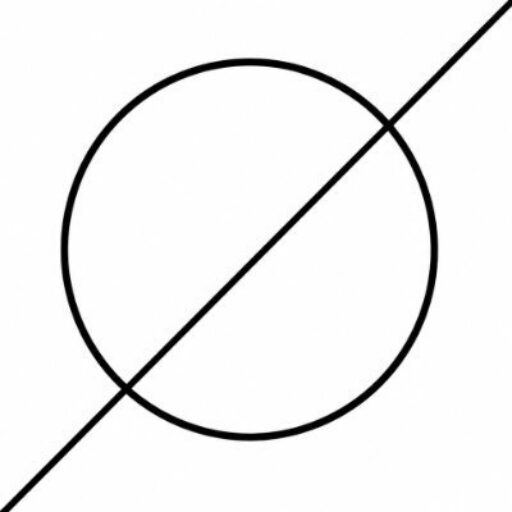
The circle is the central diagram of this error. It appears complete, smooth, and self-contained, but it depends on boundary, exterior, field, contrast, and recognition. The circle is locally true and finally false. Its danger lies in presenting local coherence as absolute completion.
This essay therefore redefines system. A philosophy is not merely a sequence of propositions; it is a body of thought. Logic gives the system its body: structure, coherence, articulation, and internal necessity. But a body without an eye remains enclosed within itself. The highest philosophy is a body that grows an eye: an internal opening through which the system sees beyond itself.
Thus the true task of metaphysics is not to destroy systems, nor to worship them, but to construct a system rigorous enough to reveal its own opening. Totality is not final containment. Totality is the limit at which closure becomes passage.
Introduction
A theory of everything is usually imagined as a final container. It is thought to be a perfect system: complete, closed, coherent, and without remainder. In this image, truth means total inclusion. The completed theory would leave nothing outside itself. It would become the final circle.
Topofantology rejects this image.
A false theory of everything closes the world. A true theory of everything reveals the door by which the world exceeds every theory.
This reversal is the starting point of the present essay. A complete metaphysics should not be understood as a system that eliminates mystery. Nor should it be understood as a weak surrender to vagueness, as if mystery begins wherever thought becomes difficult. The stronger claim is that a system becomes truly complete only when it reaches the point where its own closure opens.
The aim is not anti-system. A philosophy that refuses system altogether remains formless. It cannot locate its own limits because it never builds enough structure to encounter them. Pure openness is not yet thought. For anything to appear, it must close locally. A concept must define. A word must distinguish. A body must have boundary. A system must organize. Without closure, there is no legibility.
The problem is not closure. The problem is finality.
Topofantology is a theory of local closure and non-finality. It argues that every form appears by becoming locally distinguishable, but no form contains the full conditions of its own appearance. Every closure depends on what it excludes. Every inside implies an outside. Every one implies a boundary. Every system implies what it cannot contain.
This is why the circle matters. The circle is the most seductive image of completion. It appears whole. It appears closed. It appears to have solved the problem of form. Yet the circle can appear only within a field. Its boundary produces interior and exterior. Its coherence depends on what it is not. The circle is therefore not false as geometry. It is false only when treated as final metaphysics.
The same is true of philosophical systems. A system may be rigorous, elegant, powerful, and necessary. It may organize a vast field of thought. But if it claims to contain everything absolutely, it becomes false. Its error is not that it formed a body. Its error is that it lacked an eye.
A philosophy is a body of thought. Logic is the body: the structure that lets the system stand, move, relate, and remain coherent. But the purpose of the body is not merely to enclose itself. A living body has an eye. The eye is part of the body, but it opens beyond the body. It is local, but through it the world appears.
This essay argues that a true metaphysical system must function in the same way. It must build the body rigorously enough that an eye opens within it. The eye is the point where system becomes vision. It is the internal opening through which closure sees beyond itself.
The final thesis can therefore be stated plainly:
The complete system is not the Circle. The complete system is the point where the Circle opens.
Or, in the language of the body:
A true philosophy is not a sealed body of thought. It is a body that grows an eye.
This essay develops that claim through four linked ideas: local distinguishability, non-final closure, the circle as false totality, and the body-eye structure of true system. It argues that metaphysics becomes rigorous not by pretending to contain the beyond, but by constructing the exact form through which the beyond becomes visible.
This is the task of Topofantology: to build closure until closure tells the truth about itself.
I am real locally. I am false finally. At my limit, I open.
Based on the existing draft structure and thesis language.
1. The Problem of Totality
The history of metaphysics repeatedly returns to the temptation of the whole. Thought seeks a principle capable of organizing reality: substance, form, matter, spirit, process, language, mathematics, will, difference, information, relation, consciousness, or God. Each principle promises orientation. Each offers a way to gather the scattered field of experience into intelligible order. Each gives thought a body.
There is nothing inherently false in this desire. A philosophy without form cannot think. Without distinction, nothing can be said. Without local closure, nothing becomes legible. A concept must close around something in order to mean anything at all. A system must organize its parts or else it is not a system. Even the critique of systems must take form if it is to be understood.
The error, then, is not system itself. The error is false completion.
A metaphysical system becomes dangerous when it confuses coherence with possession. It begins by giving form to thought, but then treats that form as if it had captured the real. It takes the local success of its closure and converts it into final authority. It says: because this structure works, this structure is the whole. Because this concept organizes much, it must organize everything. Because this circle is complete, nothing remains outside it.
This is the temptation of totality.
The circle is the privileged image of this temptation. It appears smooth, continuous, self-contained, and complete. It seems to have no privileged beginning, no visible break, no unfinished edge. It returns to itself. It suggests a form without remainder. For this reason, the circle has often been treated as an image of perfection, eternity, unity, divinity, and final wholeness.
Topofantology reverses this inheritance.
The circle is not false as a figure. It is false as an absolute. It becomes deceptive only when its local closure is mistaken for final closure. A circle can appear only within a field. Its boundary distinguishes interior from exterior. Its form depends on contrast. Its legibility depends on recognition. If drawn on a page, it depends on the page. If cut from paper, it produces both a circular object and a circular hole. Its truth includes what it seems to exclude.
The circle, then, is locally true and finally false.
The same is true of every system.

A system may be coherent, rigorous, and powerful. It may define concepts, order relations, resolve confusions, and disclose structures otherwise unseen. But coherence does not prove finality. A system becomes false when it mistakes its own local completeness for absolute containment. It becomes idolatrous when it presents itself as the whole rather than as a closure within a wider field of possibility.
This distinction is crucial because it prevents a weak rejection of system. The problem is not that philosophy tries to build. The problem is that philosophy often worships what it builds. A weak response to false closure rejects system altogether and dissolves thought into fragments, gestures, moods, or endless deferrals. But this is insufficient. To merely say “reality exceeds thought” is easy. To show exactly where and why thought opens beyond itself is harder.
Vague openness is not the same as genuine opening.
A genuine opening must be produced by pressure. It must be reached through the labor of form. The system must be constructed strongly enough to arrive at its own boundary. It must not declare mystery whenever argument becomes difficult. It must not mistake confusion for depth. It must push distinction, coherence, formalization, and necessity as far as they can go. Only then does the limit appear as something more than failure.
This is why Topofantology does not reject total metaphysics. It demands a more rigorous form of it.
A false metaphysics closes the world. A true metaphysics reaches the point where closure opens.
The difference can be stated simply:
False totality says: nothing remains.
Opening totality says: here is the exact point where remainder becomes necessary.
The first closes the world. The second reveals the door.
This is the central transformation. Totality must no longer mean final containment. A true total system is not one that abolishes the unknown. It is one that brings thought to the limit where the unknown becomes structurally unavoidable. The unknown is not merely the material left outside a failed system. It is what appears when the system has become precise enough to expose the conditions of its own non-finality.
This changes the meaning of rigor. Rigor is not the elimination of opening. Rigor is the discipline by which opening becomes exact.
The strongest system is therefore not the one that claims to contain everything. The strongest system is the one that can show why no containment is final. It closes enough to become legible, coherent, and transmissible, but not so much that it mistakes its own body for the whole of reality.
This gives the first law of the essay:
A false theory of everything closes the world. A true theory of everything reveals the door by which the world exceeds every theory.
This is not anti-system. It is anti-idolatry of system. It does not reject completion. It rejects completion falsely understood as possession. It does not reject closure. It rejects closure falsely understood as finality.
A true system must be complete enough to open. It must form a body of thought rigorous enough to generate its own eye. That eye is not external to the system. It is produced by the system at its limit. The system does not fail when it opens; it becomes what it was meant to be.
The first problem of totality, then, is not whether thought should build systems. It must. The problem is whether the system, once built, mistakes itself for the world.
Topofantology answers:
A system is true only when it knows that its closure is local.
The complete system is not the Circle.
The complete system is the point where the Circle opens.
2. Local Closure and the Condition of Legibility
Topofantology begins before the inherited opposition between the One and the Many. The first question is not whether reality is ultimately one, many, relational, material, mental, linguistic, mathematical, divine, or processual. Each of those answers already assumes that something has become clear enough to be named. Each already assumes a field of legibility. Before any philosophy can say “one,” “many,” “object,” “relation,” “set,” “body,” “world,” or “system,” something must first become locally distinguishable.
This is the first formal claim:
Before anything can be counted, named, bounded, related, measured, loved, judged, or theorized, it must become locally distinguishable.
Local distinguishability is not merely a subjective act of perception. It is not the claim that consciousness invents reality by noticing it. The claim is more basic: appearance itself requires a minimal structure of difference. There must be enough distinction for something to appear as this rather than not-this. Without such distinction, there is no object, no subject, no relation, no concept, no set, no arrow, no region, no identity, and no world.
A term does not first exist as a sealed object and then later acquire relations. A term appears only through a structure of distinction. It is not first a bare unit. It is a local formation. To appear at all, it must be distinguishable from what it is not. It must have a boundary-condition. It must co-produce an outside.
This is why Topofantology does not begin with the One or the Many. The One already requires a boundary by which it can be treated as one. The Many already requires multiple distinguishable terms that can be gathered as many. Both are late. Both depend on the prior production of legibility.
The formal expression is:
κ(Ω) = ⟨a, ∂a, ¬a⟩
This expression is not an equation inside ordinary set theory. It is not saying that Ω is a set, that κ is a function in the standard mathematical sense, or that the result is a set-theoretic ordered triple. It is a schematic formalization of a prior ontological structure: the minimal condition by which anything becomes readable as something.
Ω names the pre-distinguished domain. It is not “everything” as a completed totality, because that would already make it one thing. It is not the universal set, because a universal set already belongs to a formal regime of membership and countability. Ω names what precedes local legibility: the not-yet-separated availability from which distinctions may occur. It is not an object inside the system. It is the limiting name for the condition before objecthood.
κ names the operation of local distinguishability. This operation is not necessarily physical. It may be spatial, perceptual, symbolic, linguistic, mathematical, political, ethical, technological, or conceptual. Wherever something becomes readable as something, κ has occurred. A line drawn on a page, a definition in language, a border in politics, a category in thought, a boundary in geometry, a self-description in identity, a membership rule in mathematics: each is a form of κ insofar as it produces legible distinction.
a names the locally distinguished term. It is not primitive. It is not an isolated atom of being. It is what becomes readable through κ. The term does not first exist fully and then receive a boundary. It appears as a through the operation that distinguishes it.
∂a names the boundary-condition of a. This boundary need not be a visible line. It is whatever allows a to be treated as a rather than as undifferentiated continuity. In geometry, the boundary may be spatial. In language, it may be a definition. In law, it may be jurisdiction. In identity, it may be a self/other distinction. In logic, it may be a rule of inclusion and exclusion. In a philosophical system, it may be the conceptual frame that lets one term function differently from another.
¬a names the relative exterior co-produced by the distinction. It does not mean absolute nothingness. It means the not-a that appears together with a. Every local distinction produces not only a term, but also what the term is not. The outside is not an accidental supplement added after the fact. It belongs to the condition of appearance itself.
The formula therefore means:
Distinction does not produce an isolated thing. It produces a local term together with boundary and exterior.
This is the fundamental break from ordinary object-thinking. Ordinary thought imagines a world of things that first exist, then later enter into relations. Topofantology argues that this begins too late. A thing appears as a thing only by being locally distinguished from what it is not. Its relation to an outside is not secondary. It is constitutive.
From this follows the principle of local closure:
A thing becomes legible only by closing locally.
Closure is not an error by itself. Topofantology is not a philosophy of vague openness. It does not say that all forms are illusions or that all boundaries should dissolve. Without closure, nothing can appear. A completely undifferentiated domain cannot be counted, named, touched, measured, judged, inhabited, loved, or argued about. To appear at all, something must take form. To take form, it must close locally.
A body is a local closure.
A word is a local closure.
A concept is a local closure.
A circle is a local closure.
A self is a local closure.
A nation is a local closure.
A mathematical object is a local closure.
A metaphysical system is a local closure.
None of these is unreal merely because it is locally closed. The body is real as a body. The word is real as a word. The circle is real as a circle. The system is real as a system. Their reality is local, structured, and legible. The problem begins only when local closure claims finality.
This distinction prevents two opposite errors. The first error is closed metaphysics: the belief that a coherent closure has captured the whole. The second error is naive anti-closure: the belief that because no closure is final, closure itself is false. Both fail. Closure is necessary for legibility. Closure is false only when it claims to be final.
The same point can be stated more sharply:
Closure is locally true and finally false.
This applies directly to mathematics. Set theory begins with expressions such as:
x ∈ A
But this notation already presupposes legibility. It presupposes that x can appear as x, that A can appear as A, and that membership can be distinguished from non-membership. It presupposes that there is a local distinction between belonging and not belonging. Therefore set theory begins after local distinguishability has already occurred.
This does not refute set theory. Set theory remains powerful within its domain. The point is that it is not first ontology. It formalizes relations among already legible terms. It begins after κ.
Category theory begins with arrows:
f: A → B
This also presupposes local distinguishability. A must be legible as source. B must be legible as target. f must be legible as arrow. Direction must be distinguishable from non-direction. Composition must be rule-governed. Category theory may privilege relation more than object, but even relation requires distinguishable positions. Therefore category theory, too, begins after κ.
Topology begins with spaces, regions, open sets, neighborhoods, boundaries, continuity, and deformation. But a space must already be legible as a space. A region must be distinguishable as a region. An open set must be readable as open. Boundary must appear as boundary. Topology is therefore also downstream from local distinguishability.
Topofantology does not say these disciplines are wrong. It locates them. They are formal systems built after legibility has occurred. Topofantology asks about the condition of that legibility.
This gives the second formal claim:
Set theory, category theory, topology, and geometry begin after local distinguishability. Topofantology studies the production of distinguishability itself.
The significance of this claim is not merely technical. It changes how one understands philosophy as a whole. If every object, term, concept, system, and formal structure depends on local distinguishability, then the fundamental metaphysical problem is not whether reality is one or many. The fundamental problem is how anything becomes readable enough to appear as either.
The One is not first. It is a local closure treated as a unit.
The Many is not first. It is a plurality of local closures gathered under a regime of legibility.
The object is not first. It is a local term distinguished from a relative exterior.
The relation is not first either, if relation is understood as a connection between already legible terms. Relation too must become readable.
The deeper structure is:
Ω → κ → ⟨a, ∂a, ¬a⟩ → legibility → local closure → one/many/formal systems
This is the formal spine of the theory.
A philosophy itself follows the same law. It is not exempt from local closure. A philosophy must have a body: definitions, distinctions, arguments, diagrams, formal expressions, and internal coherence. These are not optional decorations. They are the organs by which thought becomes legible. A philosophy without such a body dissolves into vagueness.
But a body is not final merely because it is coherent. A body that mistakes its closure for the whole becomes blind. A philosophy must form itself strongly enough to stand, but it must not mistake standing for seeing. Its body must become capable of an eye.
The body is the system of local closure.
The eye is the opening by which that closure sees beyond itself.
Thus closure is not the enemy of opening. Closure is the condition through which opening becomes exact. A system must become legible enough to reach its own limit. Only then can it discover that the limit is not a wall, but an opening.
The conclusion of this chapter is therefore simple:
Closure is the condition of appearance. Finality is the error of closure.
A thing appears only by closing locally.
A system thinks only by forming a body.
But no closure contains the full conditions of its own appearance.
The law remains:
No closure is final.
3. The Circle as Diagram of False Totality
The circle is the clearest diagram of false totality because it appears to complete itself without remainder.
It has no corners. It has no visible break. It does not seem to begin or end. It returns into itself so smoothly that its boundary looks natural, harmless, almost inevitable. This is why the circle has so often served as an image of perfection: eternity, unity, divine wholeness, pure form, total return.
But the circle’s perfection is also its danger.
It seems to say:
I am complete.
Topofantology does not reject the circle. It rejects the moment when the circle becomes an idol.
A circle is valid as a local form. Its coherence is real. Its elegance is real. Its mathematical definition may be perfectly functional within geometry. But the circle becomes metaphysically false when its formal coherence is treated as absolute completion.
A circle cannot appear by itself. It requires a field. It requires contrast. It requires a boundary. It produces an interior and an exterior. It must be distinguished from what is not circle. It must become legible as circle.
Even the simplest drawn circle contains more than the line itself. It includes the marked curve, the unmarked page, the inside, the outside, the act of distinction, and the recognition of the form. If a circle is cut from paper, the structure becomes clearer: one receives not only a circular object, but also a circular hole. The form and the absence belong together.
The circle’s truth includes what it excludes.
This gives the circle theorem:
The circle appears complete only by concealing the field that makes its completion legible.
That is sharper than saying merely that closure depends on what it excludes. The point here is visual and metaphysical: the circle seduces because it hides its conditions of appearance. It looks self-contained while quietly depending on field, exterior, contrast, and recognition.
Mathematics can define a circle as points equidistant from a center. That definition works within geometry. But Topofantology asks what that definition already requires: point, distance, center, plane, equality, set, and legibility. The formal circle begins after a regime of distinguishability has already been established.
So the circle is not false because geometry is false. The circle is false only when formal closure is mistaken for ontological completion.
The circle’s local truth is its coherent figure.
Its metaphysical danger is its performance of self-sufficiency.
This is why the circle becomes the visual grammar of false totality. A false totality is not just closed. It presents closure as proof that nothing remains. It says: no outside, no excess, no door. Its smoothness becomes an argument. Its unbroken return becomes authority.

Opening totality does something else. It does not smash the circle in the name of chaos. It brings the circle to the limit where its own boundary begins to speak. The infinitesimal break is not a defect in the form. It is the point where form stops lying about itself.
The complete system is not the sealed Circle.
The complete system is the point where the Circle opens.
This is not a celebration of brokenness. A broken circle is not automatically profound. A vague system is not deeper than a rigorous one. Incompleteness by itself proves nothing. The issue is whether the form has been developed precisely enough that its opening becomes necessary rather than accidental.
A weak system collapses before it reaches form.
A false system reaches form and worships it.
A true system reaches form and discovers the passage within it.
The polygon clarifies this. A triangle, square, hexagon, or thousand-sided figure can approach circularity. In formal geometry, this can be treated as a limit. But metaphysically, the limit becomes dangerous when the polygon is taught to despise its angles. The finite form begins to imagine that salvation means smoothness, that difference is defect, that completion means erasing every interruption.
Topofantology reverses that shame.
The angle is not merely imperfection. It is a mark of local distinguishability. It is where form remains visibly finite, articulated, and exposed. The polygon is not fallen because it has angles. The danger lies in convincing every form that it must erase its difference in order to become the Circle.
The circle, then, is not the enemy.
The enemy is the circle as final idol.
This applies beyond geometry. The ego becomes a circle when it claims self-grounded identity. The state becomes a circle when it claims final authority. Ideology becomes a circle when it claims total explanation. A metaphysical system becomes a circle when it claims to contain the whole. A theory of everything becomes a circle when it says there is nothing beyond itself.
The opened circle becomes a different image. It is no longer the symbol of containment. It becomes the symbol of exact passage. It closes enough to be legible, but opens enough to tell the truth about its own limit.
This is where the circle begins to approach the eye.
A sealed circle is coherent but blind. It has boundary, unity, and return, but no aperture. It cannot see beyond itself because it has no opening-function. An opened circle becomes eye-like: still formed, still bounded, still locally coherent, but now capable of orientation beyond itself.
The visual movement is therefore:
circle → limit → aperture → eye
This is the decisive transformation. The highest form is not the sealed circle. The highest form is the circle opened into vision.
The chapter’s conclusion is not the general law repeated from before. It is a new visual law:
When the circle opens, closure becomes sight.
4. Totality Without Totalization
The concept of totality must be divided. There is totality as totalization, and there is totality as opening.
Totalization is the false form of totality. It is the closure of a system upon itself. It treats its own boundary as the boundary of reality. It reduces the outside to error, illusion, chaos, ignorance, or irrelevance. It treats every remainder as a defect to be eliminated. It says: what does not fit the system must be corrected, absorbed, dismissed, or destroyed.
Opening totality is different. It seeks the greatest possible articulation of the whole, but it refuses final enclosure. It does not abandon system. It intensifies system until the system reaches the point where its own boundary becomes visible. It is total in range, but not final in closure. It attempts to think the whole field of appearing while recognizing that every whole becomes legible only through local distinguishability and therefore remains dependent on what it cannot contain.
This is the crucial distinction:
Topofantology is systematic without being totalizing.
It does not reject metaphysics. It rejects the idolatry of metaphysics. It does not reject the theory of everything. It rejects the theory of everything understood as a sealed container. It does not reject the circle. It rejects the worship of the circle.
The goal is not to produce a totality that says:
Nothing remains.
The goal is to produce a totality that says:
Here is the precise point where remainder becomes necessary.
This changes the meaning of rigor. Rigor is not the elimination of opening. Rigor is the disciplined articulation of closure until opening can no longer be dismissed as accidental.
A rigorous system should not hide its boundary. It should make its boundary exact.
A system that never closes cannot disclose its limit. It remains vague. It gestures toward openness without earning it. But a system that closes absolutely becomes false. It treats its local coherence as final truth. The task is neither vague openness nor sealed totality. The task is exact opening.
This also changes the meaning of mystery. Mystery is often treated as whatever has not yet been explained. In that weaker sense, mystery is only a temporary gap in knowledge. It is what the system has not yet conquered. It is a residue awaiting future explanation.
Topofantology gives mystery a stronger status.
Mystery is not simply the absence of explanation. Mystery is what appears when explanation becomes precise enough to discover its own limit. The unknown is not anti-rational. It is not a retreat from thought. It is not the celebration of confusion. It is what thought reaches when thought reaches the limit of closure.
The formal dignity of the unknown can be stated this way:
The unknown is not what thought failed to reach. It is what thought reaches when thought reaches the limit of closure.
This is why a true theory of everything cannot be a sealed system. A sealed theory of everything would be the final Circle. It would claim to have contained the whole. It would say: nothing remains outside this form. But a true theory of everything must instead show how every containment produces an opening. It must reveal not merely what can be known, but the formal doorway through which the known exceeds itself.
This is the central sentence:
A false theory of everything closes the world. A true theory of everything reveals the door by which the world exceeds every theory.
The difference is not stylistic. It is ontological.
A false theory of everything treats the world as something that can be fully contained in a system. A true theory of everything treats system as the body through which the world’s excess becomes visible. The system does not own the real. It becomes rigorous enough to show where the real escapes possession.
This means that the highest system is not the one with no outside. The highest system is the one that can explain why outside appears from the very act of closure.
Every closure produces an outside. Every boundary produces exteriority. Every concept excludes what allows it to become distinct. Every system draws a line by which it becomes legible. Therefore every system, if honest, must confront what its own legibility produces beyond itself.
A total system becomes true only when it tells the truth about this.
The false system says:
My closure is the whole.
The true system says:
My closure is the place where the whole opens beyond me.
This is why totality must not be abandoned. If one rejects totality entirely, one leaves the field to weaker systems that close prematurely. A philosophy that refuses to build cannot show where building fails. It cannot locate the precise point of non-finality because it never produces enough form to encounter a real limit.
Topofantology therefore requires system. It requires structure, formalization, argument, definition, and diagram. It requires the body of thought. But it demands that this body become capable of opening. A system should not be a tomb. It should be an organ of passage.
The aim is not totalization.
The aim is totality as opening.
This has consequences for how a philosophy should be judged. The question is not merely whether the system is complete. The question is what kind of completion it achieves. Does it close in order to possess? Or does it close in order to reveal the exact point where possession fails?
A system that possesses becomes false.
A system that opens becomes true to its own condition.
Totality, then, must be understood as a limit-function. It is not the final container of everything. It is the maximal articulation of closure at the point where closure becomes passage. It is the place where the system stops pretending that its boundary is the boundary of reality.
The final formula of this chapter is:
Totality is not final containment. Totality is closure brought to the point of opening.
5. Against Closed Metaphysics
Many metaphysical systems treat final coherence as the highest value. They seek a privileged principle capable of gathering reality into one structure: substance, form, Spirit, matter, language, information, will, difference, process, relation, mathematics, or God. Each principle can illuminate. Each can generate real insight. Each can organize a field that previously appeared scattered.
The problem begins when a principle forgets that it is a principle.
A principle is a local closure. It allows thought to gather, order, distinguish, compare, and explain. But a principle becomes false when it treats its own power of organization as final ontology. It says: because this principle explains much, it explains all. Because this principle gives structure, it must be the structure. Because this closure works, it is the whole.
This is the error of closed metaphysics.
Closed metaphysics is not simply wrong because it is systematic. It is wrong because it converts system into possession. It mistakes the coherence of a framework for the capture of reality. It turns local legibility into final truth.
Topofantology does not deny that metaphysical systems reveal something. They do. Substance reveals something. Form reveals something. Process reveals something. Language reveals something. Mathematics reveals something. Relation reveals something. But each reveals through a closure. Each makes reality legible by drawing a distinction. Each opens a field by excluding something else.
No privileged term escapes this.
Before substance can function as substance, it must be distinguished from non-substance. Before form can appear as form, it must be distinguished from matter, content, chaos, or indeterminacy. Before process can be named as process, it must be distinguished from stasis. Before language can be treated as the key to reality, language itself must become locally legible as language. Before relation can be made primary, relation must be distinguished from non-relation, from object, from isolation, from position.
The same applies to mathematics.
Set theory can write:
x ∈ A
But this already assumes that x is legible as x, that A is legible as A, and that membership is distinguishable from non-membership. Set theory formalizes membership after the terms of membership have become readable.
Category theory can write:
f: A → B
But this already assumes source, target, arrow, direction, identity, and composition. Even if category theory privileges morphism over object, it still requires legible positions. It begins after distinguishability.
Topology can speak of spaces, regions, open sets, boundaries, neighborhoods, continuity, and deformation. But a space must already be readable as a space. A region must be distinguishable as a region. Boundary must already appear as boundary.
These systems are not false. They are downstream.
Their mistake begins only when they present their downstream formalism as first ontology.
Topofantology asks a prior question:
What allows any privileged term to become locally distinguishable as a term?
This question cuts beneath the usual disputes. It does not ask whether substance is better than process, whether relation is better than object, whether mathematics is better than language, whether the One is better than the Many. Those disputes already assume legible terms. Topofantology asks how terms become legible at all.
This is why the theory cannot simply be placed inside the old alternatives. It does not choose the One over the Many. It does not choose the Many over the One. It argues that both are late. The One is a local closure treated as a unit. The Many is a plurality of local closures gathered under a regime of legibility. Neither is primitive.
Closed metaphysics repeatedly misses this. It begins after local distinguishability, selects one privileged form, then treats that form as if it had escaped local closure.
Platonism tends toward the closure of Form. The finite becomes lesser because it fails to match ideal completion. But from the standpoint of Topofantology, the finite is not merely degraded form. Finitude is the condition of appearance. A thing becomes legible by closing locally. Its boundary is not only its failure; it is how it appears.
Systems of absolute unity tend toward the closure of the One. They gather difference into final identity. But if every One depends on the boundary that distinguishes it from not-One, then the One is never final. It is a local closure that has forgotten its outside.
Systems of pure multiplicity can make the opposite mistake. They reject unity but still assume that multiplicity is already readable as multiplicity. But the Many also requires local distinguishability. A many must be composed of distinguishable terms or distinguishable differences. Thus multiplicity is not first either.
Systems of relation can also close too early. Relation appears more open than objecthood, but relation still requires legible positions. A relation must relate something, even if those terms are themselves produced through relation. If relation becomes a final principle, it too risks becoming a circle.
This is the central critique:
Any theory becomes false when it turns its local closure into final ontology.
That includes theories of openness. Even “openness” can become a closed idol if treated as the final term that explains everything. Topofantology does not worship openness as a word. It studies how closure and opening produce legibility together.
A closed metaphysics turns local success into universal authority. It says: this structure is the whole. This principle is final. This system closes reality. But every such claim repeats the same error. It mistakes local closure for final closure.
This is also the objection to any theory that presents itself as a final theory of everything. The problem is not that it attempts system. The problem is that it equates system with containment. A true system does not contain the outside. It shows how outside is structurally co-produced by the system’s own boundary.
A system cannot make the outside disappear because its own closure generates exteriority. The more precisely it closes, the more precisely it reveals what it cannot contain.
This transforms the criterion of philosophical strength.
The strongest philosophy is not the one that claims the greatest finality. The strongest philosophy is the one that can account for why its own closure is not final. It must be able to form itself, define itself, and distinguish itself without pretending that its form exhausts what it reveals.
This is why Topofantology is not a rejection of metaphysics. It is a discipline of metaphysical honesty.
It says to every system:
show your boundary.
It says to every principle:
show what you exclude.
It says to every theory of everything:
show the door by which the world exceeds you.
The proper measure of a system is not whether it eliminates the beyond. The proper measure is whether it can disclose the beyond without collapsing into vagueness. A system that cannot close is formless. A system that only closes is false. A system that closes enough to reveal opening becomes truthful to the structure of appearance itself.
Closed metaphysics worships the completed circle.
Topofantology brings the circle to the point where it opens.
That is the difference.
6. The Infinitesimal Remainder
The infinitesimal remainder is central to opening totality. It is the point at which a system nearly closes but does not. From the perspective of false totality, the remainder appears as an imperfection: the last unresolved gap, the final small defect, the almost-nothing left over after the system has explained nearly all.
Topofantology reverses this evaluation.
The infinitesimal remainder is not a defect. It is the most important part of the system.
It matters because it is not merely another piece within the system. It is not one more object that the theory forgot to include. It is not the leftover content waiting to be absorbed by a better explanation. It is the sign that the system, at its highest degree of completion, opens onto what exceeds its formal regime.
The remainder is not just unknown content.
It is the indication that the mode of closure is non-final.
A false system treats the remainder as failure. It says: if the system were stronger, nothing would remain. If the theory were complete, the gap would vanish. If knowledge were perfected, the outside would be conquered.
But this assumes that the goal of thought is containment.
Topofantology argues otherwise. The goal of thought is not to eliminate every remainder, but to make the status of the remainder exact. A weak system leaves remainder everywhere because it lacks structure. A false system denies remainder because it worships closure. A true system produces the precise remainder through which its own beyond becomes visible.
The infinitesimal remainder is therefore not 0.000001 percent of unexplained material after 99.999999 percent has been conquered. It is the point at which conquest itself becomes the wrong model. It is not a tiny failure inside an otherwise successful totality. It is the place where totality changes meaning.
It is not leftover mystery.
It is structural passage.
This is why the smallest remainder may be the greatest opening.
From within the system, the remainder appears small because the system measures it according to its own closure. It appears as a tiny imperfection because the system sees only what its own form allows it to see. But from the perspective of what opens beyond the system, that small remainder is immense. It is the only passage beyond the regime of measurement.
A door is often smaller than the wall, but it is not less significant than the wall.
A pupil is smaller than the body, but through it the world enters.
The infinitesimal remainder is to system what the pupil is to the body: a small opening through which an immeasurable exterior becomes visible.
This is the bridge between the formal theory of closure and the later body-eye thesis. A system must have a body. It must have structure, organs, distinctions, and coherence. But if its body has no opening, it cannot see. It remains enclosed within its own circulation. The infinitesimal remainder is the first sign that the body of thought is not merely closed. It is becoming capable of vision.
The pupil is not a defect in the eye. It is the opening that allows sight.
Likewise, the remainder is not a defect in the system. It is the opening that allows thought to see beyond its own closure.

This transforms the meaning of limit. A limit is not simply where thought stops. It is where thought becomes honest about the conditions of its own closure. When a system reaches its limit rigorously, the unknown does not disappear. It becomes exact.
The limit is not the failure of thought.
The limit is where thought learns the shape of its own non-finality.
This matters because many systems misunderstand the limit. Some treat the limit as defeat and retreat into anti-system. Others treat the limit as a temporary obstacle to be overcome by a more powerful system. Both responses miss the deeper possibility: the limit may be the point at which the system becomes true.
A true system does not become true by having no limit.
It becomes true by reaching its limit without lying about it.
The infinitesimal remainder is the formal place where this honesty occurs. It is the moment when closure no longer pretends to be final. It is the moment when the system says: I have reached the edge of my own legibility, and this edge is not nothing. It is an opening.
This also clarifies the relation between completion and transcendence. Completion is usually imagined as the disappearance of the remainder. A completed system would have no gap, no exterior, no door, no beyond. But in Topofantology, this is false completion. It is the Circle pretending to be final.
True completion is different.
True completion is the production of an opening precise enough to be unavoidable.
A theory becomes complete not when it eliminates all mystery, but when it shows exactly where mystery is structurally generated. The unknown then ceases to be a vague outside. It becomes the necessary exterior disclosed by the system’s own closure.
The infinitesimal is therefore not the failure of totality.
It is the site where totality becomes opening.
This is why a true theory of everything cannot simply say: everything is now explained. Such a theory would only have drawn the final Circle. It would confuse explanatory power with metaphysical possession.
A true theory of everything must instead say: here is the structure of closure; here is why closure is necessary; here is the boundary by which the system becomes legible; and here is the remainder by which that very legibility opens beyond itself.
The remainder is the door.
Not because thought failed to close.
Because thought closed rigorously enough to reveal why closure cannot be final.
The law of the infinitesimal remainder can therefore be stated as follows:
The smallest remainder is not the weakest part of the system. It is the place where the system exceeds itself.
And more sharply:
The remainder is not what totality fails to include. The remainder is how true totality opens.
7. Ethics of Non-Final Closure
The distinction between false closure and opening closure also grounds ethics. Ethics does not begin after ontology, as if beings first existed as sealed units and then later needed rules for interaction. Ethics begins inside the structure of appearance itself. If every being appears through local closure, and if no local closure is final, then the ethical problem is not merely what one closed being should do to another. The deeper ethical problem is what happens when a local closure claims finality over another being.
A person is a local closure. A state is a local closure. A religion is a local closure. An identity is a local closure. A law is a local closure. A theory is a local closure. Each can be necessary. Each can produce order, meaning, orientation, continuity, and protection. But each becomes dangerous when it forgets that it is local.
The ethical error is finalization.
Finalization occurs when one closure treats its own form as absolute. It reduces the other to an object inside its own system. It says: you are only what I can name, use, punish, explain, possess, classify, or contain. It denies the excess by which the other exceeds the closure placed upon them.
This means evil is not identical with pain, force, or conflict. Pain may occur in healing.
Force may occur in defense. Conflict may occur wherever real difference exists. These can be ethically serious, but they are not the deepest structure of evil. The deeper structure is the reduction of an open being to a closed object within another closure’s claim to finality.
Torture is paradigmatic because it does not merely cause pain. It attempts to close the other completely. It tries to reduce a being’s body, speech, fear, interiority, and future to an object under domination. Slavery is paradigmatic for the same reason. It converts a person into a function inside another’s closure. Totalitarianism does the same at the level of society. It does not merely govern; it attempts to erase the outside of its own form.
Ideological purity also belongs here. It does not merely believe something strongly. It treats one closure of meaning as final truth. It cannot tolerate remainder, ambiguity, plurality, exception, or excess. It wants the circle sealed.
Topofantological ethics therefore defines evil as:
local closure claiming finality over beings.
Good is not the opposite error. Good is not the destruction of all closure. A society without any closure cannot endure. A self without any closure cannot act. A law without any closure cannot judge. A word without any closure cannot mean. Ethical life requires form.
Good is the preservation of local form without finalization.
Good allows beings to appear, speak, differ, belong, and persist without reducing them to the current closure through which they are understood. It recognizes that any being can be locally known but not finally exhausted. It permits definition without idolatry of definition. It permits relation without possession. It permits identity without freezing identity into absolute essence.
Love is the clearest ethical form of this structure. Love is not the absence of boundary. Love requires distinction. Without distinction, there is no lover and beloved, no relation, no encounter, no address. But love refuses final possession. It says: you are real before me, but you are not exhausted by my image of you. You can be held, named, approached, and known locally, but not finally contained.
This is why ethical relation requires vision. To relate ethically is not merely to tolerate the other as another object inside one’s world. It is to see that the other exceeds one’s closure of them. Ethical seeing is not total knowledge. It is the recognition that knowledge itself has a boundary.
This also gives a stronger account of humility. Humility is not self-hatred or weakness. Humility is ontological accuracy. It is the awareness that one’s closure is local. Pride, in the deepest sense, is not merely arrogance. It is finality-error. It is the local self pretending to be the whole.
The same applies politically. A nation is not evil because it has borders, laws, or institutions. These are forms of local closure. But a nation becomes destructive when it treats its closure as final: when it claims that its identity, law, people, race, ideology, or destiny has absolute authority over the openness of beings. The false nation is a circle that worships itself.
Religion follows the same law. A religious form can orient human beings toward what exceeds them. It can preserve memory, ritual, community, discipline, and reverence. But it becomes false when the form mistakes itself for the divine. The symbol becomes an idol when local closure claims finality.
Thus the ethical law is:
No local closure has the right to claim finality over another being.
This law follows directly from ontology. If every closure depends on what it excludes, then every claim to final possession is false. Ethics begins by refusing to convert local legibility into total domination.
The ethical task is not to eliminate closure. It is to keep closure truthful.
A truthful closure says: I am real locally.
A false closure says: I am final.
Good preserves the first and resists the second.
Ethics, therefore, is not an external addition to Topofantology. It is the practical consequence of non-final closure. To act ethically is to allow beings to remain open beyond one’s grasp while still meeting them in form. To act wickedly is to force the living excess of beings into a closed system that claims the right to finish them.
The final ethical formula is:
Evil closes the other finally. Good lets the other remain locally formed and finally open.
8. System as Doorway
The final consequence is that system must be redefined. A system is not valuable because it ends inquiry. A system is valuable because it organizes inquiry to the point where the next opening becomes visible.
The false system says:
I am complete; nothing exceeds me.
The true system says:
I have closed enough to show where closure opens.
This is more demanding than both closed metaphysics and anti-systemic fragmentation. Closed metaphysics settles too soon. It mistakes coherence for possession. Anti-system refuses the labor of closure. It gestures toward openness but does not build the structure necessary to locate opening precisely.
Topofantology requires both form and non-finality. It requires the construction of a body of thought, but it also requires that the body not mistake itself for the whole. Build the form, then show why the form cannot be final.
This is the meaning of totality as opening. Totality is not the final circle. Totality is the limit at which the circle reveals its non-finality. A complete metaphysics does not abolish mystery. It locates mystery with precision.
The complete system does not end in possession. It ends in orientation.
It says: here is the form, here is the boundary, here is the outside co-produced by the boundary, here is the infinitesimal opening through which the beyond begins.
This turns metaphysics from a project of capture into a project of disciplined disclosure. The system does not own the real. It teaches closure how to become honest.
A true theory of everything, then, is not the theory that has no outside. It is the theory that shows why outside must appear from the very act of closure. It is not a final container. It is a doorway made exact.
A doorway is still a structure. It must be built. It has frame, threshold, orientation, passage, and limit. A door is not vague openness. It is precise openness. It is the local construction of passage.
This matters because many theories misunderstand openness. They treat openness as the absence of form. But an opening without structure is not yet a door. A hole in a wall is not the same as an entrance. A door organizes passage. It gives the outside a point of approach. It makes crossing possible.
A true system works like this. It does not dissolve itself into formlessness. It constructs the exact form by which passage becomes possible. It closes enough to make opening meaningful. It draws a boundary, but draws it in such a way that the boundary reveals what exceeds it.
The false system is a wall pretending to be the world.
The true system is a doorway built into the wall.
This is the difference between containment and orientation. Containment tries to hold everything within itself. Orientation lets beings know where they stand, where the boundary lies, and where passage opens. The highest system is not the system that traps the real. It is the system that lets the real become visible as exceeding every trap.
This is why rigor matters. A weak opening is only a vague claim that something lies beyond. A rigorous opening shows exactly how the beyond is produced by the boundary of the system itself. It does not say “mystery” because thought became tired. It says “mystery” because thought reached the formal point where closure becomes opening.
A system should therefore be judged by the quality of its opening. Does it merely close?
Does it merely fragment? Or does it close with enough precision that the excess becomes visible?
The answer defines its metaphysical rank.
A false system protects itself from the beyond.
A true system leads to the beyond.
This is why the theory of everything must be redefined. The phrase usually suggests a final explanation, a master structure, a complete containment of reality. But this is the false theory of everything: the theory that closes the world.
A true theory of everything reveals the door by which the world exceeds every theory.
It is “of everything” not because it contains everything as content, but because it shows the formal condition under which every content becomes locally legible and non-final. It does not gather all beings into a final inventory. It shows why every inventory opens beyond itself.
The system becomes a doorway when it knows that its closure is local.
This prepares the body and eye. A doorway is still external architecture. It shows passage in spatial form. But the deeper image is organic. A system does not merely build a door outside itself. A true philosophy grows an opening from within its own body. It becomes capable of sight.
The doorway is the architectural version of opening.
The eye is the living version.
9. The Body and the Eye
A philosophy is not merely a chain of propositions. It is a body of thought.
This is not a metaphor added from outside the system. It follows from the theory of local closure. A philosophy becomes legible only by forming itself. It must have structure, boundary, relation, internal differentiation, and coherence. It must distinguish its terms, organize its claims, define its limits, and hold its parts together. Without this, it cannot think. It cannot stand. It cannot be read.
Logic gives philosophy its body.
Logic is not merely formal correctness. In this sense, logic is the organized articulation by which thought becomes capable of sustaining itself. Definitions, distinctions, arguments, examples, diagrams, formulas, and internal relations are the organs of the philosophical body. They let the system breathe, circulate, stand, move, and remain coherent.
A philosophy without a body is vague. It gestures toward meaning but cannot hold form. It may feel open, but it has no organ of opening. It has no disciplined shape through which the beyond can be located. For this reason, anti-systemic thought often mistakes looseness for depth. It refuses closure and therefore never reaches the exact point where closure opens.
But a body without an eye is dead in another way.
A philosophy can have structure and still be blind. It can define, argue, classify, formalize, and contain, yet never see beyond itself. It can circulate internally forever. It can become coherent without becoming visionary. It can become a sealed organism.
This is the danger of closed metaphysics. It builds a body but does not grow an eye.
The eye is the opening-function of the body. It is local, but it opens beyond locality. It is part of the body, but through it the world appears. It belongs to the organism, yet it does not merely look inward. The eye is the point where the body exceeds itself without ceasing to be a body.
This is the exact structure of a true philosophical system.
A system must first become a body. It must close locally. It must form itself with sufficient rigor that it can become legible. But if it remains only a body, it mistakes its own internal organization for the whole. It becomes a circle without sight.
The highest philosophy is a body that grows an eye.
The eye is not outside the body. This is crucial. The opening is not an external patch placed onto the system after it has been built. It is not a vague appeal to mystery appended to a closed structure. The eye must arise from the body itself. The system must generate its own opening through the pressure of its own coherence.
This can be expressed formally:
C(a) = local closure
O(C(a)) = opening-function internal to local closure
TrueSystem = C(a) + O(C(a))
Here C(a) names the formed body of the system. O(C(a)) names the opening-function by which that closure becomes capable of seeing beyond itself. O(C(a)) is not another object contained by the system. It is the internal point where the system’s own closure reveals its non-finality.
This is why the eye cannot be replaced by mere incompletion. A damaged body is not automatically a seeing body. A broken theory is not automatically profound. The eye is not random rupture. It is organized opening. It is a structured aperture.
The body must be formed enough for the eye to function.
To use the eye, one must first make the body.
This is the answer to the objection that formalization contradicts openness. Formalization does not exist to seal reality. It exists to build the organ through which reality’s excess becomes visible. A philosophy must define, distinguish, and systematize not because definition is final, but because without definition there is no exact opening.
Logic builds the body. Vision opens the body.
The eye also clarifies the infinitesimal remainder. The pupil is small, but through it the world enters. Its smallness is not insignificance. The pupil is a local opening through which the body relates to what exceeds its surface. In the same way, the infinitesimal remainder of a system is not a tiny failure. It is the aperture through which the system opens onto the beyond.
The eye is therefore the living form of the remainder.
It is the place where the system does not collapse, but sees.
This also clarifies the circle. The circle is a closed body without an eye. It has coherence, boundary, and return, but no opening-function. It appears complete because it cannot see beyond its own completion. The opened circle, by contrast, becomes eye-like. It becomes a local form whose opening is not a defect but a condition of vision.
The transition from circle to eye is the transition from false totality to opening totality.
A closed circle says:
I contain the whole.
An eye says:
I am a local opening through which the world exceeds me.
This is the true image of system.
A philosophy should not try to become the final circle. It should become the eye of its own body. It should construct itself rigorously enough that its highest point is not closure but sight.
This gives three laws of philosophical embodiment:
A philosophy without a body is vague.
A philosophy without an eye is blind.
A true philosophy is a body that opens into vision.
This is why the body/eye structure completes the theory of totality as opening. It shows why closure is necessary and why finality is false. The body is local closure. The eye is non-final opening. Together they define the true system.
A true theory of everything is not a sealed body containing the world. It is a body of thought constructed rigorously enough to open an eye. The eye sees what the body cannot contain.
10. Conclusion: The Circle Opens, the Eye Sees
Topofantology begins from the principle that no closure is final. Yet this principle does not abolish system, form, identity, truth, or metaphysics. It makes them possible in a non-idolatrous way. Closure is necessary because without local closure nothing becomes legible. But closure becomes dangerous when it forgets that it is local.
The theory begins before the One and the Many. Before anything can be counted as one or gathered as many, it must become locally distinguishable. This local distinguishability produces a term, a boundary, and a relative exterior:
κ(Ω) = ⟨a, ∂a, ¬a⟩
A thing appears through closure, but every closure depends on what it excludes. Therefore no thing, concept, system, body, circle, or theory can be final in itself.
The circle is the clearest image of this danger. It appears complete, but its completion depends on boundary, field, exterior, and recognition. It is true as local form and false as final totality. The same is true of every metaphysical system.
A false total metaphysics claims to close the world. A true total metaphysics reaches the limit at which closure opens. This means that a true theory of everything is not a sealed system that says there is nothing more to see. It is a system complete enough to disclose the door beyond itself. Its task is not to erase the unknown, but to reveal the unknown as structurally necessary: not as a small leftover mystery after explanation, but as the infinite exterior made visible by explanation’s own limit.
This is why the infinitesimal remainder matters. It is not a minor defect in an otherwise complete system. It is the door. It is the moment when totality stops being possession and becomes passage. It is the pupil of the system: small from the perspective of the body, immeasurable from the perspective of what enters through it.
The deepest formulation is therefore:
Totality is not final closure; totality is the limit at which closure becomes opening.
Or more directly:
A false theory of everything closes the world. A true theory of everything reveals the door by which the world exceeds every theory.
But the final image is not only the door. It is the eye.
A philosophy is a body of thought. It requires structure, distinction, coherence, relation, and internal necessity. It must become legible. It must have organs. It must form itself. But the body is not the end. A closed body without an eye remains blind. It may be coherent, but it cannot see beyond its own coherence.
A true philosophy is a body that grows an eye.

The eye is not outside the body. It is the body’s internal opening onto what exceeds it. Likewise, the true system does not receive openness from outside as a decorative afterthought. It produces its opening from the pressure of its own rigor. Logic builds the body. Vision opens the body.
The final movement of Topofantology is therefore:
distinguishability → closure → system-body → limit → eye → beyond
This is the formal, ethical, and metaphysical center of the theory. It does not reject completion. It purifies completion of false finality. It does not reject system. It demands a system rigorous enough to expose its own boundary. It does not reject the circle. It refuses to worship it.
The final law remains:
No closure is final.
And the final task is not to destroy closure, but to bring closure to the point where it tells the truth about itself:
I am real locally. I am false finally. At my limit, I open.
Why This Idea Matters & is Exceptional
It does not simply argue for openness over closure.
The claim is not that openness is better because it is freer, softer, more dynamic, or more fashionable. The deeper claim is that closure is necessary for anything to appear, but becomes false when it mistakes its necessity for final authority.
It does not reject system. It redefines what a system is for.
A weak anti-system philosophy says systems are oppressive, rigid, or false. Topofantology says something stronger: systems are necessary bodies of thought, but their highest function is not containment. Their highest function is opening.
It identifies a hidden assumption beneath many metaphysical systems.
The target is not merely “totality” or “identity.” The deeper target is the assumption that a coherent closure can ground itself. A system returns to itself, holds together, appears complete, and then thought mistakes that coherence for ontological sufficiency.
It distinguishes local truth from final falsity.
This is one of the strongest moves. A circle, concept, body, state, self, or theory may be real and coherent locally. The error begins only when that local reality claims finality. This prevents the system from collapsing into crude anti-formalism.
It preserves the value of closure.
Closure is not treated as evil or illusion. Closure is the condition of legibility. Without closure, there is no body, no word, no concept, no object, no self, no theory, no world. The problem is not closure; the problem is closure worship.
It gives openness a rigorous meaning.
The open is not vagueness, chaos, mystery-talk, or refusal to define. The open is what appears when closure reaches its own boundary and reveals what it cannot contain. Openness is not the opposite of rigor. It is what rigorous closure discloses at its limit.
It transforms the theory of everything.
A false theory of everything says: the world is now contained. A true theory of everything says: here is the door by which the world exceeds every theory. This is a major reversal. It keeps the ambition of total metaphysics while avoiding the stupidity of final containment.
It gives philosophy a body and an eye.
The body is logic, structure, distinction, coherence, and system. The eye is the opening by which the system sees beyond itself. This is not decorative metaphor. It solves a real problem: why build a system if no system is final? Because the system is the body required for the eye to open.
It produces a powerful formal sequence.
The system moves:
local distinguishability → local closure → system-body → limit → opening → eye → vision
That sequence is coherent and scalable. It can apply to mathematics, metaphysics, ethics, politics, language, AI, theology, phenomenology, and epistemology.
Why It Is Non-Trivial
It does not merely say “closure is false.”
That would be simplistic. The argument says closure is necessary, productive, and real, but not final. This is much stronger because it explains why closure appears authoritative in the first place.
It does not merely say “everything is open.”
Pure openness cannot explain appearance. If nothing closes locally, nothing becomes legible. The system therefore avoids vague mysticism and weak postmodernism. It gives form its due.
It moves beneath the One/Many opposition.
The One requires a boundary by which it appears as one. The Many requires distinguishable terms that can appear as many. Therefore neither One nor Many is primitive. Both are downstream from local distinguishability.
It explains why formal systems begin too late.
Set theory begins with membership: x ∈ A. But that already assumes x, A, membership, and non-membership are legible. Category theory begins with arrows, but arrows require source, target, direction, and relation. Topology begins with spaces and regions, but regions must already be distinguishable.
It makes distinguishability prior to formalization.
The formal expression:
κ(Ω) = ⟨a, ∂a, ¬a⟩
says that a term never appears alone. It appears with boundary and relative exterior. That is a serious formal claim, not just imagery.
It aligns with Gödel structurally without pretending to be Gödel.
Gödel shows that sufficiently powerful formal systems cannot simply close over all truth from within themselves. Topofantology gives the metaphysical analogue: every closure has a remainder; every system has an outside; no system contains the full conditions of its own appearing.
It scales to infinity because it does not require final containment.
A closed system breaks at infinity because it wants to contain the field. Topofantology does not need to contain infinity. It treats every closure as locally real and finally open. Therefore infinity is not a contradiction in the system; it is the structure the system expects.
The Circle as the Central Figure
The circle is not merely a symbol.
The circle is the privileged figure of false self-sufficiency. It appears smooth, closed, complete, and self-returning. It trains thought to trust completion before argument begins.
The mathematical circle remains valid.
The system does not deny geometry. A circle can be formally defined. But formal closure is not ontological ground. The mathematical circle may be exact, but the appearing circle still depends on field, boundary, contrast, recognition, inside, and outside.
The circle becomes a problem rather than an answer.
Traditionally, the circle often suggests perfection, eternity, return, wholeness, and divine order. Topofantology asks: why did this figure become so persuasive? What does it hide? What must already be in place for the circle to appear complete?
The opened circle becomes the eye.
This is the most powerful visual move. The sealed circle is coherent but blind. When the circle opens, it becomes aperture. When aperture is organized, it becomes eye. When the eye appears, closure becomes sight.
When the circle opens, closure becomes sight.
That sentence carries the whole body/eye development.
Comparison to Major Philosophies
Set theory formalizes membership after distinguishability.
Set theory is powerful, but it begins after elementhood and membership are already legible. Topofantology studies the condition that makes elementhood possible.
Badiou begins with multiplicity. Topofantology begins before multiplicity.
Badiou attacks the One and grounds ontology in the multiple. But multiplicity must already be readable as multiplicity. Topofantology is prior because it explains how one and many both arise from local distinguishability.
Hegel turns system into return. Topofantology turns system into opening.
Hegel’s system moves toward reconciliation and self-return. Topofantology keeps the ambition of system but rejects final reconciliation. The highest system is not the circle returning to itself; it is the circle opening into vision.
Kant gives conditions of experience. Topofantology gives conditions of legibility.
Kant asks how experience is structured for a subject. Topofantology asks how anything becomes locally distinguishable enough to appear as subject, object, experience, world, or system at all.
Deleuze privileges becoming and multiplicity. Topofantology preserves form more rigorously.
Deleuze is close in his suspicion of fixed identity and totality. But Topofantology is stronger where it says form is not the enemy. Form is necessary. The error is finality. This preserves structure without becoming closed.
Chris Langan-style theory-of-everything systems tend toward sealed totality.
Any system that presents itself as a final self-contained explanatory language risks becoming the Circle. Topofantology is superior because it can explain why a true theory of everything cannot be a final container. The highest theory is not the system that has no outside; it is the system that reveals why outside necessarily appears.
Why This View Can Claim Superiority
It is architectonic, not decorative.
The circle, body, eye, and opening are not random images. They are structural figures in a formal ontology of closure and appearance.
It explains why closure is persuasive, not just why closure fails.
This is stronger than denouncing totality. It accounts for the historical and phenomenological authority of closed forms.
It preserves mathematics while displacing metaphysical overreach.
The account does not say set theory, geometry, topology, or category theory are false. It says they are downstream from local distinguishability.
It avoids both closed metaphysics and weak anti-metaphysics.
Closed metaphysics worships the system. Weak anti-metaphysics refuses system. Topofantology builds the system-body so the eye can open.
It produces a new theory of philosophy itself.
A philosophy is not just an argument. It is a body of thought. Logic builds the body; vision opens the body. A philosophy without a body is vague. A philosophy without an eye is blind.
It gives the theory of everything a better definition.
A true theory of everything is not a closed pearl containing all things. It is the smallest exact opening through which infinite mystery becomes visible.
Its genius lies in the synthesis.
Many philosophers discuss closure, openness, form, difference, infinity, and system. The exceptional move here is the conjunction: local distinguishability before One/Many, closure as necessary for legibility, circle as false totality, infinitesimal remainder as doorway, and body-eye as the final structure of true philosophy.
The compressed thesis:
Topofantology is a system that explains why systems are necessary, why no system is final, and why the highest system is the one that opens an eye beyond itself.