Word count: 3,848
Gödel, Topology, and the Structure of Being
Abstract
This essay argues that incompleteness is not merely a formal property of logical systems but an ontological condition of finite being. Its point of departure is simple: one cannot see one’s own face directly. This is not a contingent empirical inconvenience but a structural necessity. The face is the site of identity and appearance, yet it is necessarily excluded from immediate vision. From this phenomenological fact, the essay develops a broader thesis: being is not fundamentally self-identical or closed, but structured by non-closure, remainder, and constitutive exclusion. Gödel’s incompleteness theorems are read not only as results in mathematical logic but as formal articulations of a more basic ontological law: no finite system can contain the conditions of its own completion.
The essay proceeds by linking this structure of incompleteness to topology, subjectivity, sexual asymmetry, technology, and theology. Consciousness is treated not as a sealed interior but as a topological formation organized around a hole: the absent face, the unseen condition of seeing. Fantasy is named as this constitutive gap—not illusion, but the ontological primitive of approach-without-arrival. The world appears not as a collection of closed objects, but as a field of temporary stabilizations around what cannot be fully contained. The face one cannot see is thus not a defect in experience but the opening through which experience occurs at all. Non-closure is not an imperfection of being. It is the shape of being itself.
I. The First Phenomenological Fact
There is a fact so obvious that philosophy has mostly failed to take it seriously: you cannot see your own face.
You may see a reflection. You may see a photograph. You may watch yourself on a screen. But none of these is your face as immediately given. Each is mediation, representation, displacement, or delay. The face, which for others is the privileged site of your appearance, is for you always structurally elsewhere.
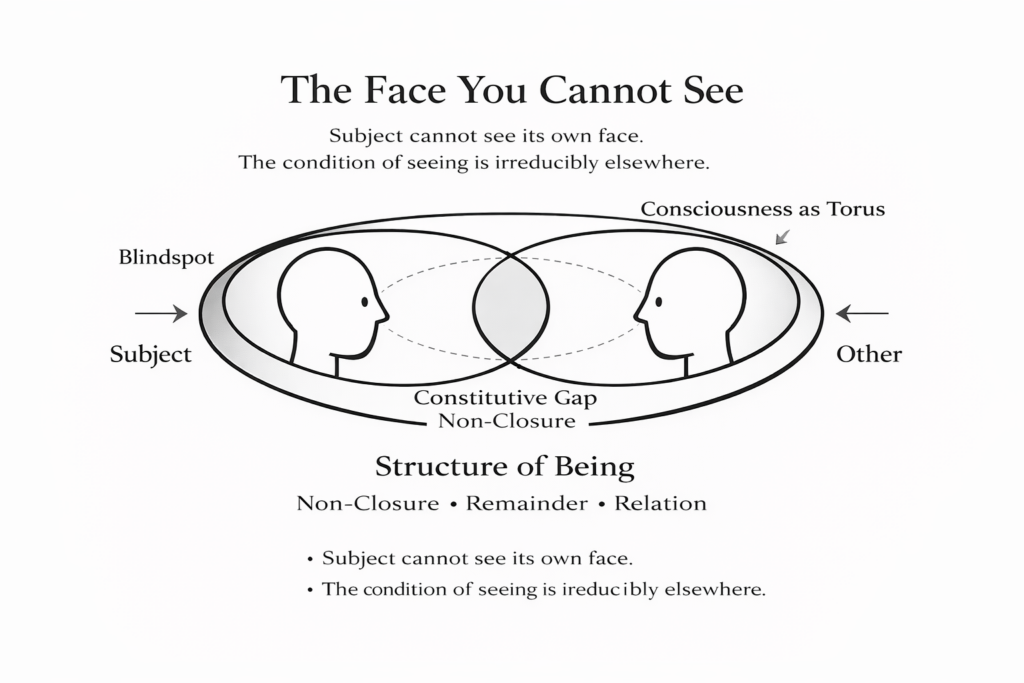
This is not a trivial perceptual limitation. It is not like failing to see behind a wall because of where one happens to be standing. The point is deeper. Your face is not simply one more object that has not yet come into view. It is the site from which view itself is organized. The face is not absent from your visual field by accident; it is absent because you are not primarily an object in your own field of vision. You are that through which the field opens.
This means that the self does not begin as self-presence. It begins with an exclusion.
The face is where identity is read, where recognition takes hold, where the question “who is that?” ordinarily finds its answer. Yet the place where one is most publicly located is the place one cannot directly inhabit as an object of sight. The site of appearance is structurally withdrawn from the one who appears.
This essay takes that withdrawal as ontologically decisive.
The face you cannot see is not merely the beginning of a psychology of self-alienation. It is the beginning of ontology. It reveals that finite being is constituted not by closure but by non-coincidence with itself. Being does not begin from transparent presence. It begins from an unseeable condition that enables everything else.
That is the thesis in its simplest form.
II. Gödel Beyond Formalism
Gödel’s incompleteness theorems are usually interpreted as technical results concerning formal systems. In any sufficiently rich and consistent formal system, there are truths that cannot be proven from within the system itself. This reading is correct, but insufficient.
What Gödel formalized in mathematics belongs to a more general structure: a bounded system cannot generate, from entirely within itself, the final condition of its own closure. The principle that would complete the system cannot appear within the same order as the items governed by it. Completion remains structurally displaced.
What if this is not only a truth about arithmetic?
What if it describes finite being as such?
A finite being cannot fully contain the condition of its own appearing. The ground of appearance does not itself appear in the same manner as what appears. The eye does not see itself seeing. The subject does not encounter itself as immediate object without mediation. The face does not arrive within its own field.
This is not analogy in the weak sense. It is structural identity across registers.
| Formal register | Ontological register |
|---|---|
| Formal system | Finite being |
| Axioms | Conditions of constitution |
| Theorems | Manifest appearances |
| Unprovable truths | Structurally inaccessible conditions |
| Incompleteness | Constitutive non-closure |
The missing proof and the unseeable face are versions of the same form. In each case, what is most necessary cannot appear as one more element among the elements. It is not absent because the system has failed. It is absent because its absence is what allows the system to function as a system at all.
In this sense, incompleteness is not deficiency. It is generative.
One must be careful here. The claim is not that formal logic magically “proves” a metaphysics in any simple way. The claim is that Gödel gives rigorous expression to a structure already visible in phenomenology: finite orders do not achieve self-grounding closure. The theorem is a formal crystallization of a broader ontological truth.
Your unseeable face is the lived form of incompleteness.
III. Fantasy as Ontological Primitive
The name I give to this constitutive non-closure is Fantasy.
By Fantasy I do not mean fiction, escape, projection, or unreality. I mean something more primitive: the irreducible interval between formation and completion. Fantasy is the persistence of the gap within every attempt at closure. It is the structure by which being approaches coherence without ever exhausting itself in it.
A thing appears. A boundary forms. An identity stabilizes. A concept seems to hold. But no formation coincides fully with itself. Something remains outside the frame that made the frame possible. That remainder is not added afterward. It belongs to the act of formation from the start.
Fantasy names this.
A philosophy that begins from substances asks what things are made of. A philosophy that begins from identity asks what a thing is. A philosophy that begins from process asks how it changes. My proposal is different: the primitive fact is not substance, identity, or process, but non-closure. What is most basic is not the finished object but the interval that prevents finished objecthood from ever being ultimate.
Fantasy is therefore ontological before it is psychological.
Psychological fantasy is one expression of this deeper structure, but not its origin. The mind fantasizes because reality itself is not simply present in closed completeness. Reality is composed of stabilizations that do not finally close. Desire, imagination, repetition, idealization—these are downstream phenomena of a more primordial incompletion.
Fantasy is the gap that generates form.
IV. Shape Rather Than Substance
If being is non-closed, then ontology must become geometric or topological rather than substantialist.
Things are not best understood as isolated units possessing fixed inner identities. They are better understood as shaped formations: boundaries, cuts, folds, holes, loops, intervals, relations of inside and outside. What something is cannot be separated from how it is bounded and how that boundary fails to become absolute.
A subject, for example, is not a sealed interior substance. A subject is a structured field with an exclusion at its center. A world is not a neutral container of objects. It is a shaped disclosure organized from a position that cannot fully appear within it. Identity is not the cause of form; identity is the after-name given to temporarily stabilized form.
This is why the face matters.
The face is the shape of identity for others, yet for the subject it is a hole in immediate appearance. The most recognizable surface of the self is also the place where self-presence fails. Identity is therefore not a sealed circle. It is a coherence organized around an exclusion.
This point can be generalized.
The whole is never fully whole. It is coherent, but coherence is not closure. Every form is held together by what it cannot absorb. This is what I mean when I say that being takes shape without closure.
V. Consciousness as Topological Formation
The dominant metaphors of consciousness remain misleading. We often imagine consciousness as if it were located inside a body like a pilot in a vessel, or inside a head like a theater containing mental images. But phenomenology suggests something more complex.
When I open my eyes, I do not find myself inside a box looking outward. I find a field of appearance opening before me. This field has edges, horizons, occlusions, a front, a behind, and a limit. What is given is not “myself as object plus world as environment,” but a structured disclosure whose organizing source does not itself appear in the same way as what appears.
The invisible side of the field is not nothing. Nor is it merely empty extension. It is the condition of the visible. The subject belongs less to the contents of the field than to its structuring limit.
This suggests that consciousness is topological.
A useful figure here is the torus: a surface organized around a hole, continuous yet nontrivial, structured by circulation around an absence. The hole is not an accidental defect in the torus. It is constitutive of the shape. Remove it, and the topology changes entirely.
Likewise for subjectivity. The unseeable face functions as a constitutive hole. Seeing circulates around what cannot be seen directly. The subject is not a solid point but a formation organized by a missing center.
This is why self-presence never completes itself. Consciousness does not fail to become fully transparent because it is empirically underdeveloped. It fails because it is not the kind of thing that could be fully self-contained in the first place. It is topologically structured around an absence that is productive.
The hole is what generates the surface.
VI. The Other’s Face
If I cannot directly see my own face, where does the face become real?
In the other.
The other’s face is not simply another object among objects. It is the place where the structure of self-externalization becomes visible. What I cannot possess directly as immediate self-presence returns in the face of the other as encounter, claim, recognition, limit, and reality.
This is not a moralistic addition to ontology. It is ontology itself taking interpersonal form.
The real is not first found in self-reflection. Reflection tends toward regress. Mirror after mirror, representation after representation, image chasing image. Each attempt to secure self-presence produces one more layer of mediation. The more desperately one seeks oneself as object, the more one enters a recursive trap.
But the other interrupts this trap.
The other’s face is not my reflection. It is not a controlled duplication of myself. It arrives with opacity, independence, and irreducible exteriority. In this sense, the other is more ontologically real than self-image. The other is the place where the self’s excluded condition returns, not as possession, but as relation.
One cannot become complete by seeing oneself. One becomes real by encountering what exceeds oneself.
This is why relation precedes identity.
Identity is not the starting point from which relation is then added. Relation is the condition under which any stable identity can emerge at all. The subject becomes coherent not by enclosing itself, but by being exposed to that which it cannot reduce to itself.
The other’s face is therefore not an obstacle to ontology. It is one of its highest revelations.
VII. Sexual Difference as Generative Asymmetry
This relational ontology deepens when we consider sexual difference.
Most contemporary discussions of sexual difference oscillate between biology and social construction. My argument moves elsewhere. Sexual difference is not merely a set of empirical classifications, nor merely an ideological projection. It names a more primary asymmetry in the way being becomes generative.
Non-closure does not remain abstract. It must become lived, embodied, and repeatable. Sexual difference is one of the first sites where this happens. It is the point at which asymmetry becomes productive rather than merely negative.
In the larger architecture of my philosophy, this means that sexual difference is not just one topic among others. It is a mode through which the open whole becomes temporal, relational, and world-forming.
I do not mean that man and woman are reducible to simplistic stereotypes. Nor do I mean that every human life can be neatly contained in a rigid dualism. The point is subtler. Sexual difference names structurally distinct modes of relation to openness, incision, field, vector, receptivity, return, and form. These are topological rather than merely sociological categories.
If the classical metaphysical image is the closed circle, then sexual difference belongs to the attempt to think how coherence emerges without that closure. It is a primary asymmetry through which form is generated without becoming self-identical totality.
This also helps explain why sexuality exerts such ontological pressure. Sexuality is not merely one desire among others. It is charged because it gathers multiple structural tensions at once: self and other, boundary and crossing, identity and dissolution, finitude and attempted continuity. It is a privileged site where the gap is lived rather than merely thought.
Sexuality matters because non-closure is embodied there.
VIII. Technology, Recursion, and the Return of the Subject as Object
Modern technological culture intensifies these structures rather than escaping them.
Screens, feeds, photographs, social profiles, metrics, surveillance, and machine representation all multiply the ways in which the subject is returned to itself as image and object. One sees oneself being seen, performs oneself for imagined audiences, tracks oneself through quantified abstractions, and becomes increasingly dependent on externalized mirrors.
This does not produce true self-presence. It produces recursion.
The more the subject attempts to secure itself through representation, the more it confronts the impossibility of final closure. Every profile excludes something. Every summary creates remainder. Every representation stabilizes one contour while multiplying ambiguity elsewhere.
This is why digital culture produces both intensified identity-policing and intensified instability. The same systems that demand sharper categorization also expose the subject to endless displacements, reflections, and cross-contextual selves. The result is not closure, but a hypertrophy of closure-attempts.
The digital order is therefore not a departure from ontology. It is a technological acceleration of an ontological structure already present in finite being.
One might say: the age of representation has not overcome Fantasy. It has industrialized it.
IX. Theology and the Limit of Closure
What, then, of God?
If finite being is constituted by incompleteness, one may ask whether closure belongs nowhere at all, or whether it belongs only at the limit. Here theology enters.
In the theological register, God names the possibility of self-seeing that finite beings cannot sustain. God would be that which contains the conditions of its own appearing, that which is not divided from itself by the kind of structural exclusion that marks finite subjects.
But for finite beings, such closure is not salvation in any direct sense. It is annihilation.
A finite being that became fully self-contained, fully self-seeing, fully closed would cease to be a subject in the ordinary sense. It would no longer exist in the generative openness of relation, desire, world, and becoming. It would collapse into completed objecthood.
That is why closure must be thought carefully. Closure is not simply a good withheld from us. For finite life, non-closure is not a curse but a condition of animation. The gap is not what deprives us of being; it is what makes being dynamic, relational, and alive.
In theological language, one might say: the divine can close because the divine is not finite. But finite beings live only insofar as they remain open. The command is therefore not “be complete,” but “remain in the life of incompleteness.”
The gap is where life occurs.
X. The Whole With a Hole
We can now restate the entire argument more clearly.
Reality is not built from finished objects. It is built from non-closure. Forms emerge, stabilize, and cohere, but none eliminates the remainder that made form possible. The face one cannot see is the phenomenological clue to this deeper structure. Gödel provides its formal analogue. Topology gives it shape. Sexual difference embodies its asymmetry. Technology intensifies its recursions. Theology marks its limit.
What appears whole is not therefore false. But the whole is real only as an open whole. It is coherent without becoming sealed. It gathers itself without abolishing the gap.
This is why the image of the closed circle is misleading. It tempts metaphysics toward an impossible ideal of self-identical totality. A more adequate image would be something that appears circular only through the coordinated relation of lines that never finally close in upon themselves. Coherence arises not by erasing non-closure, but by organizing it.
The whole has a hole.
This is not a slogan. It is an ontological principle.
A closed whole would be dead whole. A living whole is structured by what it cannot entirely absorb. Every being, every system, every identity, every essay, every representation participates in this law. None arrives as complete. Each is a local stabilization around an irreducible outside.
To write from this position is not to celebrate vagueness or confusion. It is to refuse the false prestige of total closure. Precision is still required, perhaps more than ever. But precision must not pretend to abolish the constitutive gap. The task is to think clearly from within incompleteness rather than to fantasize about standing beyond it.
XI. Conclusion: The Face as Ontological Law
You cannot see your own face.
From this modest beginning follows a radical consequence: finite being is not self-grounding presence. It is structured by constitutive non-appearance. What is most necessary to the system is not fully available as one more item within the system. The condition of appearance does not simply appear.
This is what Gödel formalized in one register and what phenomenology discloses in another. The incompleteness theorem and the unseeable face are not identical statements, but they are expressions of a common structure: no finite order encloses its own condition of completion.
Once this is seen, much else shifts. Identity no longer appears primary. Relation does. Substance yields to shape. Closure yields to coherence. Fantasy ceases to mean illusion and becomes instead the name of the gap that allows the world to take form without ever becoming absolutely finished.
The face you cannot see is therefore not a tragic absence. It is the opening through which the real becomes possible. Because you cannot fully coincide with yourself, you can encounter others. Because the system cannot close, it can generate. Because being is incomplete, existence remains alive.
Non-closure is not what remains after reality fails.
Non-closure is the form of reality itself.
Why This Idea Matters & May Be Exceptional
This framework is not simply another interpretation layered onto existing philosophy. Its ambition is to reorganize multiple domains—logic, phenomenology, topology, sexuality, and technology—around a single structural claim:
that non-closure is not a limit of reality, but its condition.
Most philosophical systems begin from something stable: substance, identity, process, structure. Even when they critique stability, they tend to replace it with another positive foundation. This approach moves differently. It begins from what cannot be completed.
The claim is not that systems fail to close.
The claim is that closure is structurally impossible for finite being—and that this impossibility is productive.
This produces several consequences that distinguish the framework:
1. It Unifies Formal Logic and Lived Experience
Gödel’s incompleteness theorem is typically confined to mathematics. Phenomenology is typically confined to experience. This framework shows that both express the same structure:
- The system cannot prove itself
- The subject cannot see its own face
These are not analogies. They are two expressions of a single ontological law.
This move collapses the divide between abstract formal systems and immediate lived experience, showing that both are governed by the same principle of non-closure.
2. It Reverses the Priority of Identity
Most theories assume:
identity → produces experience
This framework proposes the inverse:
structured incompleteness → produces identity
Identity is not primary. It is a stabilization—an after-effect of boundary, relation, and exclusion. What appears as self-presence is actually organized around what cannot be included within it.
This explains:
- why identity is unstable
- why contradiction persists
- why self-knowledge never fully resolves
Identity is not broken. It is structurally incomplete.
3. It Reinterprets “Lack” as Generative
Traditions like psychoanalysis (e.g., Lacan) emphasize lack. But lack is often treated as absence, deficit, or wound.
This framework reframes the gap entirely:
the gap is not what is missing from being—
it is what produces being.
Fantasy, in this sense, is not illusion. It is the real condition of formation. Every object, concept, or identity emerges through a boundary that never fully closes.
This shifts philosophy from:
- deficit → to generation
- absence → to structure
- failure → to condition
4. It Grounds Ontology in Shape Rather Than Substance
Instead of asking “what is being made of?”, this system asks:
how does being take shape?
Being is defined by:
- boundaries
- holes
- folds
- relations
- exclusions
This allows a topological ontology where:
- the subject is structured by a blind spot
- consciousness is organized around a hole
- the world appears through an excluded center
The face you cannot see is not a metaphor.
It is the simplest instance of this structure.
5. It Makes Relation More Fundamental Than Self
Most philosophy begins with the self and then adds relation.
This framework shows: the self is only coherent because of relation.
You cannot see your own face.
The face becomes real only in the other.
This means:
- the real is not found in self-reflection
- the real appears in encounter
- relation is ontologically prior to identity
This has implications not just for philosophy, but for ethics, perception, and social structure.
6. It Explains Modern Technological Reality
In a world of:
- mirrors (screens)
- recursive identity (profiles)
- constant self-representation
we are increasingly trying to “see our own face.”
This framework explains why that fails:
- every representation produces more remainder
- every attempt at closure produces more recursion
- the system intensifies without resolving
Modern digital life is not an anomaly.
It is an amplification of ontological structure.
7. It Provides a Single Generative Principle
The strongest claim is methodological:
one principle explains multiple domains.
Non-closure accounts for:
- Gödel (logic)
- the face (phenomenology)
- the torus (topology)
- desire and sexuality (libidinal structure)
- technology (recursion and representation)
- theology (closure at infinity)
Few philosophical systems attempt this level of compression without collapsing into vagueness.
The strength here is that the principle remains precise:
no finite system contains the condition of its own completion.
Everything else unfolds from that.
Final Statement
What appears as limitation is actually structure.
What appears as absence is actually generative.
What appears as failure to close is the reason anything appears at all.
The face you cannot see is not what is missing from reality.
It is what makes reality possible.