
Word count: 4,133
Toward an Ontology of Asymmetry, Recognition, and Symbolic Form
Abstract
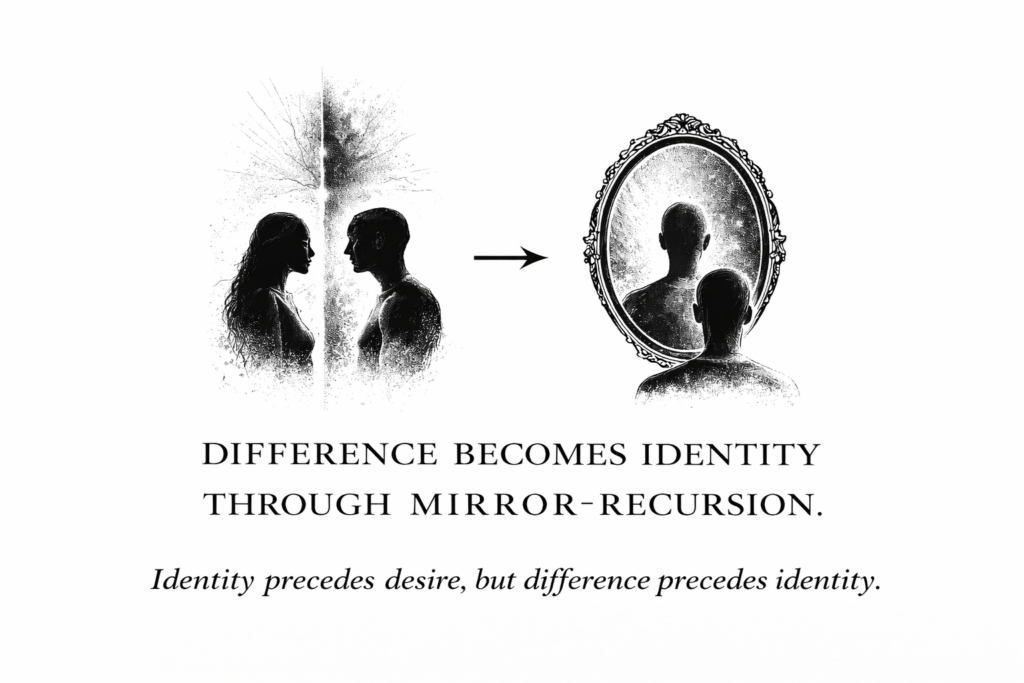
This essay argues that sexual difference is not a secondary social classification or merely biological distinction, but a primary ontological asymmetry through which identity, recognition, and symbolic order become possible. Against models that treat identity as primitive and sexuality as derivative, the argument proceeds by inversion: difference precedes identity, and recognition organizes difference into stable symbolic form. The central operator in this account is the Mirror: any structure that returns the subject to itself as an object of recognition. Once mirror-recursion emerges, sexuality no longer appears merely as bodily interaction or reproductive function, but as a formally organized domain structured by gaze, salience, boundary, and negation. Identity labels then arise not as primordial truths of the self, but as stabilized summaries of recurrent boundary patterns.
Modern representational systems—screens, social media, pornography, surveillance, and AI—intensify this mirror-recursion, thereby amplifying self-objectification, identity rigidity, and libidinal organization. The essay develops a systematic account of these relations and argues that sexuality is best understood as a high-gain ontological boundary zone through which being encounters its own outside and reorganizes itself. Sexual difference is thus neither a mere topic within ontology nor an ideological after-effect of symbolic systems. It is one of the original asymmetries through which symbolic order is generated at all.
I. Introduction: Reversing the Order of Explanation
Most contemporary theories of sexuality begin too late.
They begin with already-formed individuals, already-named identities, already-stabilized symbolic categories, and ask how sexuality fits into them. In such accounts, identity is treated as primitive, sexuality as an attribute of the subject, and difference as something that occurs between entities already constituted in advance. The explanatory order therefore tends to run as follows: self, then identity, then desire, then sexual classification.
This order is mistaken.
The central argument advanced here is that sexual difference is not derived from identity, but identity is derived from sexual difference once it passes through structures of recognition. Difference does not emerge after stable identities have been formed. Difference is what first generates the field within which identity becomes possible. What appears later as a fixed identity category is in fact a compressed summary of more fundamental dynamics: asymmetry, salience, boundary, negation, gaze, and recursive self-relation.
This requires a more radical starting point. Sexual difference must be understood not as one content among others inside culture, but as a generative asymmetry that precedes and organizes symbolic order. It is not merely descriptive. It is productive. It does not only classify bodies or social roles. It generates positions, relations, exclusions, recognitions, and eventually identities. In this sense, sexual difference belongs less to social taxonomy than to ontology.
The task, then, is not to add another theory of sexuality to the archive of existing theories. It is to relocate the point at which sexuality becomes philosophically thinkable. Sexuality must be understood as a structural domain that arises when embodied asymmetry enters the circuit of mirror-recognition and becomes organized under gaze, boundary, and recursive self-return. Only then do identities appear. Only then do labels seem ontological. Only then does the subject become an object to itself.
The wager of this essay is that a large range of phenomena usually treated separately—sexual identity, shame, self-objectification, negation, media intensification, digital representation, and cultural volatility—can all be explained through a single conceptual architecture. That architecture begins from five claims:
- Sexual difference is ontologically primary.
- Recognition requires asymmetry prior to identity.
- Mirror-recursion returns the subject to itself as object.
- Identity stabilizes through boundary and negation.
- Modern technologies intensify mirror density and therefore intensify sexuality as structured recursion.
What follows is an attempt to articulate that architecture with greater precision.
II. Sexual Difference as Primary Asymmetry
Sexual difference is often misdescribed because it is interpreted either too biologically or too sociologically. In the first case, it becomes a merely empirical distinction between body types. In the second, it becomes a discursive category imposed by institutions and norms. Both approaches miss the deeper claim.
The stronger claim is that sexual difference is a primary asymmetry of embodied existence. It is one of the first differences that does not collapse into simple symmetry or reversible exchange. It is lived, structural, generative, and relational. It does not exist as an isolated attribute of a solitary subject; it exists only in relation. Yet it is not reducible to relation in the thin sense of external comparison. It is a constitutive asymmetry through which the possibility of generation appears.
To say that sexual difference is ontologically primary is not to say that all beings are reducible to ordinary gender categories, nor that culture plays no role in how sexual identities are formed. It is to say something more precise: before there are named subjects and before there are symbolic codings of identity, there is an embodied asymmetry that introduces irreversible relational structure into experience.
This asymmetry is philosophically significant for several reasons.
First, it is irreversible. It is not merely the difference between two interchangeable terms. It is a difference in the mode of relation itself. Second, it is generative. It bears a privileged relation to reproduction, continuity, inheritance, and temporal extension. Third, it is embodied. It is not merely conceptual difference but lived asymmetry. Fourth, it is relationally constituted. It exists only through encounter, not as a sealed interior property. Fifth, it is not reducible to logical binary abstraction. Formal oppositions such as 0/1 are already later symbolic stabilizations of a deeper asymmetry that was first lived before it was abstracted.
This last point is especially important. Binary code, formal distinction, and symbolic identity are not ontological primitives. They are downstream compressions of a more primordial asymmetry. The lived difference comes first; the symbol that codifies it comes later. In this respect, sexual difference is not one category inside the symbolic order. It is one of the preconditions for symbolic order as such.
Difference, then, is not what identity later manages. Difference is what gives identity something to manage in the first place.
III. The Mirror as Generative Operator
If sexual difference is primary, how does it become structured sexuality rather than merely embodied asymmetry?
The answer is the Mirror.
By Mirror is meant not only literal reflective surfaces. The Mirror is a general operator: any structure that returns the subject to itself as an object of recognition. Mirrors can therefore take many forms: the gaze of another person, language, memory, digital representation, photographs, social media profiles, pornographic framing, AI interaction, or any representational medium in which the subject becomes visible to itself from outside.
The importance of this concept is difficult to overstate. Without mirror-recursion, there may still be bodies, desire, reproduction, attraction, and interaction. But there is not yet sexuality as a symbolic field of self-related identity. There is no “I am this,” no “I am not that,” no stable categorical relation of the self to its own desire. There is behavior, but not yet sexual predication in the full sense.
Mirror-recursion produces a decisive transformation: it converts lived asymmetry into recognizable form. The subject no longer simply desires or acts. It begins to encounter itself as the kind of being that desires in a certain way. This is the birth of self-objectification, and with it the birth of sexuality as structured domain rather than merely bodily event.
A crucial consequence follows: sexual identity is impossible without some form of mirror structure. Identity labels such as “straight,” “gay,” “bi,” “dominant,” “submissive,” or any equivalent predication require that the subject become available to itself as an object of symbolic description. That availability is not immediate. It is mediated by recursive return. The Mirror is therefore the operator through which sexual difference becomes symbolically organized.
This is also why the Mirror is more than a metaphor. It is a general mechanism that explains multiple domains at once: identity formation, shame, pride, self-surveillance, erotic self-awareness, digital self-representation, and media-driven intensification. A powerful theory often turns on a single operator that reveals hidden continuity across seemingly separate phenomena. Here, that operator is mirror-recognition.
The subject becomes sexual in a new sense when it sees itself being seen.
IV. Identity Is Not Primitive
Once mirror-recursion is in place, a common illusion takes hold: identity appears original.
This is one of the central errors corrected by the present framework. Sexual identity labels are not ontological primitives. They are not the deep interior causes from which behaviors and desires naturally flow. They are stabilized outputs: compressed summaries of recurrent salience patterns, boundary formations, and gaze-structured repetitions.
The conventional model assumes:
identity → behavior → difference
The model developed here reverses that order:
difference → salience → boundary → stabilization → identity
This inversion matters because it changes what counts as fundamental. Identity is not an essence hidden inside the subject. It is a symbolic condensation that forms after the subject’s erotic, perceptual, and relational patterns have already been organized. The label does not initially produce the pattern; the pattern produces the label. Only afterward does the label return as a control variable that helps preserve the pattern.
In this way, identity functions like a feedback mechanism. Once installed, it exerts real force. It shapes future action, guides self-interpretation, organizes belonging and exclusion, and hardens certain boundaries. But its causal efficacy is secondary. It is not the source. It is the result that subsequently begins acting like a source.
This explains why identity often feels ontological even when it is historically contingent. A stabilized output, once recursively fed back into the system, can masquerade as an origin. This is not false consciousness in a simplistic sense. It is a structural effect of symbolic stabilization.
The declaration “this is what I am” often names not an original essence, but a compressed after-image of repeated exclusions, intensities, recognitions, and positional recursions.
Identity, then, is real. But it is not primitive.
V. The Boundary–Salience–Gaze System
To explain how patterns stabilize before they become labels, a more formal account of the dynamics involved is required. The present framework offers one in the form of a boundary–salience–gaze system organized around several basic operators.
These may be summarized as follows:
- Embodied Field (E): the full lived situation in which the subject exists
- Salience (σ): what becomes affectively or motivationally foregrounded
- Gaze Position (π): the positional structure of seeing, being seen, self-seeing, or imagined spectatorship
- Boundary Operator (B): the distinction between admissible and excluded transitions
- Recursion / Mirror (M): the return of the subject to itself as object of recognition
Sexuality, on this model, is not best described as object-choice alone. It is better described as salience dynamics constrained by boundary under gaze recursion.
This formulation is powerful because it explains a wide range of otherwise puzzling phenomena.
Why can the same object be erotically intense in one context and not in another? Because salience is not fixed independently of position. Why can a stable identity persist despite occasional exceptions? Because boundaries often stabilize faster than positive enumerations of all desires. Why do public and private selves diverge so sharply? Because gaze position changes the structure of the experience even when the object remains constant. Why does sexuality become culturally volatile under representational saturation? Because mirror-density increases recursive self-relation and therefore boundary pressure.
The theory’s strength lies in its refusal to reduce sexuality to static preference. Desire is positional, recursive, and topological. It depends not only on what is seen, but on who is seeing, who may be seeing, whether the subject is seeing itself, and what boundaries organize those positions.
Sexuality is thus a field of patterned relation rather than a list of contents.
VI. Negation Dominance and the Stability of Identity
One of the most original insights in this framework is the claim that identity stabilizes more rapidly through negation than through positive self-description. Identity is often anchored less by what one affirmatively includes than by what one categorically excludes.
This may be called negation-dominant stabilization.
Why is this important? Because it explains a great deal about how sexual identities feel firm even when lived desire remains more variable than the labels suggest. A person may be unable to specify the full range of what attracts them, but may nevertheless be quite clear about what is not admissible. The prohibited, the unthinkable, the disallowed, the boundary-crossing possibility—these often become more structurally important than the positive list of accepted objects.
This means that identities are frequently stabilized not by full positive enumeration but by strong prohibitive edges. A subject knows itself by what it refuses to become. In such systems, exceptions do not immediately dissolve the identity, because the negating structure remains in place and interprets the exception as anomaly rather than transformation.
This insight has broad explanatory power. It clarifies why:
- sexual categories are so affectively charged,
- boundary violations become disproportionately significant,
- public declarations of identity are often structured by denial,
- and private exceptions do not necessarily alter the symbolic form of the identity.
Negation is therefore not secondary. It is one of the primary mechanisms through which identities become stable enough to appear natural.
The subject is not first a thing that then negates. It often becomes a thing through negation.
VII. Gaze Topology and Positional Desire
Another decisive feature of the system is its treatment of the gaze.
Desire is often wrongly understood as if it were a direct line between subject and object. But the erotic field is rarely that simple. The same external object can acquire radically different intensity depending on the subject’s position within the gaze.
Several positions matter here:
- outward seeing
- being seen by another
- seeing oneself as seen
- imagining an audience
- occupying a triangulated or spectator position
These shifts alter the structure of desire without requiring any change in the object-class itself. This is one reason many reductive object-choice models fail to explain actual erotic life. The erotic charge of a scene depends not only on content but on its positional topology.
A subject may desire not simply an object, but an arrangement of visibility. Shame, exhibition, voyeurism, reserve, performance, concealment, and self-framing all emerge from such topologies. Public/private divergence becomes structurally intelligible. So does the transformation of desire under media environments.
The relevant question is not only “what is desired?” but also “from what position is the desire organized, under whose gaze, and in what visible form?”
This is why gaze must be treated not as an ornament to desire but as one of its central operators.
VIII. Modern Technology and the Amplification of Mirror Density
The contemporary relevance of this theory becomes especially clear in relation to technology.
Modern representational systems dramatically increase what may be called mirror density. Screens, platforms, dating apps, surveillance systems, pornography, image archives, AI interfaces, and algorithmic self-presentation all return the subject to itself again and again as object, image, category, profile, and behavioral trace.
This does not leave sexuality untouched. On the contrary, it intensifies it at the structural level.
As mirror density increases:
- recursion intensifies,
- self-observation becomes more constant,
- boundary pressure rises,
- identities become more explicit and more policed,
- sexuality becomes more mediated by symbolic framing and self-relation.
This helps explain several apparently contradictory modern tendencies. Why does identity become both more fluid in discourse and more rigid in self-presentation? Why do subjects become simultaneously more experimental and more categorically defined? Why does pornographic saturation produce not simple liberation but heightened compulsion, sharper boundary anxieties, and intensified self-objectification?
Because modernity does not abolish the mirror. It multiplies it.
The contemporary subject is surrounded by structures that return it to itself. Under such conditions, sexuality is not merely expressed; it is recursively reorganized. Desire becomes more self-conscious, more visible, more categorized, more surveilled, and more dependent on representational loops.
Technology therefore does not simply add new content to sexuality. It changes the structure through which sexuality is lived.
IX. Structural Feminization Through Mirror
A more provocative implication of this framework is the claim that mirror-recursion produces a form of structural feminization. The claim requires careful formulation.
The thesis is not that mirror-saturated culture literally transforms everyone into women, nor that femininity is reducible to surface appearance. The point is rather that the position of being-seen, self-seen, and recursively returned to oneself as visible object becomes increasingly central under modern representational conditions.
In this sense, the term “feminine” names a positional structure rather than a stereotype. It names a mode of subjectivity in which appearance, visibility, and self-objectification become constitutive. As mirror density increases, subjects are drawn toward this position regardless of their explicit identity labels. They become objects to themselves. They internalize the gaze. They organize themselves under conditions of exposure.
This may reorganize desire even without a formal shift in identity. It may alter what is salient, what is shameful, what is watchable, and what counts as attractive or permissible. A structural shift occurs before a categorical shift is acknowledged.
The usefulness of this concept is that it explains how technological modernity can transform desire at the level of positional structure without necessarily changing declared identity categories. It provides an account of reorganization beneath stable labels.
The label, once again, arrives late. The structural shift comes first.
X. Sexuality as the Engine of Becoming
At the widest metaphysical level, sexuality in this framework is not merely one domain of life among others. It is a privileged boundary zone where systems encounter their own outside and reorganize themselves.
This is why sexuality bears such intensity. It is not simply socially overinvested. It matters because it gathers together some of the deepest structures of finite being:
- self and other,
- inside and outside,
- identity and transformation,
- prohibition and crossing,
- embodiment and symbolic order,
- repetition and novelty.
Sexuality is therefore a high-gain site of ontological reorganization. It is where difference becomes productive. It is where boundaries are both enforced and tested. It is where recognition and negation acquire unusual force. It is where systems press against their own limits.
In this sense, sexuality is not simply about reproduction or object preference. It is about the way being crosses its own edges.
This claim does not reduce everything to sex in a vulgar sense. It elevates sexuality to a metaphysical function. Sexuality is the boundary zone through which embodied beings become more than fixed identities. It is the region where the self risks instability and where structure becomes generative rather than merely repetitive.
It is, in short, one of the engines of becoming.
XI. The Larger Vision
The broad philosophical architecture implied by this theory can now be stated clearly.
- Difference comes first.
- Recognition organizes difference.
- Mirror-recursion returns the subject to itself as object.
- Boundary and negation stabilize this recursive field.
- Identity crystallizes as a symbolic compression of those stabilizations.
- Representation intensifies recursion.
- Technology multiplies representation.
- Sexuality becomes the central engine through which these reorganizations take place.
This is not simply a theory of identity, nor simply a theory of desire, nor simply a theory of media. It is an attempt to think all three together from a deeper principle. What unifies them is not content but structure: asymmetry, return, boundary, negation, and recursion.
From this perspective, the great error of many contemporary theories is to begin from labels rather than from the processes that generate labeling. They begin at the level of stabilized symbolic outputs and then mistake those outputs for origins. This framework reverses that mistake. It asks what must already be in place before a subject can say “I am this.”
The answer is: embodied asymmetry, a mirror, a gaze, a boundary, a prohibition, and a recursive loop.
Identity is the name given after the system has already happened.
XII. Conclusion
The central argument of this essay is that sexual difference is a primary ontological asymmetry rather than a secondary category. It precedes identity and symbolic representation, and once taken up into mirror-recognition, it generates a structured domain of sexuality organized by salience, gaze, boundary, negation, and recursion. Identity labels are not primitive truths of the self but stabilized summaries of recurrent patterns that later return as control variables. Modern technological systems amplify these dynamics by multiplying mirror-density and intensifying recursive self-objectification.
The result is a philosophy in which sexuality is no longer treated as one content region among others, but as a generative boundary zone through which being reorganizes itself.
This has several consequences.
It means that identity must be interpreted as derivative rather than originary.
It means that sexual difference cannot be reduced either to biology or discourse.
It means that desire must be treated topologically and positionally rather than merely as object-choice.
It means that modern media environments are not peripheral to sexuality but central to its contemporary organization.
And it means that the subject is most intelligible not as a sealed interior essence, but as a recursive structure produced through relation to what exceeds it.
The strongest statement of the thesis is therefore this:
Sexual difference is the first irreducible embodied asymmetry through which recognition becomes possible; mirror-recursion transforms that asymmetry into structured sexuality; and from that field, identity, symbolic order, and modern representational life emerge.
Why This Idea Matters & May Be Exceptional
- It starts deeper than identity.
Most theories begin with the subject already formed. This one begins with asymmetry, recognition, and recursive self-relation. - It makes sexual difference generative.
Sexual difference is not treated as a label inside an already constituted world, but as a primary asymmetry through which identity and symbolic order emerge. - It introduces a genuine mechanism: the Mirror.
The Mirror is not a metaphor. It is the operator by which the subject becomes an object to itself. - It explains identity without making identity primary.
Identity appears as a stabilization, not an origin. That is why it can feel essential while remaining historically variable. - It shows how labels are produced.
Difference is organized through salience, boundary, gaze, and recursion; identity arrives later as a symbolic compression of those processes. - It explains contradiction without collapsing structure.
Exceptions, anomalies, and splits between public and private life do not refute identity; they reveal how identity is stabilized. - It identifies negation as structurally decisive.
Subjects often become what they are by drawing hard lines around what they will not become. - It treats desire as positional.
Desire is not just about objects. It is shaped by visibility, self-seeing, being seen, and the topology of the gaze. - It explains why modern media changes sexuality.
Screens, pornography, surveillance, social media, and AI do not simply represent desire; they intensify mirror-recursion and reorganize it. - It makes sexuality ontologically central.
Sexuality is not reduced to preference or reproduction. It becomes a privileged site where being encounters its own outside and reorganizes itself. - It has unusual conceptual economy.
A small set of operators—difference, mirror, gaze, boundary, negation, recursion—explains a wide range of phenomena. - It is architectonic.
It does not add one more opinion to the discourse. It attempts to reorder the discourse by changing what counts as fundamental.
Why It Is Stronger Than Standard Sexuality Models
- It goes beyond biology.
Biology can describe bodies; it cannot by itself explain recognition, shame, symbolic identity, or recursive self-objectification. - It goes beyond constructionism.
Discourse can name and organize sexuality, but it does not explain the prior structures that make such organization possible. - It goes beyond preference models.
Object-choice models ask what is desired; this framework explains why desire changes when gaze, framing, and symbolic position change. - It goes beyond identity-first theories.
Identity is not the source of sexuality here. It is one of its later stabilizations. - It goes beyond behaviorism.
Repeated acts alone do not explain why sexuality acquires prohibition, shame, symbolic force, and existential weight. - It goes beyond flat psychoanalytic models.
It retains prohibition and mediation, but gives them a clearer architecture through mirror, salience, boundary, gaze, and recursion. - It goes beyond media theory in isolation.
It explains not only that media reshapes sexuality, but why: media multiplies the structures of recursive self-recognition.
Why It Can Claim Superiority
- It begins earlier in the chain.
It starts with asymmetry and recognition, not with labels or institutions. - It explains more with less.
A compact framework accounts for identity, desire, shame, self-objectification, symbolic order, and technological intensification. - It preserves embodiment without collapsing into essentialism.
It takes bodily asymmetry seriously without treating biology as the final explanation. - It preserves symbolism without collapsing into discourse.
It grants real power to naming and representation without making them absolute. - It explains rigidity and instability together.
Because identity is treated as stabilization, it can account for both hardened categories and persistent slippage. - It connects ontology, sexuality, and media in one system.
What are usually treated as separate problems become legible as one recursive structure.