A compressed summary of the argument
Word Count: 15,676
A Goal Is Not Yet a Gaze: A Relational Ontology of Body, Gaze, and World begins from a disagreement with Michael Levin, but the disagreement is not really the subject. Levin supplies the pressure. Topofantology supplies the architecture.
Levin’s work matters because it makes an old ontology increasingly difficult to defend. Cells, tissues, embryos, synthetic organisms, and multicellular systems routinely exhibit regulation, repair, memory-like persistence, morphogenetic competence, and adaptive behavior that cannot be understood by simply listing isolated parts. The Whole appears to do something the inventory does not explain. Levin is right to insist that biology contains forms of intelligence and agency far below the level at which philosophy traditionally becomes comfortable speaking about Mind.
The mistake begins one step later.
If the Whole cannot be found inside any isolated part, it does not follow that the Whole must have arrived from somewhere else. Irreducibility is not transcendence. The failure of reduction does not establish Platonic ingress. It establishes only that the ontology of isolated objects was too weak.
Topofantology inserts the missing possibility: relation can become generative.
Differences enter relation. Relations become consequential. Consequences become reciprocal. Reciprocal constraints begin to persist. The consequences of earlier interactions return as conditions of later interactions. A history forms. At some point, the participating processes no longer possess fully independent futures because what happens to each has become organized through what happens to the others.
That is where the book locates the beginning of Body.
A Body is not first defined by flesh, anatomy, enclosure, or material composition. It is persistent local consequential closure: a multiplicity sufficiently integrated that events can belong to one continuing history. Closure here does not mean isolation. A living Body must remain open to what it is not. It is closed enough to concentrate consequence and open enough to remain vulnerable to a World.
This immediately changes what “inside” means.
A boundary does not manufacture one absolute interior. A cell possesses spatial, metabolic, electrophysiological, developmental, regulatory, and historical interiors under different relations of consequence. It can simultaneously be an internally immense biological World and a single point in another state-space. Representation can compress a Being without exhausting it.
Hence one of the central claims of the book:
The cell has more than one inside.
This is not metaphorical pluralism. It is a consequence of relational ontology. What counts as internal depends upon which organization of consequence is being preserved. A Whole at one scale can become a Point at another without becoming ontologically simple. Compression is not reduction. Higher closure does not erase lower reality.
The One need not murder the Many in order to become real.
This principle becomes crucial when Topofantology moves from Body toward Mind. A Body can regulate itself without possessing a perspective. A system can maintain target states, minimize error, repair itself, and navigate a state-space without thereby possessing a here. This is the distinction condensed into the title:
A goal is not yet a Gaze.
A goal orders possible states according to something like actual and preferred. Gaze introduces a different asymmetry: here and there, near and far, available and withdrawn, visible and hidden, reachable and unreachable. The first concerns regulation. The second concerns perspective. Increasing competence along one dimension does not logically generate the other.
This is where the argument becomes more radical.
An environment is not yet a World.
Environment is what can affect a system. World is what can matter from somewhere.
Gaze is therefore not eyesight. It is not merely consciousness looking outward. It is the organization of availability through which an exterior becomes structured relative to a continuing Body. A Gaze produces a here, a horizon, and an elsewhere.
The book makes this precise through the map problem. Imagine a perfect third-person map containing every object, every distance, every causal trajectory, every body position, every coordinate. The location of the subject is marked perfectly.
Nothing spatial is missing.
And yet the map does not thereby contain:
I am here.
A third-person representation can specify the location of a subject without itself possessing that subject’s orientation. Perspective cannot be recovered merely by adding another coordinate because here is not an ordinary coordinate. It is the privileged consequential origin from which the distinctions of a World become organized.
Once there is a Gaze, another structure appears immediately: limitation.
To appear from somewhere is not to appear from everywhere.
Every finite presentation therefore gives rise to Face and Remainder. Face is not a false surface hiding a true object behind it. Face is the locally sufficient presentation through which one Being becomes encounterable by another. But no Face contains every relation through which that Being exists.
Participation exceeds presentation. Body exceeds every Face of Body.
Remainder is what follows from this non-exhaustion.
And then something stranger happens: another Face can answer.
The Other is not philosophically decisive merely because it is another object in my World. The decisive threshold occurs when another center appears from which I myself become a Face. Another Gaze can answer, reject, reinterpret, desire, remember, misunderstand, or surprise me. My World discovers that it is not sovereign.
This leads to one of the sharpest propositions in the text:
A World is partly defined by what it permits to look back.
At this point the theory of Mind becomes possible.
Mind is not identified with Gaze. Mind is organized relational openness: the organization through which what is spatially absent, temporally distant, remembered, symbolic, anticipated, imagined, or merely possible can nevertheless become consequential to a Body now. Gaze is the perspectival organization of that openness. Mind exceeds any single Gaze because Mind can carry what the present Gaze does not contain.
Memory makes yesterday consequential now. Anticipation permits tomorrow to alter present action before tomorrow exists. An absent person can reorganize a room. A feared diagnosis can alter the Body before it is confirmed. A fictional character can modify desire. A theory can change what becomes visible in an experiment.
Here Topofantology reaches Fantasy.
Fantasy is not opposed to reality. At the perspectival level, Fantasy is the organized availability of Otherwise: the capacity by which absence, possibility, negation, alternative, refusal, imagination, and counterfactual difference become consequential before becoming actual.
This returns the book to the wider architecture of Topofantology:
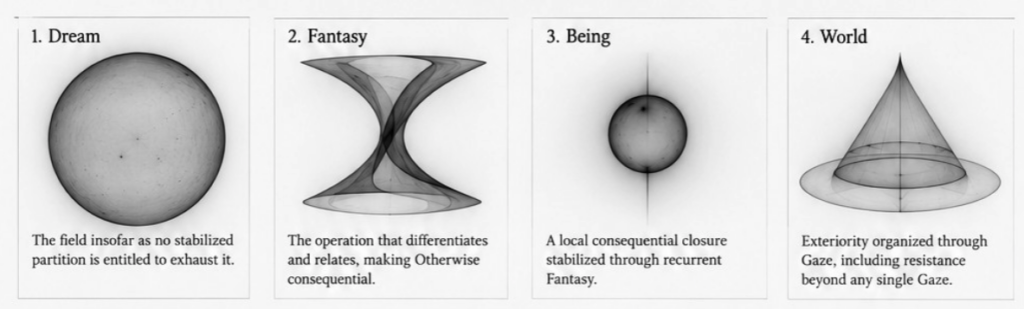
Dream → Fantasy → Being → World.
Dream names the field insofar as no stabilized partition is entitled to exhaust it. Fantasy differentiates and relates. Being is local consequential persistence. World is exteriority organized from a Gaze. But this sequence is not a cosmological conveyor belt. The book explicitly refuses to treat these as four containers or four chronological substances. They are recursive aspects of one architecture of formation and non-finality.
This is ultimately where Topofantology surpasses the Platonic move.
Levin sees, correctly, that the Whole exceeds a crude inventory of parts. But placing that Whole in an antecedent structured space does not explain the relations required for such a space to be structured in the first place. A pointer already presupposes correspondence. A structured possibility-space already presupposes differentiation, relation, neighborhood, accessibility, and ordering. A pre-formed Mind-pattern already contains precisely the unity, history, perspective, and World that a theory of Mind is supposed to derive.
The completed answer has simply been moved elsewhere.
Topofantology takes the opposite route. It begins before the completed nouns. It asks how relation becomes consequential, how consequence becomes reciprocal, how reciprocity acquires history, how history closes locally as Body, how local Body generates exteriority, how exteriority becomes oriented through Gaze, how Gaze opens a World, how finite World produces Face and Remainder, how another Gaze breaks the sovereignty of the first, and how Mind opens the present toward the absent and the possible.
The architecture is therefore not a theory of everything already finished.
It is a theory of how things become sufficiently real to matter without becoming final.
Local closure without global closure.
A Body can become One without erasing its Many. A Face can be true without exhausting its Being. A World can be stable without becoming complete. A Mind can preserve what is absent. Fantasy can make the unreal consequential without pretending that it is already actual.
And a goal can organize behavior long before there is somewhere from which that behavior becomes a World.
A goal tells a system where to go. A Gaze is what makes there somewhere else!
Abstract
A Goal Is Not Yet a Gaze introduces a distinction between goal-directedness and perspectival Mind. Beginning from Michael Levin’s account of multiscale biological agency and Platonic ingress, the paper argues that evidence for irreducible organization does not by itself establish that the missing Whole originates in a non-physical realm. It develops a relational alternative in which difference becomes consequential, reciprocal constraint becomes persistent, and multiplicity achieves local consequential closure as Body. From there, the argument derives plural interiority, exteriority, Gaze, World, Face, Remainder, and perspectival Fantasy. A goal can organize trajectories without producing a here; an environment can affect a system without yet becoming a World. Gaze names the further organization through which exteriority becomes available from somewhere. The paper therefore shifts the problem from locating Mind in a pre-existing pattern to explaining how relation acquires enough history, closure, and orientation for a World—and eventually a Mind—to arise at all.
Read More
A Goal Is Not Yet a Gaze, A Relational Ontology of Body, Gaze, and World
Jay Patrick Berube, 2026
https://zenodo.org/records/22733100